Advent Reflection – Day 17

Mosaic of the Nativity (Serbia, Winter 1993)

On the domed ceiling God
is thinking:
I made them my joy,
and everything else I created
I made to bless them.
But see what they do!
I know their hearts
and arguments:

“We’re descended from
Cain. Evil is nothing new,
so what does it matter now
if we shell the infirmary,
and the well where the fearful
and rash alike must
come for water?”

God thinks Mary into being.
Suspended at the apogee
of the golden dome,
she curls in a brown pod,
and inside her the mind
of Christ, cloaked in blood,
lodges and begins to grow.

An Orthodox icon – not the one Kenyon’s writing about, I think, though Mary’s in her brown pod. Please post here if you can identify the mosaic, I would love to know!


Advent Reflection – Day 16

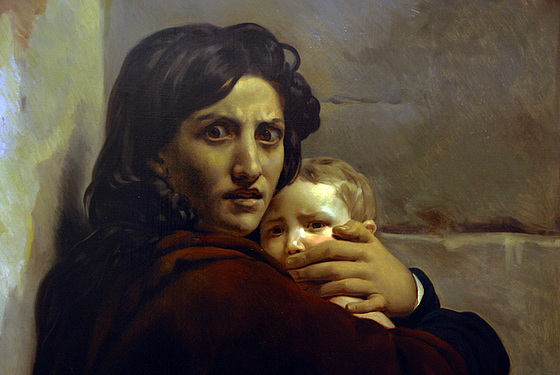
Usually we remember the massacre of the innocents after Christmas, but this year we’re remembering a little early. I sorted through classical images of the scene until I hit upon Leon Cogniet’s, painted in 1824, and I had to stop. It would be fitting to show (and you may see the detail that stopped me in my tracks here http://u1.ipernity.com/20/06/51/11880651.e59938c2.560.jpg), but this scribe decided we can all imagine the horror just fine. Better to be confronted with a glimpse of “the world’s hope,” fragile as he seems here.

Who Says

While the innocents were being massacred who says
that flowers didn’t bloom, that the air didn’t breathe bewildering scents.
that birds didn’t rise to the heights of their most accomplished songs
that young lovers didn’t twine in love’s embraces
But would it have been fitting if a scribe of the time had shown this
and not the monstrous uproar on a street drenched with blood
the wild screams of mothers with infants torn from their arms
the scuffling, the senseless laughter of soldiers
aroused by the touch of women’s bodies and young breasts warm with milk
Flaming torches tumbled down stone steps
there seemed no hope of rescue
and violent horror soon gave way to the still more awful
numbness of despair
At that moment covered by the southern night’s light shadow
a bearded man leaning on a staff
and a girl with a child in her arms
were fleeing lands ruled by the cruel tyrant
carrying the world’s hope to a safer place
beneath silent stars in which these events
had been recorded centuries ago
 
– Julia Hartwig, translated from the Polish by Stanislaw Barańczak and Clare Cavanagh

“Flight to Egypt” by Ethiopian iconographer Amete Sellassie

Advent Reflection – Day 15

More on the light that shines in the darkness….

How the Light Comes: A Blessing for Christmas Day

AndTheDarknessDidNotOvercomeItJanLRichardson

“And the Darkness Did Not Overcome It” by Jan L. Richardson

I cannot tell you how the light comes.

What I know is that it is more ancient than imagining.

That it travels across an astounding expanse to reach us.

That it loves searching out what is hidden what is lost what is forgotten or in peril or in pain.

That it has a fondness for the body for finding its way toward flesh for tracing the edges of form for shining forth through the eye, the hand, the heart.

I cannot tell you how the light comes, but that it does. That it will. That it works its way into the deepest dark that enfolds you, though it may seem long ages in coming or arrive in a shape you did not foresee.

And so may we this day turn ourselves toward it. May we lift our faces to let it find us. May we bend our bodies to follow the arc it makes. May we open and open more and open still

to the blessed light that comes.

Art & Reflection by Jan L. Richardson. Go here http://adventdoor.com/category/poetry/page/2/ to see more of her amazing Advent images and reflections or here http://janrichardsonimages.com/details.php?gid=60&pid=345 to purchase a digital download or art print

Advent Reflection – Day 14

I have a soft spot for carols that acknowledge that not all was perfect, peaceful, silent, or holy when Jesus was born, that the messiness of his birth and the world he was born into is part of the point of him being born at all. He comes to those who need him in a world that needs him. Pretty fables of all being calm and bright comfort me less than knowing the light shines in the darkness.

“He Came with His Love” performed by the Schola Cantorum of St. Peter’s in the Loop

First Coming

He did not wait till the world was ready,
till men and nations were at peace
He came when the Heavens were unsteady
and prisoners cried out for release.

He did not wait for the perfect time.
He came when the need was deep and great.
He died with sinners in all their grime,
turned water into wine. He did not wait

till hearts were pure. In joy he came
to a tarnished world of sin and doubt.
To a world like ours, of anguished shame
He came, and his Light would not go out.

He came to a world which did not mesh,
to heal its tangles, shield its scorn.
In the mystery of the Word made Flesh
the Maker of the stars was born.

We cannot wait till the world is sane
to raise our songs with joyful voice,
for to share our grief, to touch our pain,
He came with Love: Rejoice! Rejoice!

– Madeleine L’Engle

Advent Reflection – Day 13

How to be a Poet, Advent Version

I figured if I rambled through enough of my favorite Advent-related writings a theme or two for the season would emerge. I’m still circling around the articulation of it, but the first theme relates to the implicit question of how to handle our holy days and seasons in our day and age.

In Day 10’s post Andrew Greeley writes that “we who are followers of Jesus do not run from the secular; rather we try to transform it. It is our mission to make holy the secular aspects of Christmas just as the early Christians baptized the Christmas tree.” The English language harbors many words that have acquired self-contradictory meanings. We can count the word “holiday” in their number. Taking a holiday implies checking out, vacation, a break from the reality of the everyday. Greeley encourages Christians instead to make our holidays, by steadily embracing certain qualities and, I would add, fostering a certain quality of attention to the time and times. Which brings us to another ambiguous word that has been much on my mind: “secular.” The word originally referred to something “of a generation or time” – timely rather than timeless.  The Church began using it to distinguish between worldly and heavenly matters, “secular” denoting that which is passing away. From there it has come to signify that which is not religious or spiritual. In common usage it sometimes functions as the opposite of sacred, which it is not. It refers to the religiously neutral aspects of a particular time and place, which may or may not be sacred. Most of our daily activities would be considered secular – work, conversation, meals, recreation – yet we can easily recognize the spiritual significance and sacred potential of each of them. Seasons like Advent and Lent invite us to do so. Greeley reminds us to make holy our work, our conversations, and meals and recreational activities. Wendell Berry says “There no unsacred places.” During Advent we remember that God has come to us in time, at just the right time, and we redeem our time waiting for Him to come again. We are waiting for the eternal to enter the secular. Here’s the context of that line from Berry:

How to be a Poet

(to remind myself)

i

Make a place to sit down.
Sit down. Be quiet.
You must depend upon
affection, reading, knowledge,
skill—more of each
than you have—inspiration,
work, growing older, patience,
for patience joins time
to eternity. Any readers
who like your work,
doubt their judgment.

ii

Breathe with unconditional breath
the unconditioned air.
Shun electric wire.
Communicate slowly. Live
a three-dimensioned life;
stay away from screens.
Stay away from anything
that obscures the place it is in.
There are no unsacred places;
there are only sacred places
and desecrated places.

iii

Accept what comes from silence.
Make the best you can of it.
Of the little words that come
out of the silence, like prayers
prayed back to the one who prays,
make a poem that does not disturb
the silence from which it came.

– Wendell Berry

We observe Advent the way poets observe: through the radical simplicity of sitting down, being quiet, and learning to speak of silence with disturbing it. We bend our resources and histories toward playing our own particular parts in a larger intention and story. Rather than loudly denouncing the world for stealing our holiday we observe it and make it holy and offer it again. We watch and work for the sacred to animate our secular lives and celebrations. As the hopes and fears of our times and desecrated places rise to the surface so easily this time of year, we acknowledge them as our own and expect Jesus.
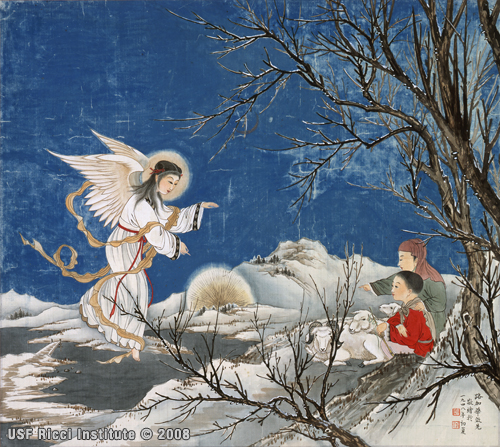
Advent Reflection – Day 12


"The Angel Spreads the Good News to the Shepherds" by Hua Xiaoxian

“The Angel Spreads the Good News to the Shepherds” by Hua Xiaoxian


from “Going to God with the Shepherds”

If you want to go to God, go without
your certainties.  Take your graces.  Leave
your certainties behind.  If you go looking
for a Triangle inside a Trefoil inside
a Conundrum, you’ll miss the greatest sight
of all, the Holy Trinity playing
children’s games on the lawns of heaven. If
you only look for the Virgin of the Window,
you’ll walk right past Our Lady, laughing and telling
stories with a group of friends….
                                                   And so
go with the shepherds on their angelic quest.
Go to that hick town that David left
as soon as he got the chance, go to the stable,
see what you never expected to see, the doors
to God opening in that manger against
all certainty….

– Louis William Countryman

Advent Reflection – Day 11

from “Room for Christ”

“It is no use saying that we are born two thousand years too late to give room to Christ. Nor will those who live at the end of the world have been born too late. Christ is always with us, always asking for room in our hearts.

But not it is with the voice of our contemporaries that he speaks, with the eyes of store clerks, factory workers, and children that he gazes; with the hands of office workers, slum dwellers, and suburban housewives that he gives. It is with the feet of soldiers and tramps that he walks, and with the heart of anyone in need that he longs for shelter. And giving shelter or food to anyone who asks for it, or needs it, is giving it to Christ….

[There was a] custom that existed among the first generations of Christians, when faith was a bright fire that warmed more than those who kept it burning. In every house then, a room was kept ready for any stranger who might ask for shelter; it was even called ‘the stranger’s room’; and this was not because… the man or woman to whom they gave shelter reminded them of Christ, but because – plain and simple and stupendous fact – he was Christ.

It would be foolish to pretend that it is always easy to remember this. If everyone were holy and handsome, with alter Christus shining in neon lighting from them, it would be easy to see Christ in everyone. If Mary had appeared in Bethlehem clothed, as St. John says, with the sun, a crown of twelve stars on her head, and the moon under her feet, then people would have fought to make room for her. But that was not God’s way for her, nor is it Christ’s way for himself, now when he is disguised under every type of humanity that treads the earth.”

– Dorothy Day

Advent Reflection – Day 10

shop star

This was my inbox this morning…

“It might be easy to run away to a monastery, away from the commercialization, the hectic hustle, the demanding family responsibilities of Christmas-time. Then we would have a holy Christmas. But we would forget the lesson of the Incarnation, of the enfleshing of God—the lesson that we who are followers of Jesus do not run from the secular; rather we try to transform it. It is our mission to make holy the secular aspects of Christmas just as the early Christians baptized the Christmas tree. And we do this by being holy people—kind, patient, generous, loving, laughing people—no matter how maddening is the Christmas rush….”

– Fr. Andrew Greeley

Advent Reflection – Day 9

The Gift


One day the gift arrives – outside your door,

Left on a windowsill, inside the mailbox,

Or in the hallway, far too large to lift.


Your postman shrugs his shoulders, the police

Consult a statute, and the cat miaows.

No name, no signature, and no address,


Only, “To you, my dearest one, my all…”

One day it fits snugly in your pocket,

Then fills the backyard like afternoon in Spring.


Monday morning, and it’s there at work –

Already ahead of you, or left behind

Amongst the papers, files and photographs;


And were there lipstick smudges down the side

Or have they just appeared? What a headache!

And worse, people have begun to talk:


“You lucky thing!” they say, or roll their eyes.

Nights find you combing the directory

(A glass of straw-colored wine upon the desk.)


Still hoping to chance on a forgotten name.

Yet mornings see you happier than before –

After all, the gift has set you up for life.


Impossible to tell, now, what was given

And what was not: slivers of rain on the window,

Those gold-tooled Oeuvres of Diderot on the shelf,


The strawberry dreaming in a champagne flute –

Were they part of the gift or something else?

Or is the gift still coming, on its way?


          Kevin Hart

strawberry champagne

Advent Reflection – Day 8

“Waiting is active. Most of us think of waiting as something very passive, a hopeless state determined by events totally out of our hands. The bus is late. You cannot do anything about it, so you have to sit there and just wait. It is not difficult to understand the irritation people feel when somebody says, ‘Just wait.’ But there is none of this passivity in scripture. Those who are waiting are waiting very actively. They know that what they are waiting for is growing from the ground on which they are standing. That’s the secret. The secret of waiting is the faith that the seed has been planted, that something has begun. Active waiting means to be present fully to the moment, in the conviction that something is happening where you are and that you want to be present to it. A waiting person is someone who is present to the moment, who believes that this moment is THE moment. A waiting person is a patient person. The word ‘patience’ means the willingness to stay where we are and live the situation out to the fullest in the belief that something hidden there will manifest itself to us. Impatient people are always expecting the real thing to happen somewhere else and therefore want to go elsewhere. The moment is empty. But patient people dare to stay where they are. Patient living means to live actively in the present and wait there.”

    – Henri Nouwen

“The Aged Simeon” by James Tissot