Unknown's avatar

About Jenn Cavanaugh

B.A. Russian Language and Literature, Willamette University; M.A. Theology and the Arts, Fuller Seminary

The Second Day of Christmas: Old, Familiar Carols

I’m spending Christmas in Marseille this year with friends who have made a cozy home here for their family and anyone else in need of one for the season. Eleven stockings were hung by the old French fireplace and we had so many amazing meals in the last couple of days I’m not sure which one was supposed to be “the holiday meal.” Every time I walk into the kitchen someone is frying up lardons and the collections of bottles and candy wrappers hand-carried here from around the globe have mysteriously multiplied. At a civilized 9 o’clock or so this morning-after our host is putting on the coffee before he runs to pick up some fresh croissants for breakfast. The kids are wrapping the dining table in the festive scraps of paper from yesterday in preparation for an elaborate, cooperative painting project received as a gift yesterday

Besides the food and the company and the respite of not having to do anything urgently for the first time in almost five months of transitioning to a new country, I will remember this about this Christmas: I heard the bells on Christmas Day. At odd times, for ten minutes at a time, then again in half an hour, playing no discernible carol, but wild – uproarious, even. Untamed bells tumbling joyous proclamation into the windy streets. The only people out were attempting their business as usual – joggers on the promenade dodging the spray of the normally calm Mediterranean; Muslim men making a point of spending the day off smoking at the café like any other day; older folk navigating an unfamiliar pharmacie de garde to treat their old, familiar ailments; tourists at Notre Dame ignoring the holiday in acts of devotion to their travel agendas.

Notre Dame de la Garde, Marseille

Notre Dame de la Garde, Marseille

While parts of the church have rediscovered Advent, reclaiming this season of anticipation in the midst of our culture’s frenzy of consumption, for most of us Christmas begins and ends with a flurry of paper, and when the presents are done, it’s over, back to business as usual. This year I’m thinking more about Christmas as a season, the twelve days that began yesterday and end in Epiphany. I’m new to this, so I sincerely hope this won’t be last my last and final reckoning with the significance of the Christmas season, but today it strikes me that it’s about living prophetically into the world’s business as usual.
Longfellow’s poem “Christmas Bells” acknowledges the phenomenon of celebrating a day that changed history, that forever altered the topography of the spiritual playing fields of reality, and finding nothing changed. It’s the same old songs of peace, love and joy sung by people who remain as contentious, difficult and miserable as ever. We sing carols of this miraculous event that revealed God to and with us in ways hardly imagined before and we look forward to doing it again next year. That’s what the church calendar does – takes mind-blowing unique births, deaths, resurrections and revelations and works them into the rhythm of our lives to be remembered, observed, and re-lived again and again. And so Christmas is the season of going back to the fields rejoicing with angelsong still ringing in our ears, knowing that unto us a son and savior has been given. Christmas is the time of pondering in our hearts what all these promises that have come true mean, because there he lies, the Lord of all, bound in rags, and he needs to be fed and changed again. We have come to worship, found it all to be just as it was said, and now it is time to return home another way, knowing what we know now about the dark politics of the place of his birth, maybe never hearing news of the place again. We make our way back to real life listening to those louder, deeper bells ringing that “God is not dead, nor doth he sleep.”

“Christmas Bells” by Henry Wadsworth Longfellow

I heard the bells on Christmas Day
Their old familiar carols play,
And wild and sweet
The words repeat
Of peace on earth, good-will to men!

And thought how, as the day had come,
The belfries of all Christendom
Had rolled along
The unbroken song
Of peace on earth, good-will to men!

Till, ringing, singing on its way,
The world revolved from night to day,
A voice, a chime
A chant sublime
Of peace on earth, good-will to men!

Then from each black accursed mouth
The cannon thundered in the South,
And with the sound
The carols drowned
Of peace on earth, good-will to men!

It was as if an earthquake rent
The hearth-stones of a continent,
And made forlorn
The households born
Of peace on earth, good-will to men!

And in despair I bowed my head;
“There is no peace on earth,” I said;
“For hate is strong,
And mocks the song
Of peace on earth, good-will to men!”

Then pealed the bells more loud and deep:
“God is not dead; nor doth he sleep!
The Wrong shall fail,
The Right prevail,
With peace on earth, good-will to men!”

Holy Days are Here Again: Christmas Edition

 “In recent years the church itself has become the target of a good deal of criticism and, for many, has simply been dismissed as a meaningful player in contemporary culture. And yet, all the while, as we have seen, there is an increasingly urgent desire for images that capture something of the depth and beauty of life, for practices that can structure one’s life and spark affection. Religion has always been the custodian of such symbols, and they were the center of the church’s life from the beginning. Yet the sad fact is that few people turn to the church for such symbols today.”[1]

Dietrich Bonhoeffer famously claimed that “the church is only the church when it exists for others.”[2] That means the things we do in and as a church are deeply motivated by the people outside of the church. This kind of talk sometimes devolves into a sense that we should warp all the things we do in support of our own spiritual walks and lives to accommodate a random, idealized person who is not yet interesting in living a Christian life. That’s the sort of thing that ends in worship services where we don’t talk about Jesus for fear of alienating someone not in the room. That is not what it means to be the church for others.

In order to be the church for others we must first be the Church. There must be something going on in our midst for the seeker to find. It is both considerate and constructive to consider often what others interested but uninitiated in our language and practices would take away from observing them. Do they extend the welcome of Christ? The Church talking about how best to minister to people where they’re at is one of the most Christ-like things we could be doing. The conversation about whether we do certain things or talk amongst ourselves in certain ways because they’re “churchy” or because they’re significant to us and to living out our faith should be ongoing. The best way to be sensitive to people who have not completely bought into our community’s vision of God, however, is not to make it blander and presumably more palatable, but rather to offer sacrificial hospitality, complete translucence, and the richest of fare to the best of our abilities.[3] People don’t go on spiritual quests looking for superficiality, but depth. It’s worth discussing what might make people think to include our church on their quest and what offputtingly shallow practices, attitudes, and lingo they might encounter here if they do.

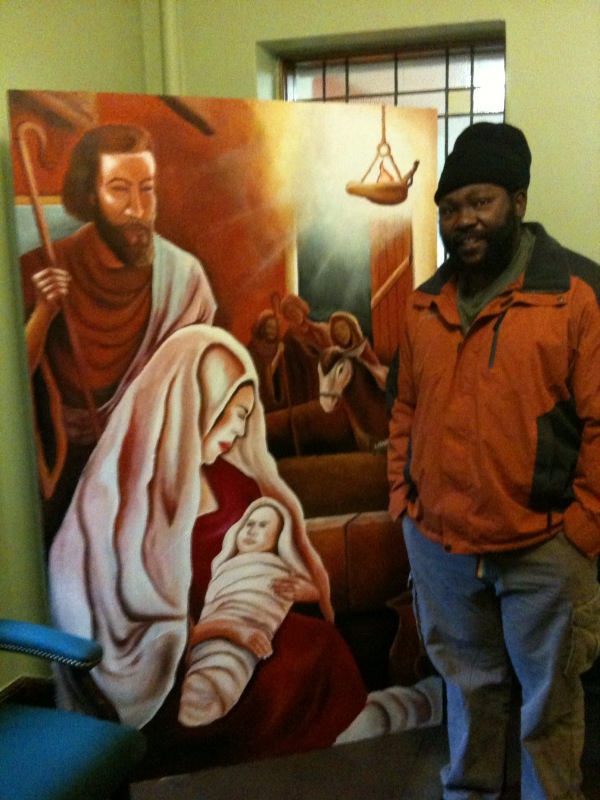
Bigga Gonzalez with the mural he painted during worship for Advent 2010. Each week the sermon and music focused on a different character in the Christmas story and so did the painting. Photograph by Jenn Cavanaugh.

Bigga Gonzalez with the mural he painted during worship for Advent 2010. Each week the sermon and music focused on a different character in the Christmas story and so did the painting. Photograph by Jenn Cavanaugh.

We often talk like we expect people to just wander in off the street in search of a place to encounter God. Remarkably, that does happen almost every time we open our doors, but it’s more of a symptom of desperate spiritual starvation than an indicator that they’re ready to throw in their lot with us on this journey. Consider the kind of confidence and trust we’re asking of people: to lose themselves in the worship of God in the company of strangers. Perhaps some word-of-mouth or outward sign will mark it as a place that is safe and trustworthy enough to enter, but increasingly the church building itself is not a sufficient sign of such. It may be that the sights, sounds and actions of our worship, ministry and community, visible from street level, audible through the open doors and perceptible in our neighbors’ daily lives could serve as such signs. Even then – even if people wander in for the music or the art or the safety itself – there’s no guarantee you have drawn them into worship. On the other hand, the symbolic act of walking into a church may be for them a greater step toward acknowledging God as God than most of your regular attenders take on an average Sunday.

Holy days are prime opportunities to be church for the world. It seems that people who do not normally attend church feel freer to come by. They are also the best times to revisit, and occasionally reinvent, our most significant traditions. It honors and blesses visitors and regulars alike to take breaks from our regular programming to dive deep into the festivals of the Christian year. What if Christmas in the church were as cozy and low-key as the secular versions most of us remember fondly as the best Christmas ever, the one that restored our souls and fostered our sense of family?

Homemade Christmas

The holidays wreak havoc on schedules. The churchy modus operandi entails planning extra, elaborate, once-a-year activities and services with only a skeleton crew to run them. Under these conditions, most proposed new traditions happen exactly once. Here’s an idea for a new tradition that may be more significant for the community, but probably less work for any one person than anything else you’ve done for Christmases past.

Sometime before Thanksgiving recruit nine volunteers who know they will be in town for Christmas Eve. Try to include a good cross-section of the church: young and old, male and female, starving artists and software engineers, different ethnicities. Assign them each a passage of scripture for a traditional lessons and carols service . Let them each plan a “lesson and carol” movement with a talk or a reading or an interpreted work of art and a song or activity for the congregation to respond with. Make sure you have at least one musician at their disposal for the singing. They each need to have their plans in writing a week prior to Christmas Eve so you can be sure not everyone is planning to sing Away in a Manger. Nine people who may not normally have much of a voice in church will have just blessed your congregation and twice-a-year visitors and made them feel like family.

To file in the "not less work, but great fun" category: the Christmas Arts & Crafts Bazaar. In recent years we've taken a break from making it so sales focused and simply spent the day making art together.

To file in the “not less work, but great fun” category: the Christmas Arts & Crafts Bazaar. In recent years we’ve taken a break from making it so sales focused and simply spent the day making art together.


[1] William A. Dyrness, Poetic Theology: God and the Poetics of Everyday Life (Grand Rapids: William B. Eerdmans Publishing Co., 2011), 220.

[2] Dietrich Bonhoeffer, Letters and Papers from Prison, 1997, 1953:282 [Ethics]

[3] One of the most powerful forms of translucence is acknowledging the limit of our powers and abilities. Instead of presenting our efforts as the end-all-be-all, what if we offered them as offerings and articulated whenever asked our experience that there is more and greater than we can do or say? This allows us to work toward God’s will being done without limiting God in others’ minds.

Lines that Make You Want to Color Outside: Toward a Creative Rule of Life

“Late at night have you experienced a vision of the person you might become, the work you could accomplish, the realized being you were meant to be? Are you a writer who doesn’t write, a painter who doesn’t paint, an entrepreneur who never starts a venture? Then you know what Resistance is…. To yield to Resistance deforms our spirit. It stunts us and makes us less than we are and were born to be. If you believe in God (and I do) you must declare Resistance evil, for it prevents us from achieving the life God intended when He endowed each of us with our own unique genius. Genius is a Latin word; the Romans used it to denote an inner spirit, holy and inviolable, which watched over us, guiding us to our calling. A writer writes with his genius; an artist paints with hers; everyone who creates operates from this sacramental center.”[1]

We do not need to learn to balance the creative life against the ordered life. For our own sakes and our communities’ we need to establish creative orders in our lives that foster creativity. We all need roomy and protected spaces in which to create. A rule of life graciously opens the door to these spaces in our lives and graciously denies entry to whatever comes around looking to squelch our work. A rule of life is traditionally designed around maintaining an orderly spiritual life, but our spiritual and creative lives are inseparable.[2] Spirituality “simply calls for connectedness… with God, with others, and with our inmost selves.”[3] Connecting to God, others, and ourselves undergirds and empowers the creative life.

Many of us suspect we are more creative than our lives really reflect because we don’t make the time to work. Many of us still need to figure out how we work and will need to experiment. We will all respond to unique rhythms; it’s something we each need to work out for ourselves and be willing adapt throughout our lives. Some need only a cup of coffee or a soundtrack, and stand back. Others will be more productive in 15 minutes of seated effort after a 45-minute walk than if they glued themselves to a desk for an hour. Some of us are so driven to work that the first key practice to add to improve the quality of our life and work would be to take a regular Sabbath from it. Structured and unstructured types alike may find establishing times for creative play motivating enough that running over the planned end time feels delightfully and productively transgressive.

For the truly schedule-resistant and tedium-phobic there are free-form ways to be more intentional about time and cultivate healthy creative and spiritual habits. At the beginning of the month identify three things you’d like to focus more on building into your life (see list below for ideas). Instead of trying to schedule each one of them into every day, identify some block of discretionary time that’s already built in to most days, even if it’s small – riding the bus, lunch, the half hour after the kids are in bed when you still have some energy or are more in need of it than ever. When that time arrives, choose the one you feel most like doing and do it. (You’ll need to carry whatever materials you’ll need for all three if you’re out of the house, so plan accordingly.) Keep a tally, if you’d like, of the days you chose each activity. At the end of the month you can see that you’ve made time and space for those things. If it was hard to do any of them during that time all month, pick a new time. If one discipline didn’t appeal to you enough to try it even once all month, pick a new discipline. You can make a new list each month or continue each activity until your tally hits 30; then it’s like you did it every day for a month – without ever once feeling like you had to!

Potential Creative Disciplines – Mix and Match:

Read a book more than one person has recommended to you

Take a class

Pray for someone else                         Write a letter

Fast from _____                          Start a poem or story

Read a Bible chapter 4 times                          Journal

Meditate                   Enjoy some silence

Listen                              Take pictures

Invite a friend over and clean the least welcoming space in your home to prepare for the visit

                         Call someone you used to be close to

Make something for someone

Plan a week of healthy meals and make a shopping list

Practice an instrument

Read a whole book of the Bible

Pray for everyone who walks by you

Calculate how much you spent today on things you don’t need and give that much to the next person that asks: fundraising letter, panhandler, tip jar, etc.

Draw

Read an in-depth article or book about a topic you wish you understood

Clean out a drawer, shelf, bag or surface that collects clutter at home or work

Institute a monthly open house

Memorize a Bible verse

Visit a gallery or museum

Ask God to remind you of someone you’ve wronged and teach you how to do right by them now. Get started on whatever it is.

Exercise to the glory of God

Go to bed eight hours before your alarm goes off

Walk someplace you’ve never walked before

Finish a project

Give God thanks for every good thing you can think of                               Study

Practice centering prayer

Identify a power struggle you can choose to lose

Take a friend out to celebrate or catch up

Start a conversation with a stranger

Take some time alone                          Ask someone for advice or forgiveness

Read a newspaper, magazine or journal prayerfully, taking time to stop and reflect

Perform a not-so-random act of kindness to meet a small need you’re aware of

Worship in a new or neglected medium: song, dance, paint, writing, etc.

For Ruth Barton, developing a Rule of Life “is ultimately what spiritual transformation is all about: choosing a way of life that opens us to the presence of God in the places of our being where our truest desires and deepest longings stir.”[4] Disciplines are simply doing the work necessary for transformation. Spiritual and creative disciplines are less about becoming more rigid in controlling our environments than about understanding and articulating the terms of the environments in and conditions under which we can relate to and co-create with God. Barton counsels establishment of a spiritual rhythm by identifying motivating desires and minimum spiritual requirements, asking “which spiritual practice and relationships have seemed to be most powerful in meeting the desires of my heart… as a way of offering myself to God steadily and consistently?”[5]

In establishing a rule of life, the potential for consistency trumps radical commitments. Our practices must be practicable. Instead of setting ourselves up for failure by vowing to do something daily that we only have time to do occasionally, why not start with an intentional commitment to do it two days a week and see if it becomes a valuable enough practice that we might make more time for it later? God doesn’t bully us into pursuits beyond our capacities, so why we would we attempt to do that to ourselves? Another consideration: if we’re trying something new in our lives, we need time to learn about how it functions in our lives, to develop a taste and appreciation for it, or even to set it aside as something that’s not helpful for us where we’re at right now. If I’ve never really seen prayer or painting as something integral to or fruitful in my life, there’s no way I can force myself to do it an hour a day cold turkey. If I’ve never read the Bible or serious literature on my own before, it’s going to take a while before I feel like I’m getting it. If I fall asleep every time I try to practice silence or meditate, maybe I need to work on ordering some other part of my life first and try again when I am well-rested.

“Our rhythm of spiritual practices also needs to be ruthlessly realistic in view of our stage of life…. One of the great temptations of the spiritual life is to believe that if I were in another season of life, I could be more spiritual. The truth is that spiritual formation takes place as we embrace the challenges and opportunities associated with each season of our life. … This is a place for learning how to be compassionate with ourselves, because God certainly is.”[6]

Marjorie Thompson reminds us that “realistic commitment is an expression of humility.”[7] It is honest, empowering, and faith-building to start small and realistic and expect big, knowing God is not disappointed in me if my daily lectio time is subsumed when one of my daughters locks herself in the bathroom or the other’s diaper fails fantastically. These are opportunities just as real and just as spiritual to grow in grace. Richard Foster calls this incarnational and sacramental living.

“We must recognize that the majority of Jesus’ life – and of ours – is found in our families and homes, in our work and play, among our neighbors and in our everyday surroundings. This tangible world is the place we most fully express the outflow of love, joy, peace, and all the fruit of the Spirit. Here and nowhere else. It was true for Jesus; it is true for us.”[8]

Remember, too, that any discipline or rule of life must involve some paring away and limits. It should not be another “to do” list piled on top of our already full lives, the added weight of which makes it impossible “to do” anything. If I’m going to post a thoughtful book review on my blog once a month, I’ll need to commit to reading that book instead of Facebook one night a week. If I determine to exercise in the morning, I need to get to bed earlier. Disciplines like giving and fasting work well in tandem, as do hospitality and simplicity, because the one makes space or frees resources for the other. These practices develop “a healthy sense of being able to say no to a good thing for the sake of a better or higher one; it gives self-confidence while enabling people to serve others.”[9]


[1] Steven Pressfield, The War of Art (New York: Grand Central Publishing, 2002), xiii-xiv.

[2] Of course, creative people do not always examine their spirituality and many would not typify what they are doing as pouring out their soul or spirit, but the creators among us generally recognize that something deep within ourselves is involved when we create, even if we describe it in different terms.

[3] Joan Chittister, Wisdom Distilled from the Daily: Living the Rule of St. Benedict Today (San Francisco: Harper, 1991), 4.

[4] Ruth Haley Barton, Sacred Rhythms: Arranging Our Lives for Spiritual Transformation. (Downers Grove, Ill.: IVP Books, 2006), 13.

[5] Barton, 151.

[6] Barton, 149.

[7] Marjorie J. Thompson, Soul Feast: An Invitation to the Christian Spiritual Life (Louisville: Westminster John Knox Press, 1995), 143.

[8] Richard J. Foster, Streams of Living Water: Celebrating the Great Traditions of Christian Faith (San Francisco: Harper, 1998), 20-21.

[9] Bradley P. Holt, Thirsty for God: A Brief History of Christian Spirituality, 2nd ed. (Minneapolis: Fortress Press, 2005), 61.

Christ for Culture – part 1

“Seven Ages: The Walking Figure” by Ghislaine Howard

“Down these mean streets a man must go who is not himself mean, who is neither tarnished nor afraid.” – Raymond Chandler [1]

“To be a witness does not consist in engaging in propaganda nor even in stirring people up, but in being a living mystery. It means to live in such a way that one’s life would not make sense if God did not exist.” – Cardinal Suhard [2]

Raymond Chandler’s walker of the mean streets epitomizes incarnation. Completely common and yet unusually honorable, this figure speaks the language of the age and acts as an agent of redemption. Cardinal Suhard’s witness, on the other hand, seems more steeped in the incense of holy mystery. Inexplicable and yet attractive, the witness calls us away from the world as we know it. For the Christian Church, Jesus Christ represents both the walker and the witness. In our accounts of him, he navigates the complexity between these two seemingly conflicting roles so gracefully and yet we agonize: How did he do it?  How do we do it?  There is no question that the reality of Jesus Christ can and should transform our human cultures, but how? Arguments for the creation of a separate Christian culture do not resonate with our accounts of a Savior who lived and died and lives for the sake of the world He so loves. Christ calls the Church to live as a faithful community of communities that, like Christ, transcends and critiques, but most critically participates in human cultures for the good of all. The Church distinguishes itself from the world-at-large by offering a unique understanding of reality that changes lives, not Christian knock-offs of worldly goods and services. Intentionally forging an exclusionary culture negates our human and God-given identities. While making too small a distinction between ourselves as the Church and our wider cultures is fatal, making too large a distinction is absurd. God sets us in human as well as spiritual families; sometimes we’re called to leave them for the sake of the gospel, but not because it is us versus them. God calls the Church

to be the bearer of God’s saving purpose for his whole world….  It means that this particular body of people who bear the name of Jesus through history… with all its contingency and particularity, is the body which has the responsibility of bearing the secret of God’s reign through world history.[3]

Our charge is unique, but we tend to claim things, such as God’s affection and attention, for ourselves that properly belong to all of creation. God’s incarnational economy requires us to root and ground ourselves not only in God’s love, but also in the cultures to which God wants to reveal divine love.

We the Church must not shun such grounding for fear of contamination. Rather we should broaden and deepen our personal and corporate cultural experiences so we’re better educated to critique our cultures and better equipped to understand our alternatives for living godly lives within them. Otherwise we do damage by talking about the world as we fear it may be rather than addressing the world as it is. We don’t merely absorb our cultures indiscriminately, however; we follow Christ’s example in embracing our identities as cultural beings and transforming the times and places in which we find ourselves from the inside. Christ remains our best model and representative in our relationships to our cultures. Christ loves and communicates to cultures through the Church and the Church should love and communicate to cultures through Christ. Jaroslav Pelikan points out that

as respect for the organized church has declined, reverence for Jesus has grown…. There is more in him than is dreamt of in the philosophy and Christology of the theologians.  Within the church, but also far beyond its walls, his person and message are, in the phrase of Augustine, a ‘beauty ever ancient, ever new,’ and now he belongs to the world.[4]

Christ neither feared nor feared for the world; rather he took up residence in it and sacrificed his life for the good of all of us in it to the glory of God. He instructs his body on earth to walk as witnesses in the world, communicating, displaying and verifying in our daily lives this gospel, this reality that has taken hold of us. We do so by living deeply, freely, and abundantly into our cultures following the standard and example of Jesus. In order to do so, we will all find it necessary to reject some key assumptions of our cultures. In Jesus’s day those false assumptions included God’s favoritism for Israel, the rich, and the religious. In my place and time they include false assumptions of the inherent goodness of radical individualism and rampant consumerism that define success in life as getting what’s “mine.”

The plain fact is that the planet does not need more “successful” people. But it does desperately need more peacemakers, healers, restorers, storytellers, and lovers of every shape and form. It needs people who live well in their places. It needs people of moral courage willing to join the fight to make the world habitable and humane. And these needs have little to do with success as our culture has defined it.[5]

The world around us poses all kinds of pressing and complex questions. We cannot assume they are all the wrong ones, that they don’t apply to us, or that we have all the answers at our disposal ready-made. Along with the danger of dismissing honest inquiry, we risk missing God’s direction; we must remain open to the possibility of God guiding and teaching us through present cultural situations. God has invited us to be part of the process of Christ becoming all in all. When we approach all the times and places and dilemmas we find ourselves in with this staggering invitation in mind we become agents of redemption in the here and now. We will know God’s goodness in the land of the living.

“Sing redemption everywhere you go.”


[1] Raymond Chandler, “The Simple Art of Murder” http://www.en.utexas.edu/amlit/amlitprivate/scans/chandlerart.html (accessed June 17, 2011).

[2] Emmanuel, Cardinal Suhard, qtd. in Madeleine L’Engle, Walking on Water: Reflections on Faith and Art, Commemorative Edition (Wheaton, Ill.: Harold Shaw Publishers, 1998), 34.

[3] Lesslie Newbigin, The Gospel in a Pluralist Society, 86-87.

[4] Jaroslav Pelikan, Jesus Through the Centuries: His Place in the History of Culture (New Haven: Yale University Press, 1999), 232-233.

[5] David Orr, “What is Education For?” In Context 27 (Winter 1991): 52.

[6] Stanley Hauerwas and William H. Willimon, Where Resident Aliens Live, 100.

[7] Philippians 3:

[8] Jeremiah 29:7

[9] Gregory Wolfe, “The Four Cultures,” Image no. 58 (2008), http://imagejournal.org/page/journal/editorial-statements/the-four-cultures (accessed January 31, 2013).

[10] Anthony Ugolnik, “Whose Crisis of Faith? Culture, Faith, and the American Academy” in The Two Cities of God: The Church’s Responsibility for the Earthly City, ed. Carl E. Braaten and Robert W. Jenson (Grand Rapids: William B. Eerdmans Publishing Co., 1997), 92.

The Creative Local Church

Our ministry began by including the arts in existing programs—from mission to worship to education. The results were remarkable, for we found that the arts touched us in all aspects of our community life: they engaged our senses, helped us build relationships among ourselves, and helped us respond to wider community needs; they expanded our theological vision, stirred our imaginations, and brought us to places where we experienced God in moving and profound ways.

       – Alice Z. Anderman “On the Cusp of a Great Adventure: One Church’s Ministry with the Arts.” ARTS 19:1

Now that we’re the better of part of a year into this blog, maybe it’s time some introductions of the bigger ideas motivating it were made. Homespun seeks to provide resources for the creative life of the local church. The idea that your local church requires a creative life may be a no-brainer or an entirely new concept for you. It may conjure up a precise image of what that could look like for your church or leave you feeling lost in abstraction. This blog is for people in the church who have an idea whose time has come and are looking for creative ways to live it into reality. It is for those who believe (or are willing to be subtly persuaded) that our churches should, by their very nature, foster creativity and beauty and who want some resources and ideas for getting started or going deeper. More fundamentally, it is for those who, in whatever capacity, feel called to help the church be the church and sense that this will require new ways of being and doing to bubble up amongst us.

Many posts on this blog will touch on the arts and worship because these are fundamental to creativity and church life, but the church’s creativity is neither tied to nor limited to “using the arts in worship.” In fact, I personally avoid the phrase, because I think that “using” the arts defeats their purpose. Artistic goods can be offered in worship by their creators, reflecting on art may assist us in presenting our whole selves before God, but “using the arts” sounds like appropriating something abstract out of context for our own ends. If you have ever been in a worship service where someone tried to use an artful good to do something it was never intended to do, then you know what I mean. Both true art and true worship resist this kind of hijacking and misuse. They work on us as we submit ourselves voluntarily to the other/ Other; they do not work for us on others. Semantics, some might say, but how we talk about what we are doing is indicative of the spirit of what we are doing. I understand the temptation to defend the inclusion and importance of the creative arts in the church by virtue of their utility, but the real reason we need the creative arts in the church is because of their power over us rather than our power over them.

Church by Hense

When creativity and artistic expression infuse the whole life of the church, not just worship, they move us toward wholeness and a holistic faith. I’ve avoided breaking down worship, spiritual formation, witness, and ministry into separate sections on separate topics on this blog, because I believe they’re not meant to be separated. Who can define the exact point where discipleship becomes Christian service? We strive to focus on God rather than ourselves in worship, and yet conversion and sanctification and all kinds of other terms we use for human transformation are natural consequences of our worship experiences. Our most mundane and non-musical ministries are tinged with worship if they’re done to the glory of God. Non-verbal actions carried out in Jesus’ name may be more evangelistic than preachments and crusades. The bane of the church’s institutional existence is that the more our activities precursor the realm of heaven, the less they’ll fit into tidy categories. They will grow like the kingdom to become more rangy and more overarching, defying definitions and requiring parables to describe. Order is by no means the enemy of originality, but isn’t it interesting that we tend to organize ourselves by dividing ourselves up when God’s hope seems to be bringing us all together? Creativity consists essentially of making new connections. Artistic expression necessarily involves mindful and heartfelt communication. Imagine a church known for the beauty of its internal and external connections and communication! Artists and their art instinctively work to dissolve false divisions which impede the coherent and creative life of the church and its members. Works of art, music, poetry, fiction and film all refuse to speak to us on only one level. They don’t work on just the emotional, rational, or spiritual side of us. We all wear many hats, but art doesn’t speak to us as roles, titles, or labels – only as complex persons. If you approach a piece of music and say “I would like to understand you… as a facilities administrator” or “…as an addict,” it will elude you until you take off all your funny hats and listen as a human being.

Creativity is not only about making art, not is it the sole purview of the practicing artist. As creatures created in the image of the Creator, we all have creative capacities, and we are not designed to function without them. Artists and artisans help the congregation by valuing and modeling the creative life, but they can’t do all the creative work of the church for us. For the church to be the church as Christ intended will require us all to walk in newness of life. Worship curator Mark Pierson describes creativity as a product of the tension between reality and desire, of dissatisfaction with what we see in light of a higher vision. I believe God does the best work on us in that tension and that we all need it to be a regular part of our lives, both individually and corporately, to fulfill our calling as the body of Christ. As we develop our creative faculties together we encourage and equip one another to respond faithfully to the realities around us with imagination rather than pretending that they fit into ideologies too rigid to accommodate them. Both the local church and the Church universal will be marked by creativity as they are empowered by God’s Spirit to act as the body of the One who is making all things new.

The Apostle’s Creed proclaims that the Church is one, holy, catholic and apostolic. That means God’s people are united in Christ (whether we acknowledge it or not), set apart for God’s purposes (whether we live into them or not), ultimately to be found in all times and cultures (i.e., “catholic,” whether Roman Catholic or not), and part of a tradition (whether we like it or not). Just as we are called individually to be members of a local body, all these local bodies are called to be members of the larger Body of Christ. As we discern and pursue our own callings within our local churches, our churches grow faithfully into their particular creative roles to do their part to help the Church body function properly as Christ’s representative throughout the whole world.

I believe to fulfill its task within the larger mission of God, each church needs freedom to embrace a unique corporate personality. This doesn’t mean forcing people into a hipper or holier-than-thou persona. It means pursuing ministry based on the gifts of all of those who have aligned themselves with our congregations. It assumes everyone in our midst is called to be a minister, but makes fewer assumptions about what ministry needs to look like to be called such. It doesn’t mean targeting your outreach and message to a narrow demographic and further dividing the Church along lines of race, gender, political leanings, age and income. It means you discern who you are as a congregation and what you’re to be about in fleshing out the realm of heaven together for your parishioners – the ones that attend your church and the ones who don’t. It means my church’s worship band has drum solos, yours has a clarinet and viola, our friend’s is alternating Youth Sunday with Old Fogey Sunday so they learn their hymns and give the organ a monthly workout, and another congregation is going a cappella for Lent. We can count on the Spirit working in and through any given church in common and disparate ways from the church down the street. Christ bids all incarnations of the Church to extend hospitality to all comers and make room for everyone who responds to what the Spirit is doing in our midst, but each of our churches will have different strangers to welcome in unique ways based on our resources and cultures. Our resultant personalities must be evolving and inclusive rather than exclusive and set in stone. The creative life is both constructive and playful. When we pursue it together we come to know one another more truly as we were created to be. Weaving creative practices into our common lives helps us know who we are together, equips us to regularly reimagine our communities for the sake of others, and keeps us all growing in and toward faith.


A Missional Ministerial Gifts Assessment

based on Creating a Missional Culture: Equipping the Church for the Sake of the World

by JR Woodward

(Completely Unauthorized

and Hopelessly Slanted by Yours Truly So Just Figure Anything You Don’t Like is My Bad )

1———————2———————3————————-4———————5

Never             Rarely              Sometimes                Usually                Always

Using the scale above, write your answers to these questions on the lines provided at the end.

1. I am a big-picture person

2. I am sensitive to the Holy Spirit

3. My heart breaks for those who don’t know Jesus

4. I think we need to focus more on the spiritual healing and formation of the congregation

5. When I read the Bible I expect to gain fresh insight

6. I can get wrapped up in projects and achievement at the expense of my relationships with God and others

7. My heart breaks for the poor and oppressed

8. I think the church should be more outwardly focused

9. I am a peacemaker

10. I prioritize my own learning

11. The church is the best place for people to actively discern and from which to pursue their purposes in life

12. I may come across as inconsiderate or inflexible

13. I consider my job a vocation and an opportunity to be a good witness

14. I look for ways to move our church toward being a family

15. The more knowledgeable we are of Scripture and how to apply it, the more faithful we will be

16. When I invite people to try something new they at least consider it

17. I tend to include the outsiders

18. I err on the side of going along with my cultural context rather than critiquing it

19. My heart breaks for those who have deep emotional wounds and I want to help them move forward

20. I am good at explaining things clearly

21. I bring people together to turn ideas into reality

22. I believe in the power of the Spirit and spiritual practices and I want others to as well

23. I’m a good storyteller

24. When someone I care about is hurting I cannot view the situation objectively

25. I get frustrated when people don’t use the sense God gave them

26. I have a profound sense of being part of God’s mission in the world

27. People are better off facing reality head-on, without illusions

28. I try to preach the gospel at all times and, if necessary, use words

29. I create opportunities for people to play together

30. I can content myself with having the right answer on an issue or question without acting on it

31. I am realistic in starting new ventures, but I don’t particularly fear failure

32. I get involved in justice issues and invite others to do so as well

33. I see opportunities for the church to live into and express the kingdom in ways specific to our context

34. I instinctively grieve with those who grieve and rejoice with those who rejoice

35. The church’s highest priorities should be the study of the Word and fruitful theological discussion

1———————2———————3————————-4———————5

Never             Rarely              Sometimes                Usually                Always

1.  ______           2.  ______           3.  ______           4.  ______           5.  ______

6.  ______           7.  ______           8.  ______           9.  ______           10.  _____

11. _____            12. _____            13. _____            14. _____            15. _____

16. _____            17. _____            18. _____            19. _____            20. _____

21. _____            22. _____            23. _____            24. _____            25. _____

26. _____            27. _____            28. _____            29. _____            30. _____

31. _____            32. _____            33. _____            34. _____            35. _____

Add up the columns here (higher numbers indicate greater relative strength):

__________         __________         __________         __________         __________

Apostle                   Prophet             Evangelist               Pastor                   Teacher

Hooray, I’m gifted, now what?

Employ your unique combination of gifts to increase the unity, maturity and ministry of the church (Ephesians 4). This sounds simple until you try it. God is asking us to use the ways in which we fundamentally diverge in our mental, emotional, and stylistic approaches to ministry to minister together. Each gift comes with its own biblical slants on humanity, the church, the faith and the world. The key here is to recognize and value the gifts and accompanying assumptions of others even though you will find them occasionally incomprehensible. The degree to which they mystify you is the degree to which you need someone else there representing them. They help make whole the mission of God. Maturity comes when these closely held and thoroughly biblical definitions and assumptions rub off on each other to expand our understanding of God and Christ-likeness. Unity comes of remembering throughout the process that we all claim Christ as Lord and are accepted by Him.

It also helps not to let these roles we’re called on to play define your identity overmuch – you are first and foremost a child of God. They are words to help us articulate our God-given strengths in blessing others. It does not constitute an excuse for self-importance or an exemption to caring for others in ways that don’t come as naturally to us. You’ll notice this list of gifts indicates less what exactly you should do in the church than how you’ll likely go about it. Nothing here dictates that you be or not be a preacher, an elder, a deacon, a Sunday school superintendent, a member of the outreach team or a worship leader.  An apostolically gifted arts pastor will have a different m.o. than one gifted in teaching, and so on.

Um, am I supposed to know what an apostle does?

Read back through the relevant questions to get a rough, composite sketch of each kind of “equipper,” as Woodward calls them. Even better, read his book. Or leave a comment and we can talk. I’d welcome any feedback or results. Was anyone else surprised by being more “evangelistic” (or “prophetic” or “apostolic,” etc.) than you thought of yourself as? If so, does that seem to be a symptom of my utter lack of training in assessment preparation, an indicator of some different assumptions about how these gifts operate in a missional church, or a sign that another leader is rubbing off on you?

Don’t take this the wrong way, but you might be [gasp!] an evangelist

I’ve been taking copious notes lately from JR Woodward’s Creating a Missional Culture: Equipping the Church for the Sake of the World, about half of which focuses on how the five kinds of leaders listed in Ephesians 4 (apostles, prophets, evangelists, pastors & teachers) can work uniquely and in unity in a church wanting to be the church for others. I’ve read about these ministerial gifts before and taken probably half-a-dozen of the dozens of self-assessments available to tell you where your gifts lie. If you’ve grown up in the Protestant church, I’m guessing you have, too. (If you haven’t then cast your mind back to your teen magazine years and those quizzes that helped you determine what bubblegum flavor you were. These assessments are a lot like those except these tell you how the Spirit of the Sovereign Lord is raising you up “to equip the saints for the work of ministry, for building up the body of Christ, until all of us come to the unity of the faith and of the knowledge of the Son of God, to maturity, to the measure of the full stature of Christ.” Very similar, yes? ) I ended up writing my own self-assessment quiz based on Woodward’s book, which I’ll post in a few days. I don’t generally accord gifts and personality assessments too much weight, especially not ones I’ve written myself, but they are good team-building conversation starters for church leaders. Particularly if you’ve already analyzed your respective bubblegum flavors to death. It was also a useful exercise in examining the slight to significant differences between how I heard these gifts described growing up and how Woodward saw these gifts operating in the context of a church committed to being church for the world. He doesn’t spend time calling out all the abuses that can happen when these gifts are assumed as mantles and titles, but he offers quiet correctives to them all the same.

The definition that seemed most altered when viewed through a missional lens was that of the evangelist. It would have had to have been a big difference for me to notice, because I would tend to gloss over that section. Based on my scores on other gifts assessments I have come to self-identify very strongly as not-an-evangelist. At times that has bothered or mystified me – I’m sociable. I care about people. I’m not ashamed of following Jesus. I believe in putting words to our faith. I want the world to know that God loves the world. While I think of my primary calling as helping the church be the church, I consider demonstrating and articulating this faith to our larger communities in credible ways to be one of the signs of the church being the church. So why wouldn’t this register on the tests?

Reading Woodward’s description of an evangelist I realized how many other descriptions I’d read that were based on narrow and rather stilted models of sharing the good news. Of course the accompanying lines of questioning used to identify the evangelists among us reflected those models as well, e.g. Would you rather hand out tracts on a street corner or prepare a Bible study? On a scale of 1-10 how willing are you to tell your friends they’re going to hell? Does at least one of your everyday accessories double as a device for sharing the gospel in five minutes or less? Do you cold-call people for a living and hate going home at the end of the day? Yes, I’m dangling a couple of toes over the deep end here, but our images of evangelism have been indelibly colored by evangelical notions of “witnessing” that differ both from simply being a witness and from what an evangelist, in the Ephesians 4 context of church leadership, would be concerned with – the witness of the church as a whole and serving as a messenger/ ambassador between the church and the rest of the world.

Assumptions that verbal assent constitutes faith and that commitment to following Christ bears no relation to our human relationships also taint our assumptions of what evangelism and evangelists look like. These assumptions actually screen out those with the gifts necessary to tell the story of God convincingly to a skeptical public and to draw people toward the community of faith. Our shift toward thinking that evangelism involves demanding an answer from the unprepared discourages those the Spirit keeps preternaturally prepared to give an answer for the hope within them from thinking of themselves as evangelists.

The true evangelists among us would be the folks who have the best handle on the gospel as good news rather than those who consider it a tough sell. According to many assessments, if you can move product and close deals you may be an evangelist, but they shunt away others who can best give the gospel away. If you think of salvation in terms larger than individual souls, you’re an apostle. If your commitment to truth leads you beyond warning sinners about judgment to calling the systems of the world and the church to justice, you’re a prophet. If you’re equipped to care for other people relationally, you’re a pastor. If you want others to recognize the heights and depths, and not just the breadth of God’s love, you’re a teacher. This tends to leave those whose faith is unusually exuberant and simple and – not always, but often – still immature, uninformed, or unexamined to communicate the gospel to the world. Yeah, how’s that workin’ out for us?

By equating one’s willingness to offer a shallow salvation through artificial methods with the spiritual gift of evangelism, we unwittingly anoint as evangelists the garrulous, who prefer being right to having right relationships and for whom the propositional truths of Christianity assure them a winning argument every time; the gregarious who can turn anything into small talk, including the staggering news that God died for you; the spiritually anxious who bear their responsibilities for the fates of others’ souls with potentially crippling fear and trembling; and the socially anxious for whom conversations with strangers never get easier, so they might as well turn them toward something important like accepting Jesus as your Lord and Savior in the hopes that some greater good will come of them. The church, thank God, has very few evangelists by this measure. But we do have the real deal. We’ve been promised them. We’re not able to do the work of the church without them. Who knows, but you might be one of them – even and especially if the thought of knocking on a stranger’s door to show them your corny beaded bracelet makes you physically ill.

If you’d like to find out, I’ll post the assessment I drafted up based on Woodward’s descriptions in a couple of days – let’s say Saturday. I wouldn’t want to be responsible for you getting all prophetic on your co-workers at the end of a long week.

A Few Good Books, Part One

I enjoy my gig as a book reviewer. It keeps me reading and writing and making some small contribution to the family’s finances. I like having concrete assignments, deadlines, and front row access to the world of Christian publishing. I enjoy dishearteningly few of the assigned books, however. As a mother of girls I receive a disproportionate number of teen girl devotionals, women’s Bible studies, and Christian parenting titles. This inevitably skews my sense of the job as a rollicking good time, in part because my personal reading tastes don’t tend toward “nice,” but primarily because I maintain an apparently minority position that books for women and young people merit as much theological rigor, ground-breaking novelty, and professional editing as books for markets deemed more discerning. Of course, I try to review each book on its own terms – if it accomplishes what it sets out to do – rather than according to personal tastes, but my reading within and outside of these sub-genres indicates that we can do better here and just don’t bother. Here are links to my reviews of a few good books. They’re not necessarily great literature, but they’re ones that somehow raise the bar on their respective fronts.

Fearless Daughters of the Bible: What You Can Learn from 22 Women Who Challenged Tradition, Fought Injustice and Dared to Lead by J. Lee Grady.
The Kindle version is only $1.99 today.

“Many books urging women to claim our positions as God’s daughters tell only half the story. They tell us we are God’s beloved little girls, privileged princesses. They expound on our roles or rights as children of God, but not our responsibilities. J. Lee Grady wrote Fearless Daughters of the Bible to encourage women to reclaim the power of God’s promises and step up and act accordingly….A father of four daughters, Grady writes in paternal tones without stooping to paternalism; ideal readers would be high school and college age.” My full review here.

Parenting Is Your Highest Calling: And Eight Other Myths That Trap Us in Worry and Guilt by Leslie Leyland Fields

“Leslie Leyland Fields debunks nine myths of Christian parenting, making the case that children are not put on this earth to fulfill us; neither are we asked to be God to them…. The depth to which some of these myths are ingrained becomes evident in the author’s own occasional inconsistency. Overall, her major points, scriptural examples and discussion questions offer an effective, affirming and hopeful counter to destructive myths our culture — and sometimes even our churches — subtly enforce.” My full review here.

One Fine Potion: The Literary Magic of Harry Potter by Greg Garrett

“Addressing evangelical concerns regarding sorcery and witchcraft head on, he argues that the supernatural functions not as an alternate belief system, but as a backdrop for a story full of Christian values — a story so Christian that its creator hesitated to discuss her own Christian faith before the last installment came out for fear of giving away the ending.” My full review here.

The Mockingbird Parables: Transforming Lives through the Power of Story by Matt Litton

“High school English teacher Matt Litton offers an outstanding spiritual reading—currently unavailable in most high school English classrooms—of Harper Lee’s classic To Kill a Mockingbird as a parable of compassion, courage and community. In the microcosm of small town Maycomb, Litton discerns lessons about parenting, responsible living, caring for neighbors and envisioning God as a mysterious neighbor who, similar to the enigmatic Boo Radley, must be engaged on his own terms rather than defined or domesticated.” My full review here.

Half the Church: Recapturing God’s Global Vision for Women by Carolyn Custis James

“The Chinese say, “Women hold up half the sky.” Carolyn Custis James figures if the majority of women worldwide suffer oppressive poverty and violence and a privileged minority still struggle to prove or believe in their own value, no wonder it feels as if the sky is falling…. Dismantling the myth of the subordinate helpmeet, she recovers the Old Testament figure of the woman of valor, the strong and capable ezer who helps as God helps.” My full review here.

Andrew Greeley on the Catholic Imagination

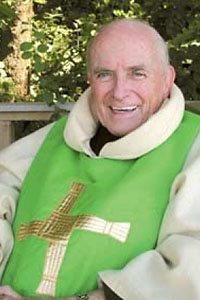
Andrew Greeley,  self-proclaimed "loud-mouthed Irish priest"

Andrew Greeley,
self-proclaimed “loud-mouthed Irish priest”

On the Relationship between Religion and Imagination

 The imagination is religious. Religion is imaginative. The origins and the power of both are in the playful, creative, dancing self.

(The Catholic Imagination of Bruce Springsteen)

On the Uniqueness of the Catholic Imagination

 A word about the Catholic imagination: Unlike the other religions of Yahweh, Catholicism has always stood for the accessibility of God in the world. God is more like the world than unlike it.

(The Catholic Imagination of Bruce Springsteen)

The objects, events, and persons of ordinary existence hint at the nature of God and indeed make God in some fashion present to us. God is sufficiently like creation that creation not only tells us something about God but, by so doing, also makes God present among us.

(The Catholic Imagination p. 6)

Catholics live in an enchanted world, a world of statues and holy water, stained glass and votive candles, saints and religious medals, rosary beads and holy pictures. But these Catholic paraphernalia are mere hints of a deeper and more pervasive religious sensibility which inclines Catholics to see the Holy lurking in creation. As Catholics, we find our houses and our world haunted by a sense that the objects, events, and persons of daily life are revelations of grace….

This special Catholic imagination can appropriately be called sacramental. It sees created reality as a ‘sacrament,’ that is, a revelation of the presence of God.

(The Catholic Imagination p. 1)

On Stories and Doctrine

 Religion begins in the imagination and in stories, but it cannot remain there. The stories which are our first contact with religion… are subject to rational and critical examination as we grow older to discover both what they mean and whether we are still able to believe them. Bethlehem becomes the Incarnation. The empty tomb becomes the Resurrection. The final supper becomes the Eucharist. These are all necessary and praise-worthy developments. Nonetheless, the origins and raw power of religion are at the imaginative (that is, experiential and narrative) level both for the individual and for the tradition. The doctrine of the Incarnation has less appeal to the whole self than does the picture of the Madonna and Child in a cave. The doctrine of the Resurrection has less appeal to the total human personality than do the excited women and the awestruck disciples on the road to Emmaus that first day of the week. The doctrine of the Real Presence is less powerful than the image of the final meal in the upper room. None of the doctrines is less true than the stories. Indeed, they have the merit of being more precise, more carefully thought out, more ready for defense and explanation. But they are not where religion or religious faith starts, nor in truth where it ends.

(The Catholic Imagination p. 4)

On Lyrics, Liturgy, and Witness

 So if the troubadour’s symbols are only implicitly Catholic (and perhaps not altogether consciously so) and if many folks will not understand them or perceive their origins, what good are they to the Catholic Church? Surely they will not increase Sunday collections or win converts or improve the church’s public image. Or win consent to the pastoral letter on economics.

But those are only issues if you assume that people exist to serve the church. If, on the other hand, you assume that the church exists to serve people by bringing a message of hope and renewal, of light and water and rebirth, to a world steeped in tragedy and sin, you rejoice that such a troubadour sings stories that maybe even he does not know are Catholic….

Those Catholics who speak to the meaning of life out of the (perhaps) unselfconscious images of their Catholic heritage have a more profound claim to be liturgists than diocesan liturgical directors, for example, who gather to devise ways to use the liturgy to brainwash the laity into accepting the social action views of those who draft pastorals. (I do not know whether the assumption that this can be done is more hilarious than the attempt to do so is obscene.) The Catholic minstrels, such as these may be, are the true sacrament-makers because they revive and renew the fundamental religious metaphors. We must treasure them rather than ignore or denounce them. Or impugn their motives.

(The Catholic Imagination of Bruce Springsteen)

– Andrew Greeley, February 5, 1928 – May 29, 2013

A Mother’s Day Festivus for the Rest of Us: Some Inclusive Alternatives for Church Observance

Most reflective congregations will already be aware of the dividing walls between those settled in “traditional” families and those who are not. Do we want to religiously observe a day that builds up those walls or one that breaks them down and builds us all up together? I believe the Church does her best work when we regard one another primarily as brothers and sisters and act together as children of God. The Church is the family into which God has set each one of us. How might some different approaches to Mother’s Day establish rather than undermine that truth in our midst? Motherhood is one role/ ministry/ calling among many. As such, it should be honored within the Church, but not above or at the expense of other roles, ministries, and callings. How might we affirm, support, and challenge each other on Mother’s Day?

1. Skip it.

Everyone knows that it’s Mother’s Day. Multiple industries are working day and night to ensure this is known. Honoring mothers is a fine thing (honoring one another at any time is a fine thing), but churches are in no way required to drop everything to issue a statement on the subject of motherhood this morning in particular. This can be an emotionally charged day for people, but it is not a national crisis and needn’t override regularly scheduled programming.

Being asked to stand is not such a significant a form of recognition that anyone with a mother’s heart wouldn’t willingly give it up to spare her single-and-hating-it sister pain. None of us wants to win a potted plant for having the most children if it means another woman in the room is forced to wonder if her miscarried or stillborn or aborted or adopted out children “count.” Does she still “have” the child if he died or disowned her or if her parental or custodial rights were terminated? No one needs an African violet that badly.

Allow the congregation to relate to one another organically and appropriately during the natural times of greeting before, during, and after the service. Trust that your people will recognize and rejoice with any woman in your midst beaming with a pregnancy-rounded glow, or distracted by devotion to her newborn, or visibly chuffed in the company of her adult children who don’t normally join her in the pews. By not directing these times the congregation will also have the freedom to support the women around them for whom this day represents loss, whether that’s through a hug in silent acknowledgement of a mother’s recent passing or a more private grief, or by checking in with offers of practical support for those caring for mothers who are fading away, or by directing the conversation toward rousing speculation about the NBA draft because this marks another year that this day must simply be borne, and not celebrated.

If the fancy hat brigade asks why you "skipped" Mother's Day, tell them. They're moms. They'll understand

If the fancy hat brigade asks why you “skipped” Mother’s Day, tell them. They’re moms. They’ll understand

2. Address it.

Just know that it can’t be a one-size-fits-all gloss. Build language into your corporate prayer time in the service that contends with the struggles of the day as well as the joys. There is an excellent example here along with some potentially relevant editorial suggestions immediately following in the comments section and a lovely follow-up here.

As a matter of personal taste, I would reframe it as a prayer rather than a message, as a time of coming before God as one people with all these experiences. But then, I like to think that everyone in the church already knows they’re welcome there. If you preceive the message that we are all in this together needs to be heard, say it loud and clear.

3. Preach it.

But please, no sermons about following Jesus while raising children, especially if it’s romanticized as some greatest calling, and even if it’s gritty as all get out. As gratifying as it can be to hear someone publicly recognize the difficulty of maintaining a spiritual life while housebreaking small humans, I reckon doctors have to pray while surrounded by others’ bodily fluids as much or more than most mothers, and I know my friends in customer service and corporate America get pooped on more times in a week than I do. What other week of the year – besides Father’s Day, of course – do we choose to preach to a fraction of the congregation? If there are any families in your church you probably have better and more meaningful ways of supporting them that aren’t potentially heart-rending to the rest of your congregants. I don’t need my church to honor me for my fertility, especially when dear friends who I know to the core of my being would make better mothers than I am are struggling to conceive or adopt. I don’t want to be honored as a mother on general principle by someone who, chances are, has no idea how I’ve interacted with my kids over the last week. Give me an exhortingly honest contingent of other parents and friends privy to the sordid details over hollow praise any day. Parents need more support than an annual sermon, and non-parents need to know they are integral to the life of the church every week of the year.

If you choose to preach a Mother’s Day sermon, preach about the inconvenient and unifying fact that we all have mothers and talk about the work of relating to our universally messed-up families of origin in all their weird permutations and uncannily entrenched patterns. Preach the texts in which God longs to mother us, gathering us up, teaching us to walk, modeling flight and catching us when we fall, then tie in the physical impossibility of forgetting the children one has borne. Help us all see God as a loving mama with our names tattooed on her hands, who will always get a little misty-eyed thinking of us when we’re far away, even if it’s because we’re in juvie or run-off with a bad crowd. Who always has a room for us even when we call her names and can’t make the token $100 she charges us in rent. Who swells with pride for our every little achievement even when we have convinced ourselves we have done well in spite of our upbringing. If your congregation is into carnations give everyone a red one on the way out as a reminder that we all have a loving and living Mother who would rather die than see us hurt.

4. Re-radicalize it.

Mother’s Day in America only goes back a hundred years or so, and most of its early supporters envisioned a day that had more to do with community organizing and peace-making than with thanking women for having children. When it became a national holiday it was to honor women who had lost children to war. “Decorative” clay handprints and poorly executed breakfasts in bed were not the original intent. What if Mother’s Day became a rallying cry for fighting for everyone’s children? Revving up the fierce side of our collective maternal instinct and living into that day when war will no longer be taught by declaring that day begins now? Something along the lines of Julia Ward Howe’s Mother’s Day Proclamation?

Despite the assumptions of physical force, the mother has a sacred and commanding word to say to the sons who owe their life to her suffering. That word should now be heard, and answered to as never before.

Arise, then, Christian women of this day! Arise, all women who have hearts whether your baptism be that of water or of tears! Say firmly: We will not have great questions decided by irrelevant agencies. Our husbands shall not come to us, reeking with carnage, for carresses and applause. Our sons shall not be taken from us to unlearn all that we have been able to teach them of charity, mercy and patience. We, women of one country, will be too tender of those of another country, to allow our sons to be trained to injure theirs.

Identify the social ill that breaks the hearts of your congregants and go at it like a mother protecting her young. Unleash your church’s inner mama bear on planning a clothes drive or activity for foster kids. Fund additional shelter beds in your town because everybody’s somebody’s baby. Scour the local middle school bathroom stalls and desks of cell numbers to call for a good time.

Mother’s Day was originally a day to mourn with those who mourn, but it is so much easier to rejoice with those who rejoice. How do we do both? What is your church doing for Mother’s Day? What ideas do you have?