Unknown's avatar

About Jenn Cavanaugh

B.A. Russian Language and Literature, Willamette University; M.A. Theology and the Arts, Fuller Seminary

Reading Aimee Bender

Los Angeles-based Aimee Bender’s brand of magical realism recalls the sun-baked darkness of classic noir in tone, but without all those other pesky conventions of the genre. In fact, her stories routinely ditch the pesky conventions and constraints of the rational altogether. She’s a fabulist dealing in truths that can only be told slant, using the surreal to heighten the visibility of the invisible emotional realities which so define our lives and ourselves.

Aimee Bender’s work begins and ends in story, so I recommend beginning and ending your reading with her short story collections to enjoy her storytelling in its purest form.

1.      The Girl in the Flammable Skirt – For Bender, form and story are inextricably linked. Hopping across genres and experimenting with structure allows her to tell a simple story with profound impact. Sometimes she braids together different styles within a single story; in “The Fugue” Bender interweaves the voices, the randomness and life-changing potential of every encounter to mimic the connections and disconnections inherent in human interaction. By dabbling in myth, fable, the fairy and folk tales, she deals with events which are mysterious, but not mystical. Magical objects (or objects rendered magical by the protagonists’ responses to them) arrive unbidden and without explanation, sometimes literally into their laps, forcing them to make what sense of them they can. Something as simple as a bowl comes to represent everything incomprehensible in the protagonist’s life. Bender depicts the visible power of invisible wounds and emotional deformities, like the young “Loser” who develops a superhuman ability to find things because he has lost so much, because he himself is lost. In “The Healer” the ice girl’s numbness and the fire girl’s longing for closeness and haplessness in hurting those she touches become physical conditions. “The Rememberer” chronicles the reverse evolution of a promising relationship which devolves until the lovers literally cannot communicate. The supernatural trope evinces the natural responses of bewilderment at the inexplicable loss of intimacy.

2.      Pick a novel, either novel. If you enjoy An Invisible Sign of My Own, you’ll appreciate The Particular Sadness of Lemon Cake. If you don’t enjoy the first one, skip dessert and pick up again with step three. In a short story you don’t miss the interior depth that Bender tends to project onto external objects or make physically manifest in her characters’ bodies, but many readers feel that keenly over the course of a novel. On the other hand, the fantastic elements are sufficiently diluted at that length that the novels might make better points of entry for readers who lack the stamina to suspend disbelief as often as a collection of Bender’s stories demands.

3.      Willful Creatures – Here we return to Bender’s forte. This second collection isn’t exactly darker than her first, but the sky is lower. Bender’s writing retains its sparkle, but it’s the reflection of broken mirrors more than the lascivious and mischievous glint in the narrator’s eye. There’s less whimsy and an utter lack of transcendence. Bender’s characters embody their own human frailties with no hint of divine image. The supernatural stands in for what is absent. Even when God appears in “Job’s Jobs”, he serves merely as a foil for the human protagonist, an omnipotent anti-muse. By reading this late in the game, though, we understand why Bender’s characters have no need for spiritual lives; their inward spiritual realities play out physically in their own bodies or in the objects around them.

If you’re hooked at this point Bender has apparently devised a ripped-from-the-fairytale-headlines quest for her true devotees. The Third Elevator has something to do with the nebulous offspring of a swan and a bluebird, looks to be beautifully illustrated and utterly charming, and is currently out-of-print and going for over $2 a page on the Amazon Marketplace. Lit Pub seems to be making a go of getting it back into circulation, but the course of fantastic inter-species avian love never did run smooth….

Epiphanies Part 2: …And Where It Settles

Click here for Part 1.

Epiphanies have to do with seeing, in the deepest sense. A spotlight comes on and shines on something that has been there all along and, as if for the first time, we truly see it. The work of the artist is to train one’s eyes to see and communicate it such a way that others see it as well, to witness and bear witness. Flannery O’Connor wrote, “Your beliefs will be the light by which you see, but they will not be what you see and they will not be a substitute for seeing.” We require light to see, which is why light is a primary metaphor for describing epiphanies: realizations come to light, connections are illuminated, and so on. Following Christ in the world depends heavily on having eyes to see and ears to hear. Artists have a particular calling to make what they see visible to others, but we are all called to live as witnesses – to see and hear and make what sense we can of God’s presence, action, and guidance – and to respond accordingly.

A quiet consensus has formed in this show – that the light by which we see enters through the cracks and crevices and that it settles, well, just about everywhere, really – everywhere we have trained our eyes to see and taken the time to look. Poet Mike McGeehon sees the light settling in the enforced pause of disparate souls at a stoplight.

In all of us here

in the 40-second meeting,

settling into our seats

for a moment together

where the intersection is.

– from “Where the Light Settles”

by Mike McGeehon

Photographer Leslie A. Zukor has a theophany by the natural light of the natural world

"The Burning Bush" by Leslie A. Zukor

“The Burning Bush” by Leslie A. Zukor

while Ron Simmons digitally enhances his photographs to reveal the prismatic refractions surrounding saints making visible all the colors hidden in the light itself.

"Apparitions" by Ron Simmons

“Apparitions” by Ron Simmons

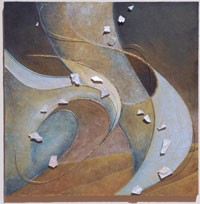
Alison Peacock sees a heavenly father in the earthly. The young Seeker in my poem and in the beautiful collage Trisha Gilmore created for her knows God’s presence before she can articulate it in

the cheek-roughness… of this… tree I can’t name… but… I will someday

– from “Seeker” by Jenn Cavanaugh

in Mars Hill Review 22 (2003)

Autumn Kegley paints her revelling revelation of the joy-filled life. Karla Manus encounters such a life and sees her relatively comfortable, joyless self in stark relief. Elizabeth W. Noyes returns again and again to the return of the full moon in which she catches sight of “infinite possibilities for echoing what is poetic, magical, mysterious and whole in the human heart, and mine.”

In curating this show, I’ve recovered a season. Between the times in which we wait for God to come and prepare for God to act, we have been given a time to train our senses to recognizing God’s presence and present work among us. In the years to come, Epiphany will be for me a time to focus on seeing God in the world, recognizing Christ in others, and becoming more receptive to the connections the Spirit makes.

The Epiphanies group show will be open at Capitol Hill Presbyterian Church of Seattle until February 14th. You can call the church office to make an appointment to see it during a weekday, join us for a service: Sunday, 2/10 @ 9:45 am or Ash Wednesday, 2/13 @ 7 pm, or drop by during the Capitol Hill Arts Walk, 5-8 pm, 2/14. See our Facebook page for more information and pictures http://www.facebook.com/CapHillPresArts

I Think God Believes in Cross Pollinating

I Think God Believes in Cross Pollinating.

Christine Sine’s lovely reflection on how God creates diversity in the natural world and in the Church and how we can help cultivate it. When God makes us one as God is one, our unity will have nothing to do with looking alike or moving in lockstep. Just as we see, hear, and feel God reaching out to us “in persons three” who are one in love and intention, so God leads, teaches, and empowers us to fill the earth with every stripe and expression of faith, hope, and love we can make together in response.

Liturgical (and Affordable!) Art

Liturgical (and Affordable!) Art.

After my own heart

Epiphanies Part I: How the Light Gets in…

About twice a year our church’s arts group plans a themed group show. We identify a theme that corresponds to an upcoming liturgical season or sermon series, send out a call for submissions, offer prizes so modest they hesitate to call themselves that, and work with what comes in. If you’re looking for a creative faith-building exercise, I recommend the practice.

Our current show is “Epiphanies,” in which eleven artists and poets reflect on those a-ha moments of connection, recognition, realization, and revelation. Now that it’s all put together, though, a secondary theme seems to be emerging: Cracks. The chorus of Leonard Cohen’s “Anthem” runs

Ring the bells that still can ring
Forget your perfect offering
There is a crack in everything
That’s how the light gets in.

For me this show has become about how the Light gets in and where it settles. Cohen’s chorus has long been a favorite of mine and our friend Matt Whitney alluded to it while he was installing his piece which uses the various textures of sidewalk cracks to form a received word.

"Clairvoyance" by Matthew Whitney

“Clairvoyance” by Matthew Whitney

Next to it we posted a poem of mine in which the tears and fissures that threaten our faith become themselves a source of hope.

                Miss Vera Speaks
They ask how she grin through that face with that life.
I say I’s never shielded from nothing
‘Cept dying young.


People deep bruised by something
Talk like the world should end.
Won’t catch me dying every day like that.


‘Cause I seen them once
Just once – the cracks in the universe –
Thought I’d fall right through.


‘Stead I laughed – said some kind of God
Put up with a tattered-old place as here
Gotta have some grace for me.
 –      Jenn Cavanaugh
(originally published in America Magazine in 2007)

When it comes to hanging these shows, we often find ourselves strategizing about how best to disguise the myriad holes, blemishes, and outright failings in sanctuary plaster. At the artist reception on Sunday I was joking about how the condition of the walls was starting to inform our artistic decisions overmuch, and a few of us got looking at this tableau:

Noyes Epiphanies Cracks

Photo by Elizabeth W. Noyes. “She Crawled Like You Out of the Wreckage” by Carrie Redway. “Swarm” by Robroy Chalmers. “Wall” by Church + Use + Time

This patch of wall we’re usually so anxious to conceal became part of this piece by Carrie Redway about the Fall and Eve’s anguished banishment from Eden and of the permanent installation by Robroy Chalmers that speaks to our congregation so eloquently and wordlessly of the Spirit’s movement in our midst. Our church building has been in continuous use since 1923. That wall has come by its imperfection honestly. Why hide it? Why not let it inform our artistic decisions?

More next week…

Volf on Relating to Culture

Quote

“There is no single correct way to relate to a given culture as a whole, or even to its dominant thrust. There are only numerous ways of accepting, transforming, rejecting, or replacing various aspects of a given culture from within. This is what it means for Christian difference to be internal to a given culture.”

– Miroslav Volf in It is Like Yeast

30/30 Project

30/30 Project.

Tupelo Press is inviting poets to write and post a new poem a day for 30 days as a fundraiser. I happen to know two of the nine poets involved in this project this month. I can only applaud them and aspire to such prolificacy, but I do plan to kick in a couplet for the Million-Line Poem they’re working on. Creative, collaborative ways of raising support and involving people in a community – give you any ideas?

Poetic Liturgy for Epiphany

Here are a few of the prayers I’ve written or arranged for our Epiphany service on Sunday. Next week I’ll share an image or two from the group show we’ve put together for the season.

Prayer of Confession:

Please join me in a responsive prayer of confession. I will read the light print and we will read the bold print together.

God, like the magi, we are unlikely traveling companions in the faith.

Some of us are wanderers, some of us are pilgrims,

But we are all strangers in strange lands.

We all speak different dialects.

We struggle to communicate with one another,

Much less with the locals.

God of Holy Mystery, our language fails

when we try to describe even your signs,

much less your Self.

And yet we blabber on in lingo

that has lost its meaning for us

and complain when the world doesn’t understand.

God, forgive us.

Instead of babblers, make us heralds, revealing You as creator of all.

Holy Spirit, we confess that even the most seasoned travelers among us

Make poor decisions when it comes to preparing

For the journey of faith you’re leading us on.

We draw our own maps that have no bearing on reality,

We carry the wrong equipment and refuse to abandon it,

Or we pack along amusements that distract us from all there is to see,

So it’s as if we never left our couches.

Spirit of All Truth, you give us all we require

for the journey, equipping, empowering,

teaching, and guiding us.

And yet we burden ourselves and others

with extra baggage unsuitable for pilgrims

that weighs us down and wearies us.

Spirit, forgive us.

Instead of tourists, make us emissaries, revealing You as wise, true, and faithful.

Jesus, we remember the gospel stories,

All the ways people approached you and left changed

And we see ourselves in them.

Some of us come like the shepherds with nothing but wonder and a capacity for joy.

Some of us come like the wise men with little frame of reference for who you really are

Or with gifts that seem inappropriate at the time.

Some of us have been waiting for you all our lives,

Some of us are just hoping vaguely for a miracle to heal us,

Some of us have left your presence sad because we can’t leave something else behind,

Some of us have committed violence in your name

because we’re still not sure what you’re about, even though we’ve walked with you for years.

Lord Jesus, you come to us

as God and as a fellow human being

inviting us into new life made whole.

And yet we pursue whomever, whatever we want

calling it by your name,

making sacrifices you don’t require,

holding tightly what binds us when you’ve told us to let go,

offering anything but the hearts you came to win.

Beloved Child of God, forgive us.

Instead of wayward children, make us disciples, revealing you as Savior of all.


Declaration of Pardon for 3 readers: 

text:“Briefly It Enters, and Briefly Speaks” by Jane Kenyon,

liturgical arrangement by Jenn Cavanaugh

3: I am the blossom pressed in a book,

found again after two hundred years….

1: I am the maker…

2: the lover,

3: and the keeper….

2: When the young girl who starves

sits down to a table

she will sit beside me….

1: I am food on the prisoner’s plate….

3: I am water rushing to the wellhead,

filling the pitcher until it spills….

1: I am the patient gardener

of the dry and weedy garden….

2: I am the stone step,

the latch, and the working hinge….

3: I am the heart contracted by joy…

the longest hair, white

before the rest….

2: I am there in the basket of fruit

presented to the widow….

1: I am the musk rose opening

unattended, the fern on the boggy summit….

All: I am the one whose love

overcomes you, already with you

when you think to call my name….


Offering Prayer

It is the season of revelation… that which was waiting is now revealed… that which was hidden is now out in the open… that which was obscured is now clear… that which was masked in complexity is now plain to see… that which was reserved is now accessible to all… that which was bound in criteria is now free… that which was hope is now reality… Into the darkness has come light… the light has been revealed and it is love! We see now that every good and perfect gift comes from you and that you give us these gifts to be a blessing to others. Accept our gifts, Lord and make use of them to make your love of the world visible to all.


Closing Prayer & Benediction: based on Psalm 74:9, 12

The world says: “There are so many stars, how can you follow just one?”

The enemy says: “’We are given no signs from God;
no prophets are left,
and none of us knows how long this will be.’”

“But God is my King from long ago;
he brings salvation on the earth.”

 God of all creation, you give us signs from which to get our bearings. Help us
recognize them. Spirit, give us wisdom to know the direction you’re leading and the strength to follow. Lead us to Christ and through us manifest Christ to world. Amen.

Follow the star, go in peace, serve the Lord.

Link

Twelve Things You Were Not Taught in School About Creative Thinking

“Creativity is paradoxical. To create, a person must have knowledge but forget the knowledge, must see unexpected connections in things but not have a mental disorder, must work hard but spend time doing nothing as information incubates, must create many ideas yet most of them are useless, must look at the same thing as everyone else, yet see something different, must desire success but embrace failure, must be persistent but not stubborn, and must listen to experts but know how to disregard them.”

Christmas/ Incarnation

from “Feast Days: Thanksgiving – Christmas”
by Annie Dillard

Let me mention
one or two things about Christmas.
Of course you’ve all heard
that the animals talk
at midnight:
a particular elk, for instance,
kneeling at night to drink,
leaning tall to pull leaves
with his soft lips,
says, alleluia.

That the soil and fresh-water lakes
also rejoice,
as do products
such as sweaters
(nor are plastics excluded
from grace),
is less well known.
Further:
the reason for some silly-looking fishes,
for the bizarre mating
of certain adult insects,
or the sprouting, say,
in a snow tire
of a Rocky Mountain grass,
is that the universal
loves the particular,
that freedom loves to live
and live fleshed full,
intricate,
and in detail.

God empties himself
into the earth like a cloud.
God takes the substance, contours
of a man, and keeps them,
dying, rising, walking,
and still walking
wherever there is motion.

Icons-of-the-incarnation-im

Art from Sophie Hacker’s Icons of the Incarnation