Unknown's avatar

About Jenn Cavanaugh

B.A. Russian Language and Literature, Willamette University; M.A. Theology and the Arts, Fuller Seminary

Sacred Space on a Budget: Advent

At our small, city church, our idea-to-budget ratio runs extremely high. I have long applied this quote to my own life, but it has also become a prevailing theme and philosophy in our arts and worship planning:

“Economy is the art of making the most of life.

The love of economy is the root of all virtue.”

– George Bernard Shaw

As much of a fan as I am of putting your money where your values are, I have also seen how making much of little stimulates creativity. Limits are good for art, and improvising with found materials has become part of our aesthetic and ethos. We’ve ingrained this practice to such a degree we didn’t manage to spend the relatively roomy budget we allowed ourselves for dolling up the sanctuary this season. The more dramatic bits were practically free, made from paper, foil, scrap wood, and an upcycled string of bulbs.
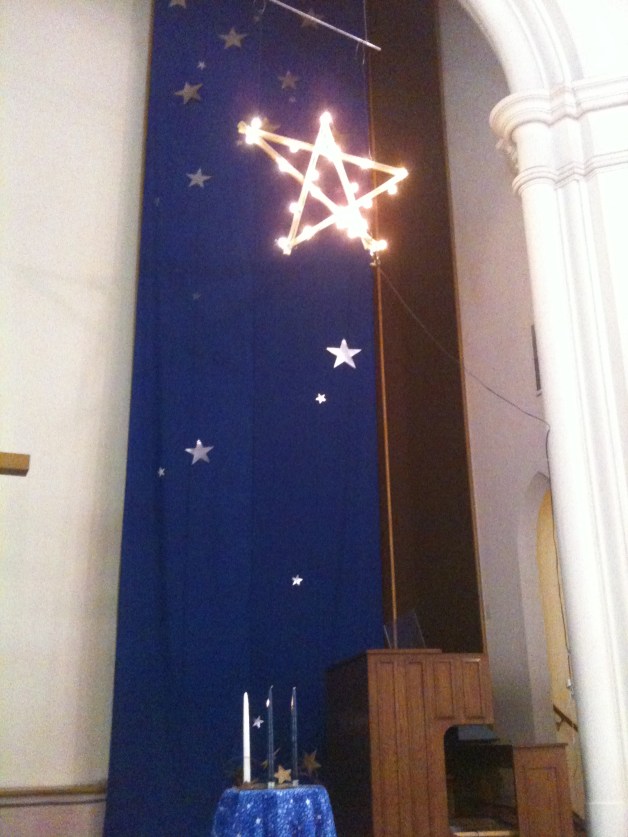
Star by Trish, Fabric Hanging by Deb & Cristie

Star by Trish, Fabric Hanging by Deb & Cristie

The Advent “wreath” is a 6′ length of wire with rusted tin stars coiled around a basic candleholder.

We strung a big X of fishing line across the sanctuary above the pews and hung silver origami stars of various styles at varying lengths. The silver caught the light and the layout created the illusion of depth, distance, and filling space on multiple planes with only 13 stars and 2 lines.
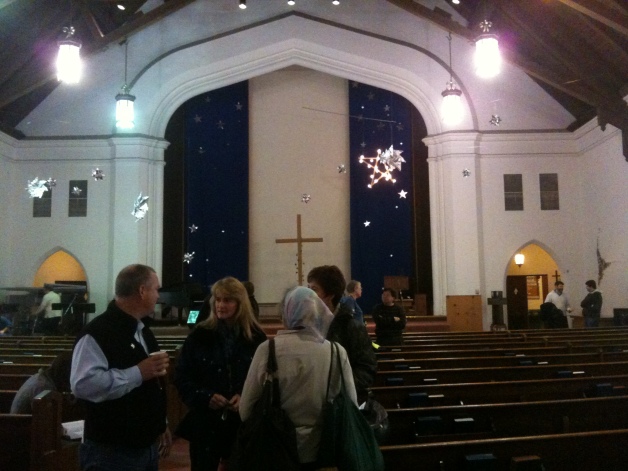
I really must take some pictures with an actual camera again someday, but you get the idea.

I really must take some pictures with an actual camera again someday, but you get the idea.

We’re planning to save these for another year and add a similar number of stars on two lines run straight across to achieve more of a knock-out effect. Here are the stars up close along with links to the online tutorials I followed to make them.

The septima stars were quite simple to fold. The component pieces could be easily mass-produced by a chatty group with idle hands, and the pattern is forgiving enough you can use slightly imperfect aluminum foil squares.
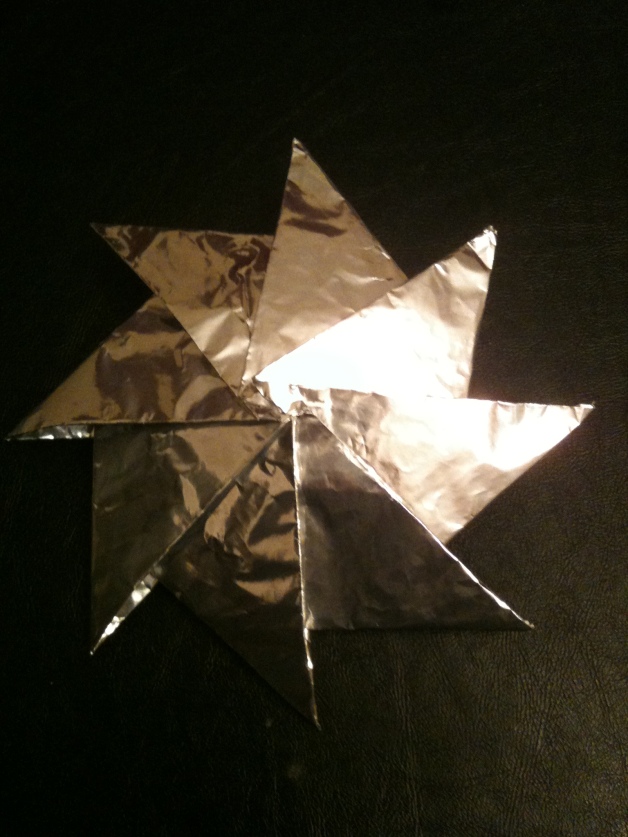
septima star

The kusudama pieces are a little more complicated, and I did cheat and use one piece of tape at each join so they could survive the handling necessary to hang them. Better suited for origami paper and crafty types willing to pay more attention to detail. If you do too many yourself, be prepared to dream about crane folds.
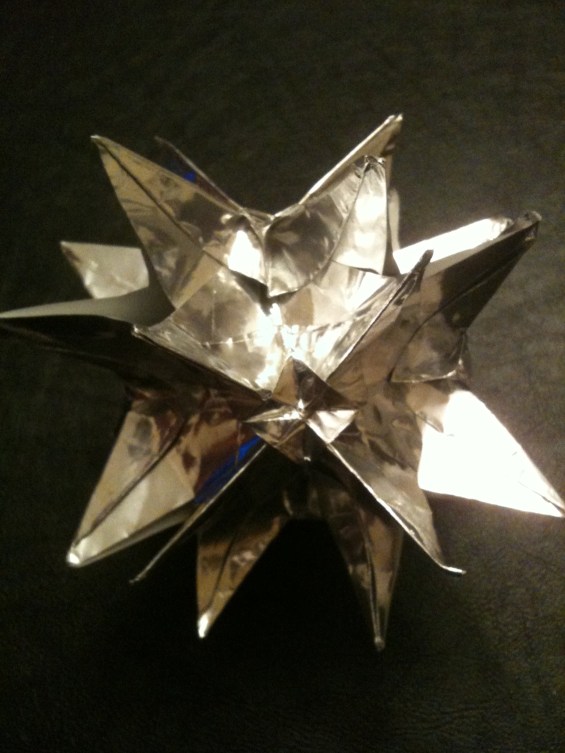
kusudama Click here for more beautiful patterns. Most are more involved, and many are more flower-like than star-like. Hmm… Easter, anyone?

Advent Reflection – Day 23

The Savior must have been
A docile Gentleman—
To come so far so cold a Day
For little Fellowmen—

The Road to Bethlehem
Since He and I were Boys
Was leveled, but for that ‘twould be
A rugged Billion Miles—

– Emily Dickinson

Eight elegant lines of Theological Anthropology and Christology dancing on the tongue and lingering in the mouth. Christ is at once one of us, subject to the rigors of travel and the nip in the air; yet very God, leveling the impossible expanse between us by walking it in humble and generous condescension.

Advent Reflection – Day 22

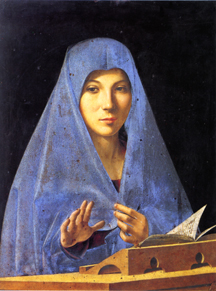
1_Virgin_Annunciate2
from “The Virgin Annunciate by Antonello da Messina”


Again.     Closer.


This time only one hand startles,
Losing her place in the book of hours.
The other goes on worrying the light
Habit of modesty worn to protect the angels.


Will it be the image bound to emerge from this blur of words
Shuddering through her? A full moon of the language of rising up
And coming down, building up and tearing down, swelling until
Everything she sees echoes with its own formation and demise….


– Jenn Cavanaugh

Advent Reflection – Day 21

Part of one of my favorite poems, period. Now with connections to yesterday’s words from Barth. Read along to the music….

from “Messiah (Christmas Portions)”  by Mark Doty

Who’d have thought

they’d be so good? Every valley,

proclaims the solo tenor,

   (a sleek blonde


   I’ve seen somewhere before

—the liquor store?) shall be exalted,

and in his handsome mouth the word

   is lifted and opened


   into more syllables

than we could count, central ah

dilated in a baroque melisma,

   liquefied; the pour


   of voice seems

to make the unplaned landscape

the text predicts the Lord

   will heighten and tame.


   This music

demonstrates what it claims:

glory shall be revealed. If art’s

   acceptable evidence,


   mustn’t what lies

behind the world be at least

as beautiful as the human voice?

   The tenors lack confidence,


   and the soloists,

half of them anyway, don’t

have the strength to found

   the mighty kingdoms


   these passages propose

—but the chorus, all together,

equals my burning clouds,

   and seems itself to burn,


   commingled powers

deeded to a larger, centering claim.

These aren’t anyone we know;

   choiring dissolves


   familiarity in an up-

pouring rush which will not

rest, will not, for a moment,

   be still.


   Aren’t we enlarged

by the scale of what we’re able

to desire? Everything,

   the choir insists,


   might flame;

inside these wrappings

burns another, brighter life,

   quickened, now,


   by song: hear how

it cascades, in overlapping,

lapidary waves of praise? Still time.

   Still time to change.

Advent Reflection – Day 20

I fully intended to provide some commentary on this amazing excerpt from Karl Barth’s commentary on Luke 1:5-23, but he says it all and brings together the seemingly disparate themes I’ve been dwelling on this season: the sacred and the secular, our disconnection and longings for more, and our role as heralds and followers. All I could do was hang on and try to redact it faithfully (emphases mine).

“Above all it saddens us that we are so cut off from each other, that there are always such different worlds – you in your house and me in my house, you with your thoughts and me with mine. This is simply not the way life is meant to be, this separate life we all lead. But with one single change we could have infinitely more joy and good fortune and righteousness among us, if we could open our hearts and talk with each other.

And then we experience the fact that we are mute. Yes, we certainly talk with each other, we find words all right, but never the right words; never the words that would really do justice to what actually moves us, what actually lives in us; never the words that would really lead us out of our loneliness into community. Our talk is always such an imperfect, wooden, dead talk. Fire will not break out in it, but can only smolder in our words….

Zechariah was mute because he did not believe the angel. We all are just like Zechariah in the sanctuary. Every one of us has a hidden side of our being that is, as it were, in touch with God. We are secretly in a close connection with the eternal truth and love, even if we ourselves are not aware of it…. Yes, this inward word of God, which God speaks to us by means of his angels, contains precisely that which so moves and unsettles us. It is this word that so delights and grieves us, and which we would so gladly tell one another.

Without this word we would not suffer so deeply from the need that presses in upon us, and from the injustice that we must stand by and watch. We would not be able to resist so powerfully and become so indignant against the lies and violence that we see dominating life apart from this word. We would not have the urge to exercise love and to become loving if it were not for the fact that within us is God’s voice, placed into our heart. In this way God spoke to Zechariah of something quite grand – a coming great decision and turning of all things, of the approaching better age at hand, of the Savior meant to become a helper for the people, and of his herald, whose father he himself would become….

Believing is not something as special and difficult or even unnatural as we often suppose. Believing means that what we listen to, we listen to as God’s speech. What moves us is not just our own concern, but precisely God’s concern….

We must once and for all give up trying to be self-made individuals. Let us cease preaching by ourselves, being right by ourselves, doing good by ourselves, being sensible by ourselves, improving the world by ourselves. God wants to do everything, certainly through us and with us and never without us; but our participation in what he does must naturally originate and grow out of his power, not ours. O, how we could then speak with one another. For whatever does not grow out of God produces smoke, not fire….

So now here we stand, simultaneously deaf and mute like Zechariah…. In spite of his unbelief, he was still a herald of Advent, one who waited for God…. When everything came to pass which he could not believe and could not express, then he was suddenly able to believe and speak. For God does not stand still when we come to a standstill, but precedes us with his deeds and only waits so that we can follow. And so we will accept – even with all that we cannot say, and with all that we have not yet heard – that we are also heralds of Advent. We will finally believe, and then we will also hear.”

–          Karl Barth, “Lukas 1:5-23,” from Predigten 1917 , translated by Robert J. Sherman in Watch for the Light: Readings for Advent and Christmas (Farmington, Penn.: The Plough Publishing House), 133-140.


Advent Reflection – Day 19

Advent by Rae Armantrout

In front of the craft shop,

a small nativity,

mother, baby, sheep

made of white

and blue balloons.

skygodgirl


               *

Sky

           god

                      girl.


Pick out the one

that doesn’t belong.

             * 

Some thing


close to nothing

                               flat

from which,


fatherless,

everything has come.

Advent Reflection – Day 18

Getting back to notions of the secular and sacred…

I’m being haunted by a mythical creature. It’s Sufjan Stevens’ Christmas Unicorn. It’s stalking me. I’m not sure what it wants. I suspect it doesn’t have a real agenda or even one coherent message for me, but over and over again this season I’ve heard one couplet or another trotting up behind me, pretending to mind its own business, but being all sly and apropos and quite obviously following me for the rest of the day.

This weekend involved spending too much time in my own head exploring the spectrum of mental health and illness on which most of us fall in between, and how we all set ourselves and each other up for crazy, and here came the lines

Oh I’m a criminal pathology
With a history of medical care
I’m frantic shopper and a brave pill popper
And they say my kind are rare

I’ve been devoting much energy toward keeping Christmas simple this year, but yesterday was a full day of shopping and preparations and hoofbeats that sounded like

Oh I’m hysterically American

I’ve a credit card on my wrist….

 I dip into a few of the posts littered around my virtual life written by people doing what they’re supposed to be doing – digging for reality, making meaning, sharing insights, confronting others’ otherness – and instead of inspiring me, it compounds my cynicism even as I sit down to do the same thing.

We are legions wide and we chose no sides

We are masters of mystique

 This time of year I find myself saying “‘Tis the season” to just about everything, good and ill, because it is. Does any other time of year catalyze so much reconciliation and relational dysfunction? It’s the season of connection and disconnection that brings out the best and the worst in us. Our overconsumption in this time represents the antithesis of the historic call to fast and yet it becomes a form of stress that performs at least one of the functions of fasting: it reveals our failings and discontents. We have to face how disconnected and dissatisfied we really are because the season stirs in us longings to be connected and satisfied.

The Christmas Unicorn’s main theme is our search for the sacred in the secular. We have to admit that we are working with a mishmash of observances of our own creation at Christmas, but it doesn’t mean there’s nothing there to observe.

Oh I’m a Christian holiday
I’m a symbol of original sin
I’ve a pagan tree and magical wreath
And a bowtie on my chin

Oh I’m a pagan heresy
I’m a tragic-al Catholic shrine
I’m a little bit shy with a lazy eye
And a penchant for sublime….

For I make no full apology
For the category I reside
I’m a mythical mess with a treasury chest
I’m a construct of your mind….

The Christmas Unicorn freely and unapologetically admits he’s a mongrel beast, as are all our human holy-days, as are we all. Our traditions are artificial constructs that alternately gain and lose significance over time, which is why we require new ones, even if they are artificial constructs. We long for the sublime, but it’s a little too subliminal for us. We need to attach it to something concrete or to establish something concrete from which to jump into it. Nostalgia manifests our desire to be part of a tradition, which in turn outs our desire to be part of something larger than ourselves. Those desires can and will be misdirected, sure. We can put our hope in the nostalgia itself, but there’s nothing wrong with the impulse, and the occasional misdirection is a symptom of reality. We were created to be part of something larger that is not yet complete.

You may dress in the human uniform, child
But I know you’re just like me
I’m a Christmas Unicorn! (Find the Christmas Unicorn!)
You’re a Christmas Unicorn too!

And then the beast slays me with a borrowed refrain as nostalgic to my generation as White Christmas, at once a confession and assurance of pardon:

Love, love will tear us apart again
It’s all right. I love you.

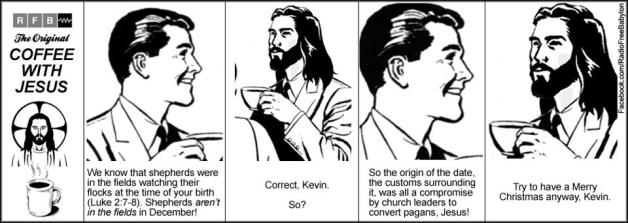
merrychristmasanyway

Advent Reflection – Day 17

Mosaic of the Nativity (Serbia, Winter 1993)

On the domed ceiling God
is thinking:
I made them my joy,
and everything else I created
I made to bless them.
But see what they do!
I know their hearts
and arguments:

“We’re descended from
Cain. Evil is nothing new,
so what does it matter now
if we shell the infirmary,
and the well where the fearful
and rash alike must
come for water?”

God thinks Mary into being.
Suspended at the apogee
of the golden dome,
she curls in a brown pod,
and inside her the mind
of Christ, cloaked in blood,
lodges and begins to grow.

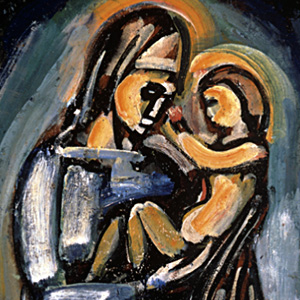
An Orthodox icon – not the one Kenyon’s writing about, I think, though Mary’s in her brown pod. Please post here if you can identify the mosaic, I would love to know!


Advent Reflection – Day 16

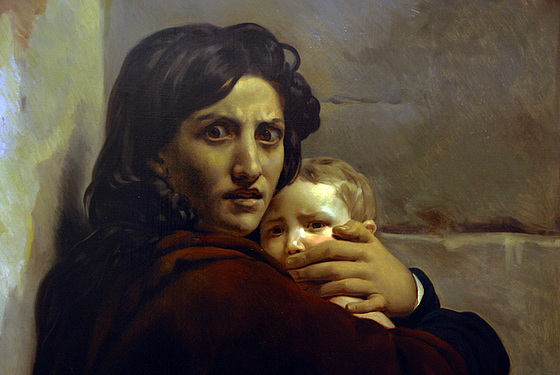
Usually we remember the massacre of the innocents after Christmas, but this year we’re remembering a little early. I sorted through classical images of the scene until I hit upon Leon Cogniet’s, painted in 1824, and I had to stop. It would be fitting to show (and you may see the detail that stopped me in my tracks here http://u1.ipernity.com/20/06/51/11880651.e59938c2.560.jpg), but this scribe decided we can all imagine the horror just fine. Better to be confronted with a glimpse of “the world’s hope,” fragile as he seems here.

Who Says

While the innocents were being massacred who says
that flowers didn’t bloom, that the air didn’t breathe bewildering scents.
that birds didn’t rise to the heights of their most accomplished songs
that young lovers didn’t twine in love’s embraces
But would it have been fitting if a scribe of the time had shown this
and not the monstrous uproar on a street drenched with blood
the wild screams of mothers with infants torn from their arms
the scuffling, the senseless laughter of soldiers
aroused by the touch of women’s bodies and young breasts warm with milk
Flaming torches tumbled down stone steps
there seemed no hope of rescue
and violent horror soon gave way to the still more awful
numbness of despair
At that moment covered by the southern night’s light shadow
a bearded man leaning on a staff
and a girl with a child in her arms
were fleeing lands ruled by the cruel tyrant
carrying the world’s hope to a safer place
beneath silent stars in which these events
had been recorded centuries ago
 
– Julia Hartwig, translated from the Polish by Stanislaw Barańczak and Clare Cavanagh

“Flight to Egypt” by Ethiopian iconographer Amete Sellassie

Advent Reflection – Day 15

More on the light that shines in the darkness….

How the Light Comes: A Blessing for Christmas Day

AndTheDarknessDidNotOvercomeItJanLRichardson

“And the Darkness Did Not Overcome It” by Jan L. Richardson

I cannot tell you how the light comes.

What I know is that it is more ancient than imagining.

That it travels across an astounding expanse to reach us.

That it loves searching out what is hidden what is lost what is forgotten or in peril or in pain.

That it has a fondness for the body for finding its way toward flesh for tracing the edges of form for shining forth through the eye, the hand, the heart.

I cannot tell you how the light comes, but that it does. That it will. That it works its way into the deepest dark that enfolds you, though it may seem long ages in coming or arrive in a shape you did not foresee.

And so may we this day turn ourselves toward it. May we lift our faces to let it find us. May we bend our bodies to follow the arc it makes. May we open and open more and open still

to the blessed light that comes.

Art & Reflection by Jan L. Richardson. Go here http://adventdoor.com/category/poetry/page/2/ to see more of her amazing Advent images and reflections or here http://janrichardsonimages.com/details.php?gid=60&pid=345 to purchase a digital download or art print