Unknown's avatar

About Jenn Cavanaugh

B.A. Russian Language and Literature, Willamette University; M.A. Theology and the Arts, Fuller Seminary

Lenten Calendar: Wounds

“If someone asks, ‘What are these wounds on your body?’ they will answer, ‘The wounds I was given at the house of my friends.’” – Zechariah 13:6

I knew a woman with a wound that had never healed. She came from Kosovo. Ten years before I met her she’d had a procedure to drain a lung her tuberculosis was filling up fast, and the gaping hole it left in her side never closed up. She was perfectly capable of everyday activities, but it affected her whole life. She was beautiful and intelligent, with a mix of stoicism and cheerfulness prized in her culture, but she never married. All her friends and siblings did, including a brother who had suffered a head injury as a child that left him wall-eyed and slow. He had a dozen healthy children and a grandchild on the way. She had a wound that told the story of her life.

Even those of us with wounds that have healed know that every scar has a story. They are mementos of reckless childhoods, of moments in which we forgot our own strength or limitations, of burst appendices, of giving birth. They are physical records of our lives that we carry around on our bodies.

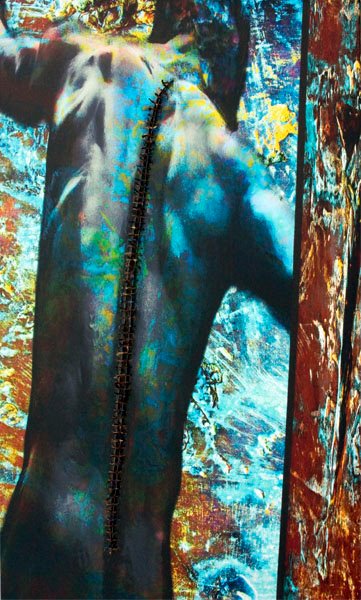
Seattle artist Paul Tonnes has a major abdominal scar from a surgery he was too young to remember to correct a condition he was too young to recall having, and yet his body reminds him. The printed canvases in his series Wounds have all been slashed and stitched together in such a way that the violence done is still visible, even palpable, but the damage is being held together in hopes of healing. The Wounds do not depict the violence – no indication is given of the source of these wounds – as much as the healing process. The palette of the pieces is bold, mottled, and reminiscent of bruising. The stitching is roughly done with twine, utilitarian knots and autopsy needles, some of which still dangle from the canvas as if to acknowledge the work left to be done; others remain worked into the canvas itself as if they are an integral part of the work.

wounds tonnes

art by Paul Tonnes

Some of the wounds seem old or even postmortem. Did the youthful immortal, sculpted of marble and sporting a Y-incision, suffer from internal injuries? Was cracking his perfect chest the only way to see them? Were they visible even then? One woman’s wounds seem to serve as points of connection to the world around her, as much as sources of pain. Her wounds seem smaller than the others, more like stings. Other wounds are still open and raw, but no blood and guts pour out of them. The openness is a void, a space for healing. Or maybe those are the cracks that Leonard Cohen recognized were present in everything because “that’s how the light gets in.”

Not all the wounds are on the figure’s person. Some are environmental, but the tension of them is felt in the musculature of the Davidic torso and the amorphous body reminiscent of Michelangelo’s Four Prisoners; the poorly sewn gash in the canvas suggests the damaged surroundings in which he’s struggling for the freedom to be fully formed. An Atlas-like figure bends under a burden with a tightly stitched seam. As the artist noted, if the stone had not been repaired, our beleaguered titan would have had half as much to carry, but someone somehow took the trouble to make the burden itself whole. Who does that?

The physicality of these ruptured canvases reminds me of the physicality of Lent. Lent is a time many of us seek to identify and break the physical habits that inhibit our spiritual lives or establish new habits that reconcile our physical and spiritual lives. Sometimes we subject ourselves to things at Lent because we want to get our heads around the harrowing reality of our sins and of Christ’s sacrificial journey to Jerusalem to put them to death in his own body. We suffer graphic and gut-wrenching depictions of the Passion and exactly what happens when a nail is driven through a human hand. We imagine ourselves suffocating. We are people with a violent and physical story. These canvases bring me back to the healing beauty of the cross and the wounds of Christ that are our wounds. Some of these wounds are fresh and raw. Some are emotional scars with stories that have shaped our stories and where we see ourselves in the story of salvation.

Tonnes offers powerful images to sit with during Lent as we consider the violence done to and around us, as we confess and repent of the violence we’ve done, as we present our wounded bodies and souls to the One who offers healing, and as we cultivate the disciplines that will help us continue to do so all year long. Any one of them could be read as a Christ figure. Any one of them could be any one of us.

Paul Tonnes is a Seattle artist working in the mixed media realms of digital manipulation, print, and encaustic. His series “Wounds” consisting of cut and stitched canvases explores the human body’s potential for healing. You can see more of his profound work at paultonnes.com


Lenten Calender: Star-stuff

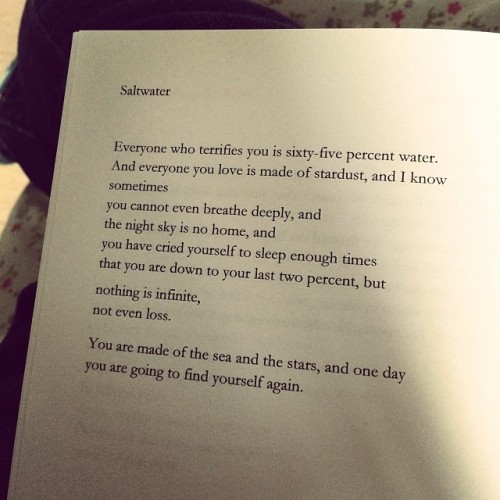
Saltwater by Finn Butler

poem and photo by Finn Butler

Remember you are dust. That we are all dust. That we are each made of the same earthy, elemental, universal stuff that God has seen fit to bring to life. That we are all mortal and responsible for not quenching the divine Spirit in our own or in anyone else’s frail earthen vessel.

It may feel like we’re made of dry clay and only held together by sweat and tears, but it is just as true to say that we are made of the sea and stars, hand-crafted by a loving God, and set spinning with a will and a purpose. “For I know the thoughts that I think toward you, says the Lord, thoughts of peace and not of evil, to give you a future and a hope.” (Jeremiah 29:11)

Purposes come in all shapes and sizes. What is one thing you know that you have been set in place to do? Set aside some time today or this weekend to pursue it with a will and a purpose, in a spirit of hope and with a mind set on the future.

Lenten Calendar: Ash Wednesday

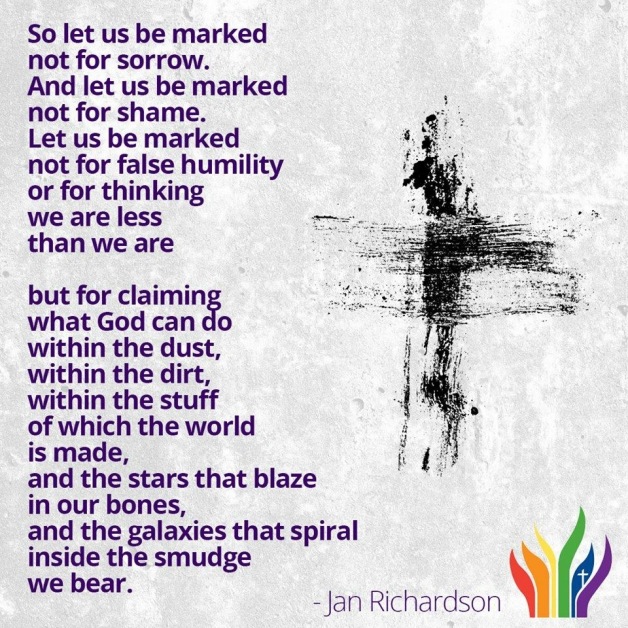
jan richardson ash wednesday

The imposition of ashes. Most of us don’t relish any kind of imposition, so what brings us out on a school night to rub dirt on each other’s foreheads? What kind of season kicks off with people lining up to be reminded of their own mortality? A rather grim one, you’d expect. But Lent turns morbidity on its head and makes it an invitation into life. Lent begins where we end, but ends with the death of death.

Ash Wednesday is an in your face, on your face, square between the eyes reminder that we’re all going to die, so let’s stop wasting life being anything less than God made us to be. Also, we’re dust, so let’s not feel any pressure to be anything more than God us to be, either. Accepting that our days are numbered teaches us to number our days and so gain a heart of wisdom. Life is precious in its finitude and we live it better when we are mindful of what we are spending it on.

Many of our modern fasts take into account that time is a limited resource. What practice would you like to build into or moderate or remove from your life to make the most of your time?


Lenten Calendar: Another Season, Another Fast

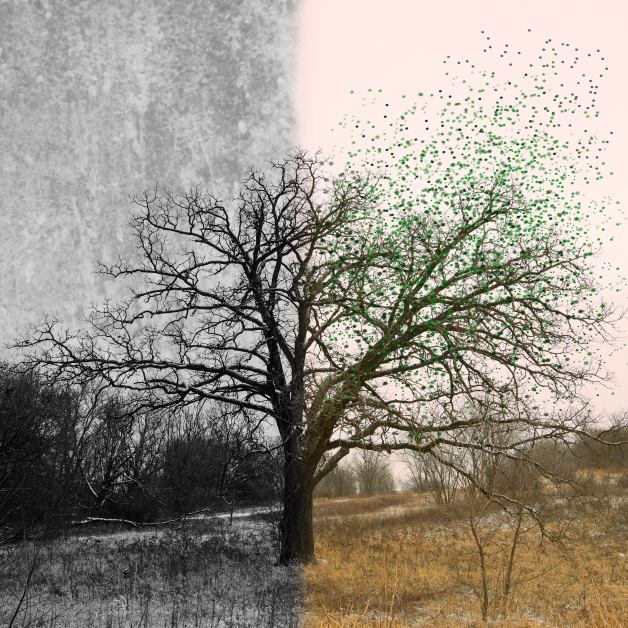
Julie Elfers Winter to Spring

art by Julie Elfers

I’ve blogged a few of years of Advent reflections, but Lent calls for a different kind of pace and energy that I’m just now trying to summon and articulate for the first time.

Both Advent and Lent are fasts, designated times of preparation that allow us to better celebrate the feasts of Christmas and Easter. Both seasons are quiet, but Advent mirrors the deepening stillness of winter’s approach, where Lent channels the subterranean stirrings of early spring.

Advent is lament, crying out in our need and powerlessness as the darkness deepens around us. Lent is repentance, throwing off every self-imposed impediment so we can walk in freedom and power in the light, The discipline of Advent is to cultivate hope in spite of the darkness around us. The discipline of Lent is to spite the darkness within and share the hope that is also within us.

During Advent we meditate on the wonder of God coming to be human as we are: small and vulnerable. During Lent we follow Jesus in his earthly ministry, striving to become human as he is: whole and restoring others to wholeness.

In Advent we fall to our knees in anticipation of a blessing and receive the gift of a savior. In Lent we rise to our feet to be a blessing and learn to give sacrificially in the model of the Savior.

Advent is dwelling on the promise of Isaiah 9:6; it’s a call to wait on the Lord. Lent is embracing the exhortation of Isaiah 58:6; it’s a call to action.

Each of the 40 days of Lent I will try to post a little something to get us moving. A song, a poem, an article, a study, a wandering exploration, a quote…. We’ll see. I have no overarching plan beyond the grand tradition of the disciples – just praying to be able to keep up as Jesus quickens his pace toward Jerusalem.

Words of Witness – Advent Week 4: LOVE

We gather here today in response to God’s love

that feeds our souls like a good meal with friends,  

filling our minds and hearts and senses

until our best selves overflow.

aerial photo of mountain surrounded by fog

Photo by icon0.com on Pexels.com

Despite the selfish demands and betrayals of love we have suffered.

Despite the impatient and half-hearted attempts at love we have offered.

Despite our flawed definitions and our misplaced affections,

We come.


We come because of all these things, believing

in a love that is bigger than us, and better;

that is offered to us as we are,

even as it is beyond our scope to comprehend as we are.

Lord help our unbelief.


We gather in love

and in need of God’s perfect love.

A love that has been through everything

and come out stronger.

A love that knows and accepts us so deeply

that the stranger no longer poses a threat.

A love to grow into.

The gentle touch of the sun on our upturned faces

Its soft warmth on our backs when it is no more

and no less than the light by which we see.

A faint trickle of water music

heard throughout life’s song-rich forest

telling us that wherever we go,

we will never go thirsty.


We are God’s people.

We light this candle as a sign of the love of God,

who comes to walk in our shoes

and make a home among us.

O come, Immanuel. 


Composed by and for the American Church in Paris community, the work of the people to the glory of God.

Words of Witness – Advent Week 3: JOY

We gather here today in God’s Spirit of joy

that erases all memory of pain and fear

like the holy cry of a newborn child.


Despite the status quo and daily grind that stifle our humanity

Despite unanswered prayers that make us doubt divinity

In the face of desperation and discrimination, sickness and loss,

In the face of death itself, we come.


We come because of all these things,

believing that God’s joy is as unconditional as God’s love,

as unbounded and independent of circumstances as God’s own Spirit.

Holy Spirit, help our unbelief.


We gather in the joy of the Spirit who groans for us,

longing that our joy be made full,

that our joy be made deeper

than the pride we can buoy only with compliments,

more grounded than the mania we conjure against depression.

The joy of letting our guard down.

The joy of going beyond our limitations and our successes.

Giving more, doing more than we thought possible

only to find we have and are more than when we began.

Joy in the journey when the end is not yet in sight.

Walking freely in the counsel of the wise.

Being blessed by our children.

Joy transcending time and place

to make joy possible in our time and place.

20171027_073630472_iOS

“The Way of Water” – photograph by Jenn Cavanaugh

We are God’s people.

We light this candle as a sign of God’s joy

who comes to us in the newness of life

and makes a home among us, and for us.

O come, Immanuel.


Composed by and for the American Church in Paris community, the work of the people to the glory of God.

Words of Witness – Advent Week 2: PEACE

We gather here today in response to Christ’s peace

that draws our eyes upward

like birdsong and rainbow against a storm-dark sky,

promising an end to destruction.

 
Despite the interminable warzones we shrug must always be so;

Despite the seething culture wars boiling over into our own streets;

Despite our clenched fists, anxious minds, and overburdened hearts;

Despite our frustrated relationships and hard-wired wariness, we come.

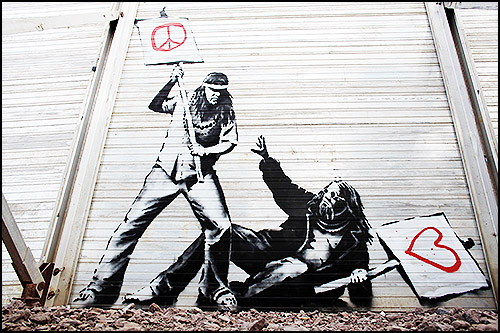
banksylovevspeace

by Banksy

 
We come because of all these things,

believing that our inner chaos can be rightly ordered,

that wrongs will be righted, that wars and fears shall cease,

that a day will come when we will no longer live by the sword or die by the gun.

Jesus help our unbelief.

 
We gather in the name of the savior who is our peace,

a peace beyond fleeting distraction,

beyond the suppression of hostility.

A more perfect peace we glimpse

from the zone we enter when we run, when we bike,

when we read, when we create.

Peace resonating after the choir’s last chord.

Peace with God and with ourselves.

Well-placed trust in friends and harmony with enemies,

smiles from strangers and the company of those who love us.

All the world’s children tucked safely into beds,

Falling snow framed in a picture window,

and the time to watch it fall,

mug in hand, good things baking in the oven.

The smell of a forest in its prime, clearing the air,

The trickle of snowmelt, reviving the earth.

Peace running like a warm bath at the end of a hard day,

when all has been done and done well.

 
We are God’s people.

We light this candle as a sign of God’s peace

who comes to us in the fullness of time

and makes a home among us.

O come, Immanuel.

Words of Witness – Advent week 1: HOPE

We gather here today in response to God’s hope

that calls us like church bells,

heralding the birth of a savior

and new life offered to all.

selective focus photography of paintbrush near paint pallet

Photo by Steve Johnson on Pexels.com

Despite the failure of our systems to protect the innocent.

Despite the arrogance of those who say there is no hope.

Despite our distorted desires

and disheartening battles, we come.


We come because of all these things,

believing that things could be different,

that things could be better;

that we could be changed.

God help our unbelief.


We gather in hope

and in need of God’s perfect hope.

A hope like unbounded light

at the end of our tunneled vision.

A hope like cool waves on sunburnt skin.

A hope that smells like fresh-baked bread,

sustaining our bodies.

A hope that tastes like fresh spring water,

restoring our souls.

A hope like the mess of a palette

resolving itself on canvas

into wonder.


We are God’s people.

We light this candle

as a sign of our hope in the God who comes to us in our darkest hour

and makes a home among us.

O come, Immanuel.


Composed by and for the American Church in Paris community, the work of the people to the glory of God.

Frederick Buechner on the Church as Family

Frederick Buechner turns 92 on Wednesday (long may he drive the darkness back), but this is a word best heard gearing up for a Sunday.

“Life is extraordinary, and the extraordinariness of it is what Jesus calls the Kingdom of God. The extraordinariness of it is that in the Kingdom of God we all belong to each other the way families do. We are all of us brothers and sisters in it. We are all of us mothers and fathers and children of each other in it because that is that we are being called together as the Church to be. That is what being the Church means. We are called by God to love each other the way Jesus says that God has loved us.

Loving each other doesn’t mean loving each other in some sentimental, unrealistic, greeting-card kind of way but the way families love each other even though they may fight tooth and nail and get fed to the teeth with each other and drive each other crazy yet all the time know deep down in their hearts that they belong to each other and need each other and can’t imagine what life would be without each other — even the ones they often wish had never been born.”

— Frederick Buechner

from “The Church” in The Clown in the Belfry (pp. 149-159). San Francisco: Harper, 154.

Into the Labyrinth: The Road to Emmaus

Traditionally, the labyrinth is an uncluttered opportunity for centering prayer. It usually consists of a single path that leads into the center and back out. There are twists and turns, switchbacks, and apparent setbacks that actually take you further along the path to your goal, but feel like moving in the wrong direction. Unlike in a maze – the labyrinth’s choose-your-own-adventure cousin – if you simply walk the path in front of you, you will get where you’re going. Labyrinths are often found outdoors or in relatively bare chapels with an altar and candles that welcome people to come and unburden themselves of whatever they’re carrying, yoke themselves to Christ, and practice walking in the spirit. It is a lovely form of sacred space: simple yet suggestive. The idea presented below is not intended as an improvement over a traditional labyrinth. We borrowed the labyrinth motif because it brought to life the sense of realization while in movement, the walking epiphanies of the story of the disciples meeting Jesus on the road to Emmaus. As such, it would be appropriate to set up during Epiphany or during Lent – when we wander the desert not to lose ourselves, but to find our center – as well as when we did it: during the season of Easter, before Ascension, when this story originally took place.

WP_20141208_17_01_36_Pro__highres (2)

A labyrinth of the everyday – trompe l’oeil outside Chartres Cathedral

Road to Emmaus Labyrinth

Luke 24:13-35

Our[1] labyrinth consisted of a huge drop cloth on the floor marked in a variation on a classic labyrinth pattern.[2] With staggered starts, the labyrinth could accommodate four or five people at a time. We set up eight compact, numbered stations along the path – five going in, one at the center, and two going out.[3] Two readers (one reading the script, the other the scripture passages throughout) recorded an audio tour with music as follows. People were given headphones and a cheap, one-button mp3 player and invited to pause and play and go at their own pace. In this script the numbers correspond to the track number.

  1. “Welcome”

Welcome to the Emmaus Road Labyrinth. Here we enter the story of two disciples meeting the resurrected Jesus as they walked along the road to a town called Emmaus. In a sense, we’ll be walking along with them as we progress into and back out from the heart of the labyrinth. A labyrinth is not a maze. A maze is a puzzle to be solved. A labyrinth is a path to be followed. Walking a labyrinth is a completely different exercise than running a maze. Here there is no fear of being lost. The labyrinth externally enacts the internal experience of centering. Spiritually, it represents space set apart, or sacred space, in which we are drawn into the center, to the recognition of the presence of God, then return to the world blessed and changed by the experience, and better equipped to be an agent of blessing and change.


Each station in the labyrinth has one track on this audio guide. Go at your own pace. This is a time to walk in the Spirit, swap stories with Jesus and listen for the voice of God in your life. If the words or music become a distraction, feel free to pause, skip ahead or ignore the recording entirely. Enter the labyrinth and continue walking until you reach station one.


  1. “Station One (going in): They were kept from recognizing him” Luke 24:13-16

Jesus’ followers then and now have different perceptions of who he is and what he came to do. The disciples’ false perceptions of Jesus kept them from knowing and loving him for who he is. They thought he was a teacher, a revolutionary, a ruler; they thought he was dead.

It is difficult to recognize the presence of God when God doesn’t act according to our assumptions. St. John of the Cross called this the dark night of the soul. He saw it as a time in which, despite all appearances and perceptions, even though it feels like stumbling around in the dark, the soul grows in faith and intimacy with Christ Himself, rather than with illusions of Him.


Open the flaps to see images of the Jesus we think we know. Ask him to reveal himself so that we may love him as he truly is.[4]

Music: “The Dark Night of the Soul” by Loreena McKennitt


  1. “Station Two (going in): Downcast” Luke 24:17

The Seder is the traditional meal and central celebration of Passover. To read about the origins of Passover, please pause this recording and read Exodus 11 & 12 marked in the bibles here. The entire extended family is to come together. Throughout the meal, they retell the Exodus story in the first person as if they had been one of the slaves freed from Pharaoh’s bondage. The bitter herbs, horseradish here, are eaten to remind the participants of the bitterness of slavery.  Are you downcast? Where are you experiencing bitterness? Taste the herbs and let the words of Psalm 22 be your cry to heaven.


  1. “Station Three (going in): Storytelling, Part 1” Luke 24:18-24

The disciples on the road were consoling each other by telling stories and remembering Christ. On index cards, write about a time in your life when you met with God. Pin them to the storyboard. Read others’ stories and allow others to read your story.


  1. “Station Four (going in): Storytelling, Part 2” Luke 24:25-27

Now Jesus tells his story, explaining his work throughout the ages, establishing and re-establishing relationships with his people. Flip through a bible and take some time to hear God’s story of constant provision and love. The lectionary bookmarks and bibles are free for you to take with you.

Music: “Jesus’ Blood Never Failed Me Yet” by Jars of Clay (light) or Gavin Bryars (strong)


  1. “Station Five (going in): Welcoming the Stranger” Luke 24:28-29

The disciples welcomed Jesus though they did not yet recognize him. Who is the stranger walking along the road with you now? Have you ever encountered Christ in or through a stranger? Have you ever been that stranger? Consider these questions as you watch the video.[5] Pause this program and use the headphones attached to the monitor.


  1. “Station Six (center): Breaking Bread” Luke 24:30-31

Here in the center of the labyrinth, Jesus meets us and offers sustenance for the journey outward. Break bread with Christ. Join in this prayer from “Six Recognitions of the Lord” by Mary Oliver as you take and eat.


Oh, feed me this day, Holy Spirit, with

the fragrance of the fields and the

freshness of the oceans which you have

made, and help me to hear and to hold

in all dearness those exacting and wonderful

words of our Lord Christ Jesus, saying:

Follow me.


[minute pause]

When you are ready to begin your journey back out into the world, take a card and exit out the corner opposite from the one you entered. Practice walking prayerfully.


  1. “Station Seven (going out): Burning Hearts” Luke 24:32

What is Christ saying to you on the road? What does scripture say about Jesus? What does it say about you? Have you looked recently to see? Light a candle and pray for the scriptures to be opened to you, for the words to burn within your heart.

[pause]

What words from the scripture cards or from your bible reading do you want burned deeper into your heart? Write them onto a paper heart, tack it to a candle and take it with you. Light it at home, while it burns pray that the scriptures will be opened to you and your heart opened to them.

Music: “Listen” by Michelle Tumes


  1. “Station Eight (going out): Returning to Jerusalem” Luke 24:33-35

Where is your “Jerusalem?” Where will you now return and share what you have experienced? Who can you talk to about what you are learning about Jesus?

Christ is risen! Take a cross to give to a friend as a reminder of Christ the Lord, alive and walking with us.


[1] You know you have a successful collaboration going when no one can remember whose ideas were whose and they’ve become too interwoven to attribute them separately anyway. I got to write the script, but the experience as a whole was thought through and produced by everyone in our alt worship planning group: Cristie Kearny, Deb Hedeen, Judy Naegeli, Trisha Gilmore, Cathy Stevens, Heidi Estey, Kirk Heynen, James Kearny and Anika Smith.

[2] Ours happened to have one path leading in to the center and a different path leading back out, but generally I would recommend the Half-Chartres (basically the inside half of the design at Chartres Cathedral). You can find instructions for making a 12’ x 12’ version at “Karen’s Small Labyrinths” http://www.angelfire.com/my/zelime/labyrinthssmall.html#halfchartres. The size shown there would be sufficient for people to use one or two at a time with a single station in the middle, but wouldn’t accommodate what I’m describing here. Ours was about 4 times that size, maybe 25’ x 25’.

[3] The stations should be clearly numbered with the station number and the track number and labeled “going in” or “going out” so as not to confuse anyone. Remember they are all actually set up on and around a flat, open surface, so they will not be laid down linearly. If you use a single path labyrinth, people will be walking by stations 7 and 8 on the way in, but should only stop at them on the way out. We set up stations on small, low tables and music stands so they wouldn’t pose as obstacles by taking up too much space. Café tables would work nicely for the stations you can place around the outside of the circuit. Ideally, if someone’s standing at a station, another person should be able to pass them without stepping completely off the path.

[4] Our artists made this interactive piece. You can create your own by making a collage poster of images of Jesus or roles people think of Jesus playing: the miracle worker, the rustic shepherd, the white-suited televangelist, the revolutionary in a beret, the pacifist at a sit-in, etc. Then overlay the poster with another piece of poster board and cut flaps in it that open onto the various images.

[5] We commissioned a videographer and a high school student in our congregation to collaborate on a video of different kinds of people. You could make your own using stills of people in your church and neighborhood or footage from mission trips. Or you could download something along the lines of The Work of the People’s “Stranger” (http://www.theworkofthepeople.com/index.php?ct=store.details&pid=V00520) or LifesongMD’s “World Faces” (http://youtu.be/z6RLHKRs9D8).