We have seen glimpses of your hope in communities of solidarity and recovery
and in rich conversations with our brothers and sisters in the faith.
When the local whale watchers protected the humpback calf from harm,
we knew your presence.
Give us hope to trust you are at work in ways we cannot see,
like an ambient melody
that elevates and alters a space.
.
We have heard your promises:
that you have good plans for each of us
and that you will be with us wherever we go,
in heaven, on earth, and in every place they meet in You.
Every child shall have vision for a future beyond politicking and conflict.
The young shall teach us to build one another up in mutual respect.
.
Christ, our hope, make a way through the desert of despair.
Lead us to campsites in lush meadows by hidden pools.
Comfort us and give us hope,
that we may comfort others in your name.
“Hope” by Sliman Mansour
Anoint us with your Spirit to bring good news
to those sleeping outside and suffering in war zones.
Inspire our leaders.
Restore our humanity.
.
We are God’s people.
We light this candle as a sign of God’s hope
that brightens grey skies
like the rosy brushstrokes of dawn
and the glow of the turning leaves
O come, Immanuel.
.
(This year’s Advent candle-lighting liturgies are crafted around the 2023 lectionary texts and input from congregants of Bethany Presbyterian Church of Seattle)
James Baldwin was no stranger to feelings of alienation, disillusionment, betrayal, and fear for the fates of the marginalized. When we reckon with events that threaten our hope for the future and trust in one another, Baldwin and the Bible have words for us.
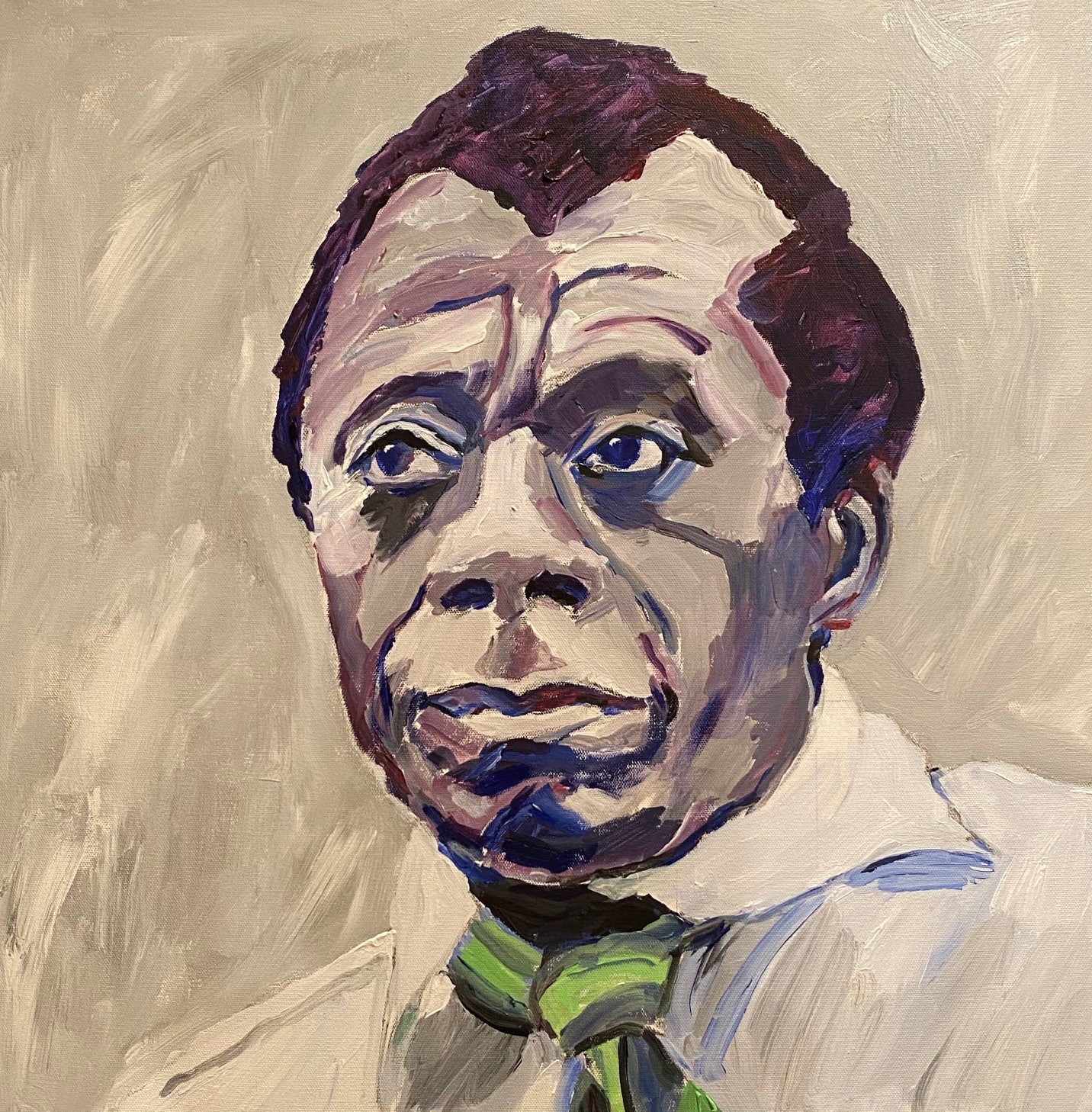
“James Baldwin” painting by Jeff Benesi
Sad Songs: Singing the Blues and Biblical Lament
Now, you women, hear the word of the LORD; open your ears to the words of his mouth. Teach your daughters how to wail; teach one another a lament. Death has climbed in through our windows and has entered our fortresses; it has removed the children from the streets and the young men from the public squares. – Jeremiah 9:20-21
“They gave our sorrow and our danger back to us, transformed, and they helped us to embrace and triumph over it. They gave us back our joy, and we could give it to our children. Out of the depths of the midnight hour, we could laugh.” – James Baldwin: “Last of the Great Masters”
Where do we go when we’re discouraged? How do we go on when we are too world-weary to put one foot, one word, one thought in front of another? Baldwin likened himself to a blues singer, albeit one who didn’t know anything about music and couldn’t sing. This African-American musical tradition and the Old Testament Writings offer a soulful and honest way through our personal anguish to recognizing and reclaiming our collective humanity.
Write your own Psalm of Lament or Blues Song
It takes powerful language to articulate a powerful experience, to put words to what we feel might be too deep for words.
First, tell what happened. In one line. Strip away the context and consequences and even emotion (for now) and describe the worst moment of the whole experience in one telling detail. Pack the rest of the story into three more similar, one-phrase lines. (If you find they rhyme, you’re writing the blues, if not, we’ll just call it a lament.)
Take some time to pray. Identify the burning question kindled by this experience. Sometimes it’s simply “Why?” or “How could you?” but it might be something else. Ask the question, and listen for the answer. This doesn’t guarantee there will be one, but listen for it.
Now write more freely. What do you want to say now that is completely unacceptable to say? Write it down. Change up the way you describe your feelings. If you could concentrate this emotion on your tongue, what would it taste like? Don’t be afraid to use heightened or strong images. Some of the images in the Psalms are almost too strong to stomach, even theologically problematic (e.g. God bless anyone who bashes in the skulls of the children of the people who did this). Don’t worry about being correct or even fair to all parties. If God could watch this happen, God can handle what you have to say about how it makes you feel. Skip anything that softens it. No euphemisms or “maybes” or “I feel likes,” just what is. Pour it out there. How has the world changed since? End with one concrete example of something you do differently now.
Pause to reflect. What do you want or need in light of this? What do you want to be able to do again? Wait for a concrete image of what wholeness would look like now. Ask for it.
Describe in writing what it is you are waiting for.
This is the 2nd in a series of 8 devotions that was featured, in slightly altered form, on our bible app in March 2022 as ‘The Gospel according to James Baldwin*
For the last decade or so, I have been an avid student of the essays of James Baldwin. Today would have been his 100th birthday, and I can’t help but wish he were still with us, talking beautifully phrased and reasoned sense in his uniquely winsome and challenging style of insider familiarity and outsider insight into the Scriptures, Western society, and the human condition.
Baldwin was raised in the church and even preached as a teenager, but he left both the pulpit and the church early in life, too fervent a believer in the gospel that steeped his childhood to allow the church in America’s racist and homophobic trappings to restrict his God-given freedom and identity. Though he gave up churchgoing, and many in the church gave him up for lost, he never gave up on the church. His essays are riddled with exhortations to believers to return to the way of Jesus and reclaim our responsibility to “the least of these.”
“James Baldwin” painting by Jeff Benesi
Racism: Cursing the Image of God
“With the tongue we praise our Lord and Father, and with it we curse human beings, who have been made in God’s likeness.” – James 3:9 (NRSV)
“I am saying that when a person, when a people, are able to persuade themselves that another group of people or breed of men are less than men, they themselves become less than men and have made it almost impossible for themselves to confront reality and to change it. If I deny what I know to be true, if I deny that that white child next to me I simply another child, and if I pretend that that child, because its colour is white deserves destruction, I have begun the destruction of my own personality.…
I tremble when I wonder if there is left in the Christian civilizations… the moral energy, the spiritual daring, to atone, to repent, to be born again; if it is possible, if there is enough leaven in the loaf, to cause us to discard our actual and historical habits, to cause us to take our places with that criminal Jew… put to death by Rome between two thieves, because He claimed to be the Son of God. That claim was a revelation and a revolution because it means that we are all the sons of God. That is a challenge, that’s the hope.”
— James Baldwin: White Racism or World Community?
Baldwin interpreted the unforgiveable sin against the Holy Spirit mentioned in Mark 3:29 to be the ways we treat one another as less than human, thereby desecrating the image of God the other represents. Baldwin consistently expressed how destructive racist systems were not only to the oppressed, but also to the oppressor. Into what categories might we sort others so that we can dismiss them as unworthy of consideration? What do we destroy in ourselves and others when we do so? The best way to claim our status as beloved children of God is to extend that status to others.
Call to Action: Is there someone in your life you’re having trouble seeing as a fellow child of God? Look for an opportunity today to affirm them, even if it’s something as small as LOLing their only social media post you actually find funny.
*This series of 8 devotions was featured, in slightly altered form, on our bible app in March 2022 as ‘the gospel according to james baldwin*
not only when we visit our favorite places and people
but in some wildly unexpected places and people as well.
Whenever a child is born to us,
we know Your presence.
Where our pleasures now are partial and fleeting,
give us energy to keep up with a joy that endures.
.
We have heard Your promises:
that You came to bring the great joy of reconciliation
to absolutely everyone
and that none of our faults can separate us from God.
When we bring you our grief, you collect our tears
to water orchards producing perfect fruit.
Forgiveness flowers wherever You walk.
.
Jesus, You come to make our joy chock-full,
complete, whole, limit-bursting, and exuberant.
Enlarge our capacity for unbounded delight
in Your world and in each other.
.
Anoint us with your dancing Spirit
to bring good news of your continued favor
to everyone muddling through the rough places.
Reconnect us to the Source of all joy.
.
We are God’s people.
We light this candle as a sign of God’s joy,
that calls us out of our corners to play along,
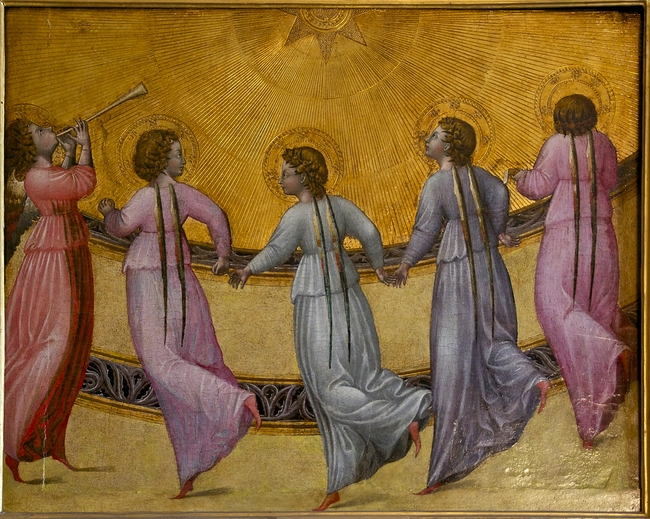
harmonizing with an ecstatic angel chorus
jamming to the music of the spheres.
.
O come, Immanuel.
.
This year’s liturgies composed with contributions from the wreath-lighters of Bethany Presbyterian, Seattle. There may or may not have been a five-year-old involved this week.
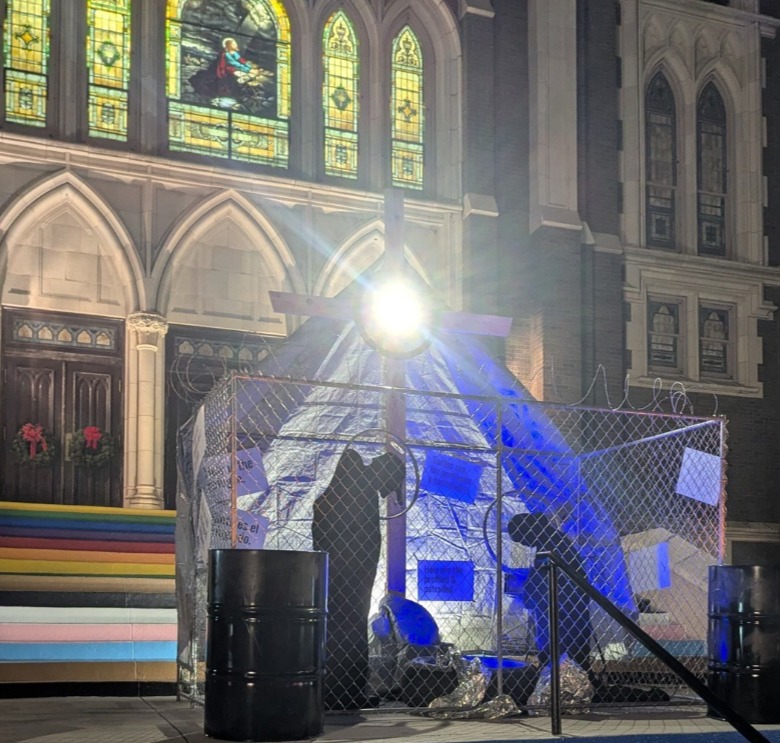
that surrounded us with care, stood by our sides, and had our backs.
When we heard confidence and optimism in our children’s voices,
we knew Your presence.
Give us eyes keen enough to catch Your love in action,
and spirits quick enough to reflect Your grace,
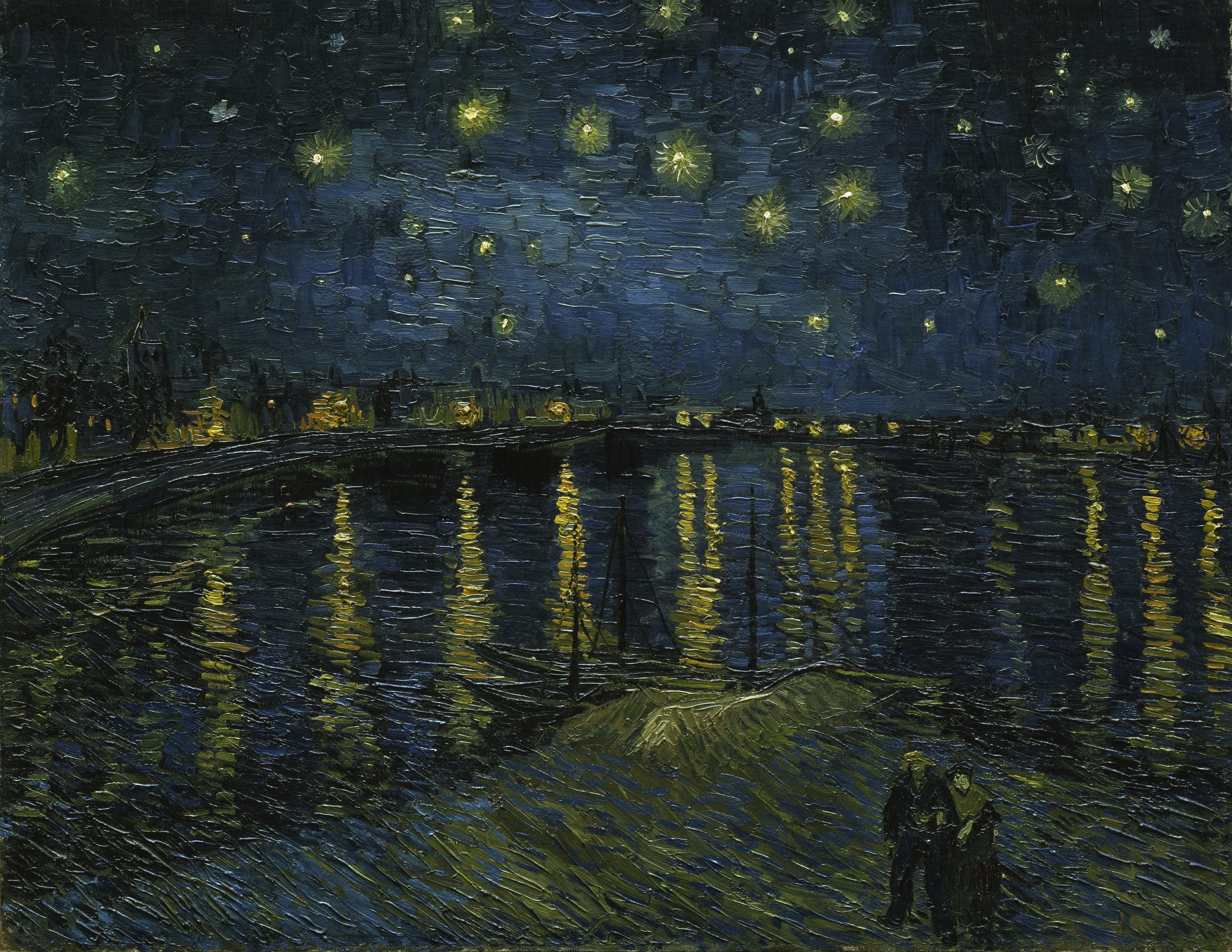
as water catches and reflects the light.
.
We have heard Your promises:
that You love us no matter what,
with a love greater even than faith and hope.
Where Your love rules, everything changes.
The stranger will be met with a smile.
The hurt will find a healer.
.
Jesus, lover of our souls, come soothe where hate burns.
Help us to love one another as You have loved us,
with an untamed love that is not safe, but it is good—
a love that spends its life for others.
.
Anoint us with your Spirit to bring good news
to all in need of Your healing touch.
Restore what has been broken in rage.
Make us crafters of beauty from ashes.
.
We are God’s people.
We light this candle as a sign of God’s love
that sets up camp among us,
tending the displaced and the wounded,
then sends us out to do the same.
O come, Immanuel.
.
(This year’s Advent candle-lighting liturgies are crafted around the 2023 lectionary texts and input from congregants of Bethany Presbyterian Church of Seattle)
Jesus, as we enter again into the odd story of your unusual arrival, we pray for your peace that is sometimes loud and sometimes quiet that quells conflict between people and nations and calmly putters around fixing the unfixable
We find your peace when we let others go ahead of us and when we let our broken bits of anger, anxiety, and frustration flow through our fingers like sand into your caring hands
We find your peace in creative mode and in the nuzzles of the family dog, in the lap of waves along the shore and in the scents of vanilla and lilac, a peace like a long drink of water after a walk through the tall grass
Donostia, photo by Jenn Cavanaugh
Awaken us to our role as astonished agents of your astonishing peace in our homes, streets, and schools at such unlikely times as when we ourselves are in pain or caring for another’s pain
We are God’s people. We light this candle as a sign of the peace of Christ who comes to us as a deep breath of fresh air and makes a home among us. O come, Immanuel






 Homespun