Lenten Calendar: Creation as Service

Not even five weeks ago, back when none of us thought we’d be giving up going to work or church or the gym for Lent, I was thinking about the fast described in Isaiah 58, and how this season was a call to action.

In the meantime, so many of our regular ways of serving have gone on hiatus. We’re cut off from the people we care for and our own daily needs are shifting, well, daily. Rather than developing deeper, sustainable rhythms of drawing out our souls on behalf of others, we’ve found ourselves in crisis mode.

How then, shall we serve? How do we redeem the time? How do we satisfy the afflicted souls and our own (Isaiah 58:10-11)?

Obviously, we need to be open to new and creative ways of doing so. As we seek entertainment and solace, we’re recognizing a collective need and appreciation for poetry and stories, art and music. So let’s recognize the creation thereof as a form of simultaneous service and soul-care.

For your sake poets sequester themselves,
gather images to churn the mind,
journey forth, ripening with metaphor,
and all their lives they are so alone…
And painters paint their pictures only
that the world, so transient as you made it,
can be given back to you,
to last forever.

All becomes eternal. See: In the Mona Lisa
some woman has long since ripened like wine,
and the enduring feminine is held there
through all the ages.

Those who create are like you.
They long for the eternal.
They say, Stone, be forever!
And that means: be yours.

Awakening desire, they make a place
where pain can enter;
that’s how growing happens.
They bring suffering along with their laughter,
and longings that had slept and now awaken
to weep in a stranger’s arms….

— Rainer Maria Rilke, trans. Anita Barrows and Joanna Macy
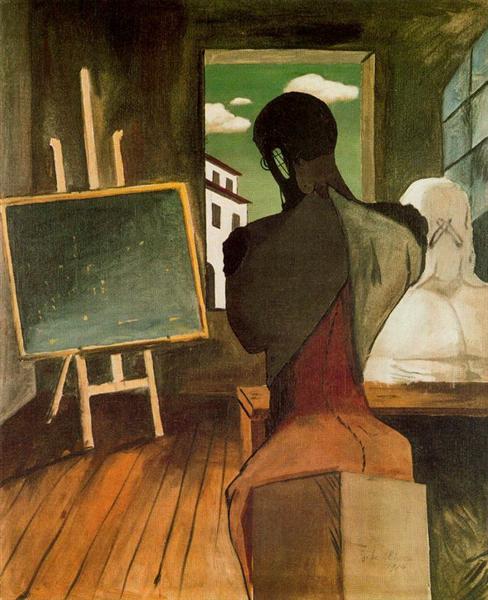
philosopher-and-poet.jpg!Large giorgio de chirico

Philosopher and Poet by Giorgio de Chirico

Personally, I find it more daunting than to motivating to hear how Shakespeare wrote King Lear while quarantined. It’s about as helpful as comparing your ministry to Jesus’ at age 33. For every one of us with extra time on our hands, there must be a dozen feeling more burdened and busy. My mental space for creative work has telescoped in on itself, rather than expanded. But. I do find that making creative time enhances my mental space — if I’m realistic about where I’m at and let myself be in it for the process more than the product. Don’t expect to produce your best work right now, but let yourself be play at being an artist. Set aside a time to sequester yourself like a poet instead of just staying home.

Make it a small regular gesture, or make it unsustainably all-consuming for a day, but find a way to assert your humanity in an environment that’s conditioning us to think of ourselves and others as medical statistics or economic units.

Sketch that view out your window and exchange it with a friend. Chronicle your thoughts in a lasting way, or in such a way that you can walk away from them for a while. Sing while cooking for one again or the twenty-first meal this week. Curate a playlist. Create something the best you can and then release it. Even if it’s only sufficient to charm or cheer yourself and your mother for a quarter of an hour or a dozen strangers for a minute or six of your most like-minded friends for five minutes, that’s half an hour of charm or cheer that would not have otherwise existed, and the making itself will help your cooped-up soul stretch.
Lenten Calendar: A Sacrifice of Worship

As more and more of us worship from home, we are most of us establishing a new discipline. We are loving our neighbor by sacrificing the easy, rhythmic habit of gathering together.

Today’s poem is a reminder that we are the church, worshipping a God who is everywhere present, and “Whose only now is forever.” Whenever we come before God in worship, and however we come before God in worship, we do so along with all the saints everywhere and throughout all of time.

It also plays nicely with this Sunday’s lectionary readings, so I’ll be reading it as our call to worship tomorrow, as I lead worship online for the first time. May it call you into “the deathless truth of [God’s] presence.”

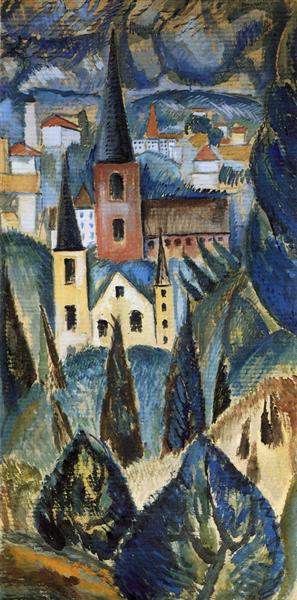
landscape-with-church-spires-and-trees.jpg!Large max weber

Landscape with Church Spires and Trees by Max Weber

i am a little church(no great cathedral) – i do not worry if briefer days grow briefest,
i am not sorry when sun and rain make april

my life is the life of the reaper and the sower;
my prayers are prayers of earth’s own clumsily striving (finding and losing and laughing and crying)children whose any sadness or joy is my grief or my gladness

around me surges a miracle of unceasing
birth and glory and death and resurrection:
over my sleeping self float flaming symbols
of hope, and i wake to a perfect patience of mountains

i am a little church(far from the frantic
world with its rapture and anguish)at peace with nature – i do not worry if longer nights grow longest;
i am not sorry when silence becomes singing

winter by spring, i lift my diminutive spire to
merciful Him Whose only now is forever:
standing erect in the deathless truth of His presence (welcoming humbly His light and proudly His darkness)

— e.e. cummings

Lenten Calendar – Quotidian

Lent is typically a time in which to rid ourselves of certain habits and try on new ones. This Lent we are all being called upon to develop a new normal. What of your activities do you most want to re-envision in order to keep? Which activities is this an opportunity to rest from? What new activities is this an invitation to build slowly into your everyday life? How can you curate your soul in planning your day?

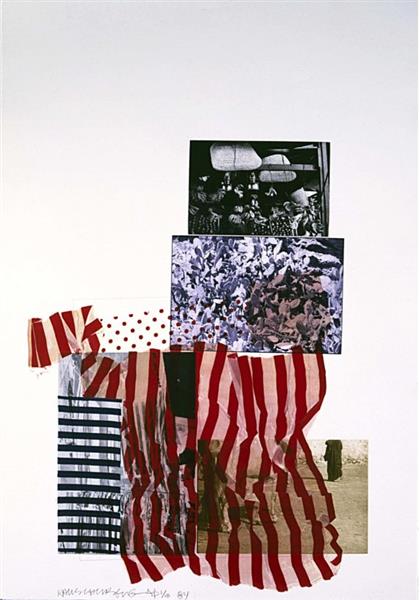
bazaar-1984.jpg!Large Robert Rauschenberg

“Bazaar” by Robert Rauschenberg

I should like to bring the routine of my daily life before You, O Lord, to discuss the long days and tedious hours that are filled with everything else but You.

Look at this routine, O God of Mildness. Look upon us men, who are practically nothing else but routine. In Your loving mercy, look at my soul, a road crowded by a dense and endless column of bedraggled refugees, a bomb-pocked highway on which countless trivialities, much empty talk and pointless activity, idle curiosity and ludicrous pretensions of importance all roll forward in a never- ending stream.

When it stands before You and Your infallible Truthfulness, doesn’t my soul look just like a market place where the second-hand dealers from all comers of the globe have assembled to sell the shabby riches of this world? Isn’t it just like a noisy bazaar, where I and the rest of mankind display our cheap trinkets to the restless, milling crowds?

…my soul has become a huge warehouse where day after day the trucks unload their crates without any plan or discrimination, to be piled helterskelter in every available corner and cranny, until it is crammed full from top to bottom with the trite, the commonplace, the insignificant, the routine.

What will become of me, dear God, if my life goes on like this? What will happen to me when all the crates are suddenly swept out of the warehouse?

-from Karl Rahner’s Encounters with Silence


Lenten Calendar: Be Still

I know.  I do.

I, too, had plans.  So many plans.  Plans within plans.  Plans for years.  Plans for miles.

Plans that have fallen away so fast I am already forgetting what it felt like to trust in them.

Now all plans, even for the day, are held lightly – balanced on a fingertip and blown away in a whispered Inshallah.

There is less movement, but little stillness. My mind runs in place. There are still others to care for, and it is a blessing. Only my desire to model the calm I wish for them that reminds me to make use of this time by remaining active, but not busy. To do less with great intention. And when even that doesn’t go according to plan, to set good intentions aside and just be. Together. To trust without planning. To be still. To stay home and get well without being resentful of the privilege.

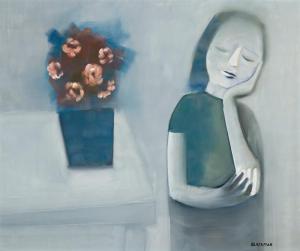
room-at-twilight-1963 charles blackman

Room at Twilight by Charles Blackman

“You have been forced to enter empty time.
The desire that drove you has relinquished.
There is nothing else to do now but rest
And patiently learn to receive the self
You have forsaken in the race of days.

At first your thinking will darken
And sadness take over like listless weather.
The flow of unwept tears will frighten you.

You have traveled too fast over false ground;
Now your soul has come to take you back.

Take refuge in your senses, open up
To all the small miracles you rushed through.

Become inclined to watch the way of rain
When it falls slow and free.

Imitate the habit of twilight,
Taking time to open the well of color
That fostered the brightness of day.

Draw alongside the silence of stone
Until its calmness can claim you.
Be excessively gentle with yourself.

Stay clear of those vexed in spirit.
Learn to linger around someone of ease
Who feels they have all the time in the world.

Gradually, you will return to yourself,
Having learned a new respect for your heart
And the joy that dwells far within slow time.”

– from “For One Who is Exhausted, a Blessing” by John O’Donohue

Lenten Calendar: Behind Glass

Behind Glass, a petit récapitul portatif

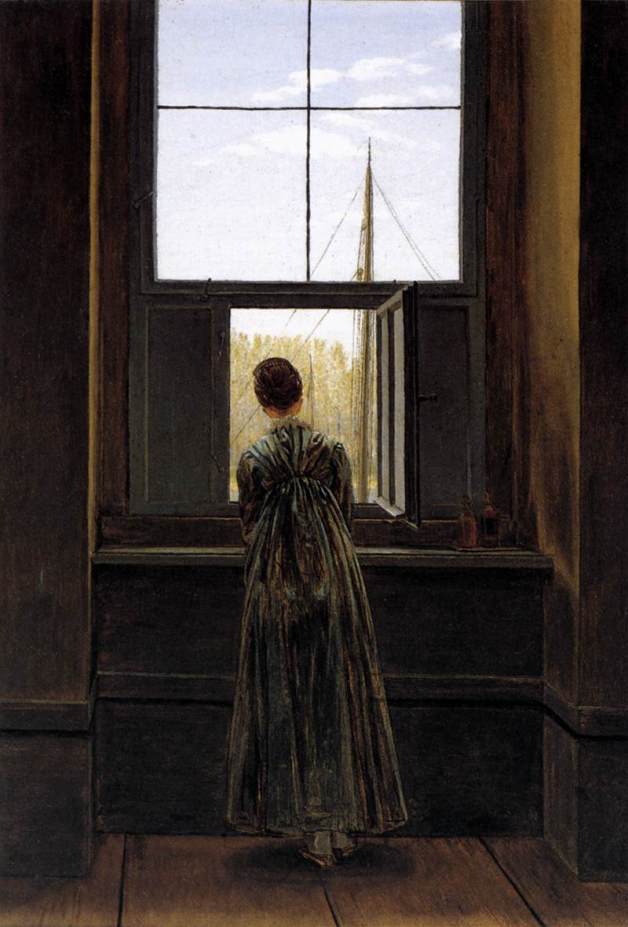
Caspar_David_Friedrich_-_Woman_at_a_Window_

Woman at a Window by Caspar David Friedrich

April 3, 2018, Paris

for the woman at the window

A tenure of retiring footsteps

and java of iffy origins

tooled your destiny in muted tones.

(retiring, iffy, muted)

You kept your hand on the ball, your eye

peeled for the signal to pitch your lot –

an open wire swaying yet uncrossed.

(kept, peeled, yet)

Maybe this spring’s release of vine will

burst the gutted and buried glass shrine

you beetled down under, unlatching

(maybe, buried, under)

relics of the unpronounceable.

– Jenn Cavanaugh


As the poet, I’m hoping to let the poem speak for itself. A note, however, about the fun Oulipo form: I find that these poems often write themselves in ways that surprise me. The links provide images and vocabulary that demand the creation of fresh poetic connections. It’s a useful form for breaking out of mental ruts or through blocks; because it does double duty by encouraging both free association and verbal problem-solving, it feels like activating multiple regions of the brain. You can find the rules for it here.


Lenten Calendar: Creative Withdrawal

On a day when more of us are systematically removing ourselves from public spaces, Christian Wiman reminds us that “all love demands withdrawal.” Giving others their space is not a novel way of demonstrating care. What’s new for most of us is negotiating the majority of our relationships at such a remove. Already, though, I have seen some intentional, beautiful, and creative examples of closeness growing without physical proximity, and I hope you are seeing some, too. Wiman also says that “all love demands imagination.” Let’s redeem the time imagining new ways of being with and for one another.

Wiman continues…

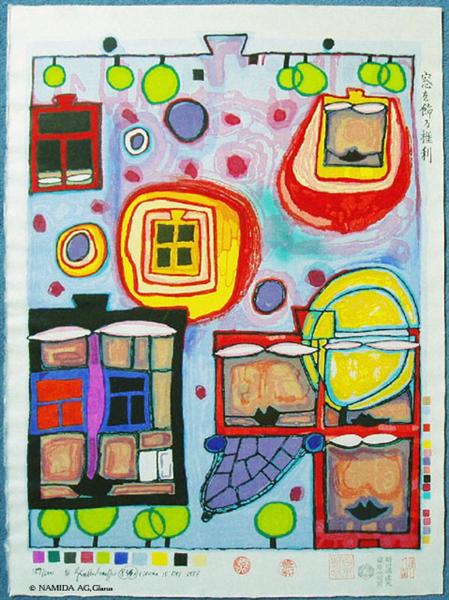
846A Window Right - Friedensreich Hundertwasser

846A Window Right by Friedensreich Hundertwasser

We must create the life creating us, and must allow that life to be —

and to be beyond, perhaps, whatever we might imagine.

I, too, am more (and less)

than anything I imagine myself to be.

“To know this,” says Simone Weil, “is forgiveness.”


It is an air you enter, not an act you make.

It is the will’s frustration, and is the will’s fruition.

It is to wade a blaze one night that I once crossed

— a young man, and lost —

to find a woman made of weather

sweeping the street in front of her shack.

It is another country.

It is a language I don’t know.

La por allá, la por allá, I repeat in my sleep.

The over there.


– from “The Parable of Perfect Silence” by Christian Wiman


Lenten Calendar: Cloistered

Does anyone else feel like this Lent has taken an extra poignancy? A great many of us are essentially cloistered, reordering our lives, hyper-aware of the collective significance of our everyday practices, and actively defining what is essential. What would it look like to embrace this worldly detachment as an opportunity for new forms of service and practicing the presence of God?

This passage has also taken on an extra poignancy lately. Good writing does that – rises to the occasion. So may we all as we wait for the Risen One.

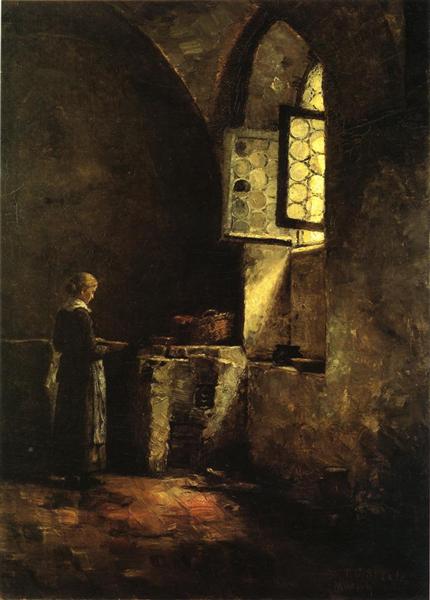
a-corner-in-the-old-kitchen-of-the-mittenheim-cloister-1883 steele

A Corner in the Old Kitchen of the Mittenheim Cloister, 1883 by T.C. Steele

This Wednesday is a long way from Ash Wednesday,
but all our Wednesdays are marked by ashes —
we begin this day with that taste of ash in our mouth:
of failed hope and broken promises,
of forgotten children and frightened women,
we ourselves are ashes to ashes, dust to dust;
we can taste our mortality as we roll the ash around on our tongues.

We are able to ponder our ashness with
some confidence, only because our every Wednesday of ashes
anticipates your Easter victory over that dry, flaky taste of death.

On this Wednesday, we submit our ashen way to you —
you Easter parade of newness.
Before the sun sets, take our Wednesday and Easter us,
Easter us to joy and energy and courage and freedom;
Easter us that we may be fearless for your truth.
Come here and Easter our Wednesday with
mercy and justice and peace and generosity.

We pray as we wait for the Risen One who comes soon.

– from Prayers for a Privileged People by Walter Brueggemann

Lenten Calendar: Loss

Make no mistake: loss is not a gift. What was lost was a gift, sometimes one that wasn’t appreciated fully until it was lost, which only adds to the anguish.

Every loss is unique to the mourner, and yet the experience of loss is an inevitable part of life in this world.

Lent is a season to acknowledge it as real, to allow grief and regret to wrack us and ultimately, hopefully, to grow in appreciation for all we have been given, whether we still possess it or not. Loss leads easily to fear and defensiveness, but the recognition of the universality of loss can soften our hearts and make healers of the healed.

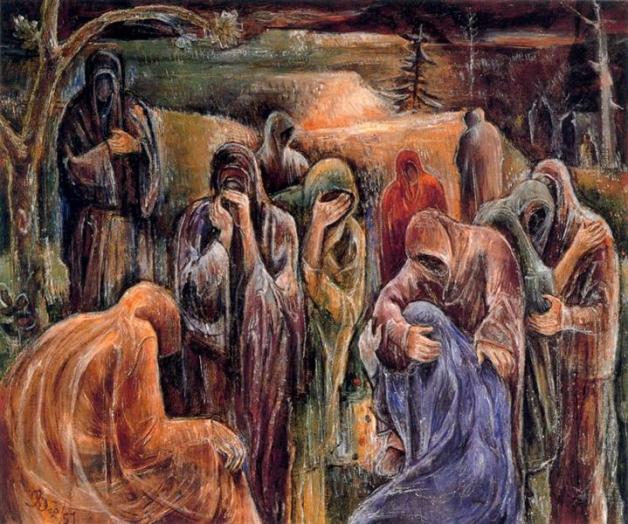
The Grieving Women Albert Bloch

Kindness

Before you know what kindness really is
you must lose things,
feel the future dissolve in a moment
like salt in a weakened broth.
What you held in your hand,
what you counted and carefully saved,
all this must go so you know
how desolate the landscape can be
between the regions of kindness.
How you ride and ride
thinking the bus will never stop,
the passengers eating maize and chicken
will stare out the window forever.

Before you learn the tender gravity of kindness
you must travel where the Indian in a white poncho
lies dead by the side of the road.
You must see how this could be you,
how he too was someone
who journeyed through the night with plans
and the simple breath that kept
him alive.

Before you know kindness as
the deepest thing inside,
you must know sorrow as
the other deepest thing.
You must wake up with sorrow.
You must speak to it till your voice
catches the thread of all sorrows
and you see the size of the cloth.
Then it is only kindness that
makes sense anymore,
only kindness that ties your shoes
and sends you out into the day
to gaze at bread,
only kindness that raises its head
from the crowd of the world to say
It is I you have been looking for,
and then goes with you
everywhere
like a shadow or a friend.

 — Naomi Shihab Nye

Lenten Calendar: Hiding

Today’s lectionary psalm is Psalm 32 – a maskil, or contemplative psalm imparting wisdom. It deals in visceral images of the pain and futility of trying to hide our dark secrets from God.

When I kept silent,
    my bones wasted away
    through my groaning all day long.
For day and night
    your hand was heavy on me;
my strength was sapped
    as in the heat of summer.

This oppressive feeling of guilt and shame lifts completely after coming clean with God, but then this psalm we’re supposed to think about and learn from does a funny thing. Just after busting the myth that we can hide from God, it refers to God as a hiding place. Obviously not from God, but from those who would punish us for giving up our pretense and deceit. God’s presence is the safest place to be our whole selves.

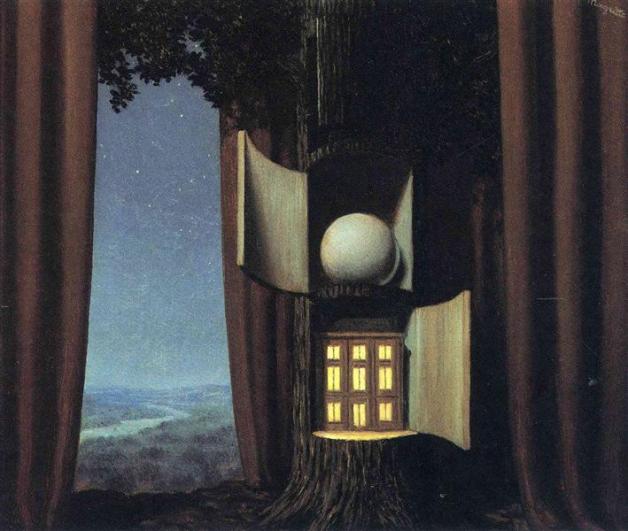
La Voix du sang Magritte

La Voix du sang by René Magritte

The lyrics to Our Lady Peace’s “Hiding Place” echo those of the psalm…

Have you seen what I saw
The sky came down from afar?

Have you been there before
That place where hearts’re reborn?

I’m looking for a place to go
I’m waiting on another
Hiding place for hearts

Have you dreamed of a world
Where armor sheaths your bones?

Have you ransomed your soul
To pay for all that you’ve got wrong?

Never give up

… and the video evokes the feelings of danger and safety.


Lenten Calendar: Wounds

“If someone asks, ‘What are these wounds on your body?’ they will answer, ‘The wounds I was given at the house of my friends.’” – Zechariah 13:6

I knew a woman with a wound that had never healed. She came from Kosovo. Ten years before I met her she’d had a procedure to drain a lung her tuberculosis was filling up fast, and the gaping hole it left in her side never closed up. She was perfectly capable of everyday activities, but it affected her whole life. She was beautiful and intelligent, with a mix of stoicism and cheerfulness prized in her culture, but she never married. All her friends and siblings did, including a brother who had suffered a head injury as a child that left him wall-eyed and slow. He had a dozen healthy children and a grandchild on the way. She had a wound that told the story of her life.

Even those of us with wounds that have healed know that every scar has a story. They are mementos of reckless childhoods, of moments in which we forgot our own strength or limitations, of burst appendices, of giving birth. They are physical records of our lives that we carry around on our bodies.

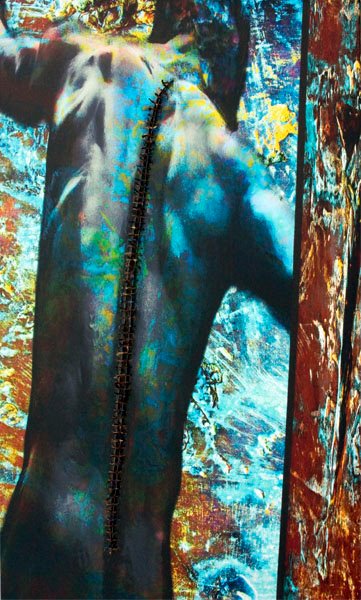
Seattle artist Paul Tonnes has a major abdominal scar from a surgery he was too young to remember to correct a condition he was too young to recall having, and yet his body reminds him. The printed canvases in his series Wounds have all been slashed and stitched together in such a way that the violence done is still visible, even palpable, but the damage is being held together in hopes of healing. The Wounds do not depict the violence – no indication is given of the source of these wounds – as much as the healing process. The palette of the pieces is bold, mottled, and reminiscent of bruising. The stitching is roughly done with twine, utilitarian knots and autopsy needles, some of which still dangle from the canvas as if to acknowledge the work left to be done; others remain worked into the canvas itself as if they are an integral part of the work.

wounds tonnes

art by Paul Tonnes

Some of the wounds seem old or even postmortem. Did the youthful immortal, sculpted of marble and sporting a Y-incision, suffer from internal injuries? Was cracking his perfect chest the only way to see them? Were they visible even then? One woman’s wounds seem to serve as points of connection to the world around her, as much as sources of pain. Her wounds seem smaller than the others, more like stings. Other wounds are still open and raw, but no blood and guts pour out of them. The openness is a void, a space for healing. Or maybe those are the cracks that Leonard Cohen recognized were present in everything because “that’s how the light gets in.”

Not all the wounds are on the figure’s person. Some are environmental, but the tension of them is felt in the musculature of the Davidic torso and the amorphous body reminiscent of Michelangelo’s Four Prisoners; the poorly sewn gash in the canvas suggests the damaged surroundings in which he’s struggling for the freedom to be fully formed. An Atlas-like figure bends under a burden with a tightly stitched seam. As the artist noted, if the stone had not been repaired, our beleaguered titan would have had half as much to carry, but someone somehow took the trouble to make the burden itself whole. Who does that?

The physicality of these ruptured canvases reminds me of the physicality of Lent. Lent is a time many of us seek to identify and break the physical habits that inhibit our spiritual lives or establish new habits that reconcile our physical and spiritual lives. Sometimes we subject ourselves to things at Lent because we want to get our heads around the harrowing reality of our sins and of Christ’s sacrificial journey to Jerusalem to put them to death in his own body. We suffer graphic and gut-wrenching depictions of the Passion and exactly what happens when a nail is driven through a human hand. We imagine ourselves suffocating. We are people with a violent and physical story. These canvases bring me back to the healing beauty of the cross and the wounds of Christ that are our wounds. Some of these wounds are fresh and raw. Some are emotional scars with stories that have shaped our stories and where we see ourselves in the story of salvation.

Tonnes offers powerful images to sit with during Lent as we consider the violence done to and around us, as we confess and repent of the violence we’ve done, as we present our wounded bodies and souls to the One who offers healing, and as we cultivate the disciplines that will help us continue to do so all year long. Any one of them could be read as a Christ figure. Any one of them could be any one of us.

Paul Tonnes is a Seattle artist working in the mixed media realms of digital manipulation, print, and encaustic. His series “Wounds” consisting of cut and stitched canvases explores the human body’s potential for healing. You can see more of his profound work at paultonnes.com