Easter Card

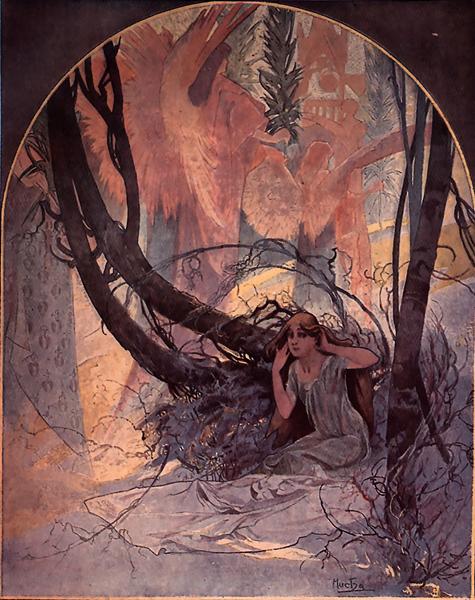
easter-chimes-awaken-nature-1896.jpg!Large Alphonse Mucha

“Easter Chimes Awaken Nature” by Alphonse Mucha

Seraphim sing in no time zone. Cherubim see

as clearly on as back, invest acacia wood with arkhood

in their certainty; their winged ornamentation

gilds the tabernacle shade. Comprehending the

compacted plan centered in every seed, the grown

plant is no more real to them, and no surprise.

Dampened by neither doubt nor supposition,

the archangel sees with eyes sharper than ours.

For him, reality’s seemingly random choice is all clear

Cause and Effect: each star of snow tells of intelligence;

each cell carries its own code; at a glance each angel

knows from whence the crests of all the wrinkles on

the sea rebound. He has eternity to tell it all,

and to rejoice.

easter-angel-1959.jpg!Large salvador dali

“Easter Angel” by Salvador Dali

But here and now in Judea, what is

this scandal of particularity? This conjunction of straw

and splendor? Of deity and agony? The echo of

sharp laughter from a crowd, as hammered nails pierce flesh,

pierces the Bright Ones with perplexity. They see

the Maker’s hands helpless against Made Wood.

The bond is sealed with God’s blood, the body buried.

In this is Love’s substance become darkness

to their light. The Third Day sweetens the mystery.

Astonished heralds now of Resurrection,

they have eternity to solve it, and to praise.


 — from “Angel Vision” by Luci Shaw
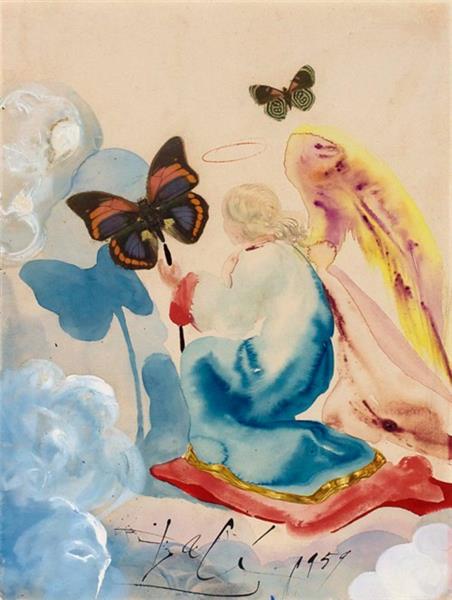
Did you know that Hallmark commissioned Salvador Dali to make a series of greeting cards? I believe this must have been one of the few images saccharin enough for such a use, and yet…. Trusting the artist enough to look deeper I see that butterfly crucified and the angel meditating on the grueling and transformative power of the cross, on death and resurrection and God and humanity revealed in one body.

Happy Easter! Christ is risen!
Lenten Calendar: Transformation

My Cocoon tightens — Colors tease —
I’m feeling for the Air —
A dim capacity for Wings
Demeans the Dress I wear —

A power of Butterfly must be —
The Aptitude to fly
Meadows of Majesty implies
And easy Sweeps of Sky —

So I must baffle at the Hint
And cipher at the Sign
And make much blunder, if at last
I take the clue divine —

–Emily Dickinson

20200309_192924897_iOS (2)

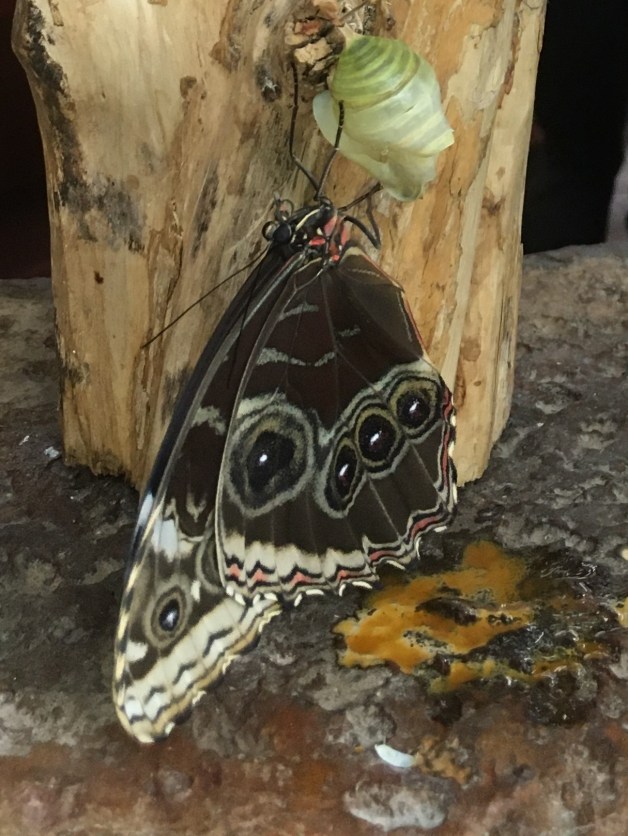
photo by Jenn Cavanaugh

We romanticize the caterpillar’s transformation, and it’s easy to do because it’s hidden. And because we relish the concept of shedding a homely, crawling, bristly self for a soaring and beautiful one, but no one wants to undergo what the caterpillar does. It’s a real death and resurrection. Essentially, it digests itself. Breaks down into goo and reforms on a cellular level before a sticky and difficult rebirth.

I’m sure I’ve learned this fact half a dozen different times, because my imagination regularly rejects it and returns to my childhood image of the insect contortionist twisting and bending, unfolding to reveal what it always was inside.

It turns out that there’s some truth to that image as well, in that there are structures within the caterpillar that it has always carried within itself that emerge intact to become the exterior qualities of the butterfly. It doesn’t break down completely, just the parts that were inherent to the larval stage break down and reform around the structures of the mature and fully realized version of itself, which entomologists call the imago. The structures are called imaginal discs. They carry a “pre-pattern” of the butterfly’s final incarnation. Entomologists, whom I’ve never properly credited as the poetic souls they obviously are, can chart a “fate map” for an imago by studying these discs.

I wonder, can we do the same for ourselves? I suspect that outside perspective helps here, but what parts of your self that have always been hidden inside you do you suspect are ready to emerge like wings? What divine clues have you been given to your ultimate design?

If transformation were really all about contortion and twisting into an unfamiliar shape, it seems like the caterpillar would seek out a wide, open space in which to do it. Instead, it creates a small, confined and private space in which to let the hard carapace that protected it dissolve, to let its wings and antennae move to the surface. In our Lenten confinement, so may it be.