Lenten Calendar: Cloistered

Does anyone else feel like this Lent has taken an extra poignancy? A great many of us are essentially cloistered, reordering our lives, hyper-aware of the collective significance of our everyday practices, and actively defining what is essential. What would it look like to embrace this worldly detachment as an opportunity for new forms of service and practicing the presence of God?

This passage has also taken on an extra poignancy lately. Good writing does that – rises to the occasion. So may we all as we wait for the Risen One.

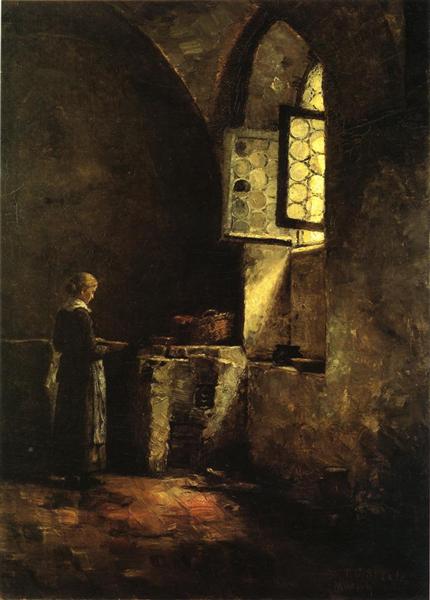
a-corner-in-the-old-kitchen-of-the-mittenheim-cloister-1883 steele

A Corner in the Old Kitchen of the Mittenheim Cloister, 1883 by T.C. Steele

This Wednesday is a long way from Ash Wednesday,
but all our Wednesdays are marked by ashes —
we begin this day with that taste of ash in our mouth:
of failed hope and broken promises,
of forgotten children and frightened women,
we ourselves are ashes to ashes, dust to dust;
we can taste our mortality as we roll the ash around on our tongues.

We are able to ponder our ashness with
some confidence, only because our every Wednesday of ashes
anticipates your Easter victory over that dry, flaky taste of death.

On this Wednesday, we submit our ashen way to you —
you Easter parade of newness.
Before the sun sets, take our Wednesday and Easter us,
Easter us to joy and energy and courage and freedom;
Easter us that we may be fearless for your truth.
Come here and Easter our Wednesday with
mercy and justice and peace and generosity.

We pray as we wait for the Risen One who comes soon.

– from Prayers for a Privileged People by Walter Brueggemann

Lenten Calendar: Ash Wednesday

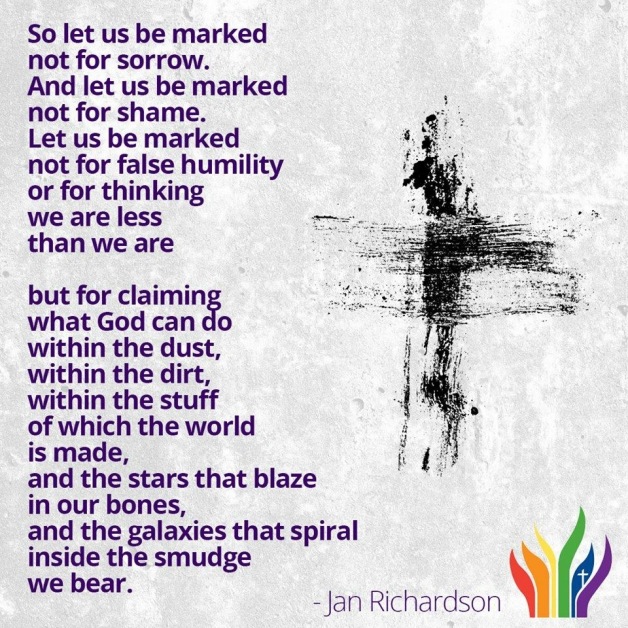
jan richardson ash wednesday

The imposition of ashes. Most of us don’t relish any kind of imposition, so what brings us out on a school night to rub dirt on each other’s foreheads? What kind of season kicks off with people lining up to be reminded of their own mortality? A rather grim one, you’d expect. But Lent turns morbidity on its head and makes it an invitation into life. Lent begins where we end, but ends with the death of death.

Ash Wednesday is an in your face, on your face, square between the eyes reminder that we’re all going to die, so let’s stop wasting life being anything less than God made us to be. Also, we’re dust, so let’s not feel any pressure to be anything more than God us to be, either. Accepting that our days are numbered teaches us to number our days and so gain a heart of wisdom. Life is precious in its finitude and we live it better when we are mindful of what we are spending it on.

Many of our modern fasts take into account that time is a limited resource. What practice would you like to build into or moderate or remove from your life to make the most of your time?


Dietrich Bonhoeffer Florilegium

Quote

“’Speak out for those who cannot speak’ – who in the church today still remembers that this is the very least the Bible asks of us in such times as these?”

– Dietrich Bonhoeffer
Letter to Erwin Sutz,
11 Sept 1934
in Works, Vol 13, 217.

Has anyone else been thinking about the Confessing Church a lot lately?

In honor of Dietrich Bonhoeffer’s birthday today, the good people at The Englewood Review of Books have collected five passages from his writings to help us reflect on what costly discipleship might look like for us in the here and now.

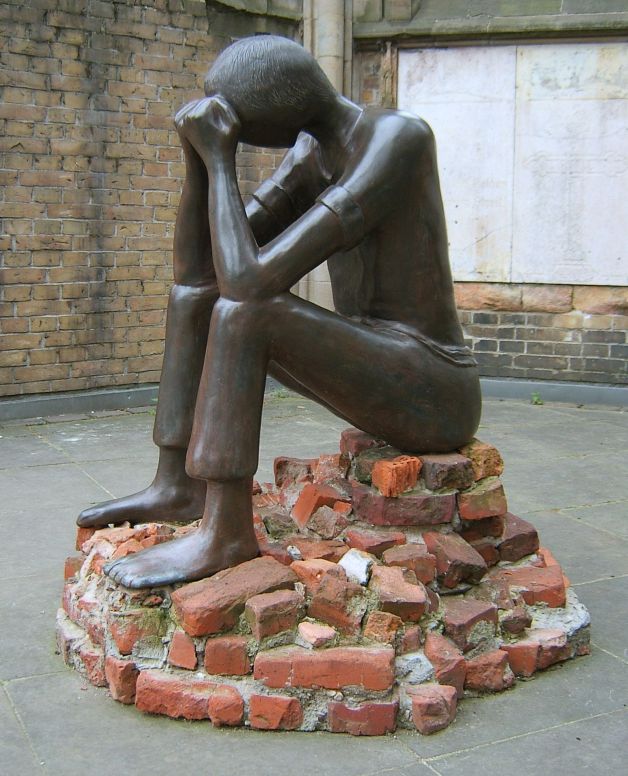
edith-breckwoldt-pruefung

Prüfung (Examination)/ The Ordeal by Edith Breckwoldt. 2004, Mahnmal St. Nikolai, Hamburg

The inscription on the other side reads

No man in the whole world

can change the truth.

One can only look for the truth,

find it and serve it.

The truth is in all places.

 Dietrich Bonhoeffer


Advent Again – day 16

On that day the deaf shall hear
    the words of a scroll,
and out of their gloom and darkness
    the eyes of the blind shall see. – Isaiah 29:18

dark-sea-dave-anderson

“Dark Sea” by Dave Anderson http://clampart.com/2012/04/dark-sea/dark-sea/

from “Song for the Last Act” by Louise Bogan

Now that I have your voice by heart, I read
In the black chords upon a dulling page
Music that is not meant for music’s cage,
Whose emblems mix with words that shake and bleed.
The staves are shuttled over with a stark
Unprinted silence. In a double dream
I must spell out the storm, the running stream.
The beat’s too swift. The notes shift in the dark.

Now that I have your voice by heart, I read.

Now that I have your heart by heart, I see
The wharves with their great ships and architraves;
The rigging and the cargo and the slaves
On a strange beach under a broken sky.
O not departure, but a voyage done!
The bales stand on the stone; the anchor weeps
Its red rust downward, and the long vine creeps
Beside the salt herb, in the lengthening sun.

Now that I have your heart by heart, I see.

Open Mics, Open Doors: Cultivating Culture and Relationships

“All culture making requires a choice, conscious or unconscious, to take our place in a cultural tradition. We cannot make culture without culture. And this means that creation begins with cultivation – taking care of the good things that culture has already handed on to us. The first responsibility of culture makers is not to make something new but to become fluent in the cultural tradition to which we are responsible. Before we can be culture makers, we must be culture keepers.”[1]

When we start talking about the church acting as a community center or a cultural center, people get understandably nervous. The local church should be much more than a community or cultural center, and those models should not constrain a church’s mission, and yet it must act in those capacities if it is to be both local and the church.

Your neighborhood may be different, but mine has some serious trust issues with “church” in the abstract. Organized Christianity has earned a reputation for bait and switch. Free meals! But I have to listen to someone yell at me about death and hell before I can eat? Welcoming community! Until my work schedule changes and no one notices I’m gone. (Or worse, they do, and hound me to come when I can’t.) Hip music! Followed by half an hour of trying to work through which two-thousand-year-old cultural mores still apply to women. Christians rationalize these kinds of disconnections on a regular basis, but we need to hear these disjointed messages as our visitors do. These scenarios come off as false advertising at best and intentional deceit at worst.

Why are there so many strings attached to the things we do in Jesus’s name? It communicates that we see the gospel as such a tough sell we have to lure people into the salesroom with a gimmick. In the words of R.E.M. “What if we give it away?”[2] What if we fed people simply because Jesus himself invites us to and tells us he’ll be on the receiving end of anything we give? What if we applied our shrewd-stewardly stratagems toward working out how to make the most of our resources to care for others more comprehensively, not how to get more out of them in return? To the degree that our churches have tried to sell and barter the words of life entrusted to us freely, we must own responsibility for the numbers of people who have chosen not to buy in to the churched life.

"Shelter?" by Heidi Estey. This was our poster monster for an outdoor group show in which almost all the pieces were eventually "taken in" by passersby - part of why we now put together our outdoor shows with in-house artists aware of such eventualities.

“Shelter?” by Heidi Estey. This was our poster monster for an outdoor group show in which almost all the pieces were eventually “taken in” by passersby – part of why we now put together our outdoor shows with in-house artists aware of such eventualities.

Considering ourselves, our traditions and our assets to be cultural and community resources would correct our attitudes substantially. A church, building and people, should be a blessing to its parish. The whole Judeo-Christian story we find in scripture is about God forming a people set apart to be agents of blessing to the rest of the world. To be chosen does not mean that we are in with God and the others are out; it means we are the ones called to invite the others in. This has nothing to do with imposing our lifestyle on others and pressuring them to conform to an enlightened Christian culture so they can know God like we do. It has to do with welcoming them in a way that communicates God’s desire to be known by them, creating buffer zones in which to hear that quiet voice, and making room amongst us for those who choose to follow it.

Few of us had any say in the physical design of our meeting places, but the onus is now on us to make them convey welcome. Our church is by far the churchiest looking church I have ever been a part of. Those of us moving in after years of worship in a movie theater and an office building suffered some serious culture shock. It’s an extremely staid and solid red brick and stained glass affair. Approaching from the front all you see are concrete stairs leading to three massive sets of wooden double doors. The view most often seen from the street is of these six immense and eminently closed doors. It’s imposing. I’ve been going to church all my life and I can hear these doors slamming shut just looking at them. The transformation when those doors are all flung open is supernatural, especially at night with warm light and music and voices pouring out onto an otherwise dark street. Suddenly it’s inviting. All the connotations of sanctuary make sense again. Strangers pop in just to say how happy they are to see the doors open.

The openness of our doors has become hugely symbolic for me. The unfortunate reality is that the cavernous open space behind those doors is an absolute bear to heat. In July and August it’s a relief to have the doors open, but almost any other time of year it’s a sacrifice. If you come to worship with us in February you will find one of the six doors propped not quite half open. If you’re fifteen minutes late the only thing holding that door open will be a tripped one-inch-wide deadbolt. We have bass and drums and lots of porous windows so if you walk by you know something’s going on, but it’s hidden behind essentially closed doors. Suffice it to say, I think any excuse to open those doors that’s not antithetical to the gospel is a good excuse. If it’s an activity that blesses our neighbors, meets needs in the community, or helps us fulfill our commission as cultivators of creation and creators of culture, so much the better.

Cultivating culture is different than conserving culture. Whether or not we avail ourselves of them, the Church on the whole has done a fine job of conserving its cultural goods: the writings of the first bishops, medieval mystics and the Scholastics; the stories of Asian martyrs; the paintings and sculptures of Michelangelo and treasured Orthodox icons; the chants heard morning and evening for centuries throughout Europe. If we only conserve culture, though, the Church will function merely as a museum. The Church is a unique institution called both to conserve and create, and as such, must be continuously reinventing the priestly ministry of representing humankind to God and God to humanity while consciously maintaining a tradition that runs back through the apostles and the patriarchs to our creation in the image of the Creator and Ruler of all. We who have historically been at the forefront of movements to recreate and reorder society have abdicated our responsibilities. Neither conservatives who commit to structures simply because they exist nor radicals who reject the very idea of structure that makes creative life sustainable are embodying the image of God or serving as Christ called us.

As cultivators we watch for the new growth peeping up from the earth around us, determine whether it’s the genuine article or a choking weed, and nurture the good growing things around us. We look for the plants in need of particular care, especially those good for food or medicine, and tend to their specific needs. As a Christian and as a poet, when I look around, one area of the garden that I see failing to thrive that I would like to help maintain for my culture is the thoughtful use of words. Dana Gioia wrote a fabulous essay called “Can Poetry Matter” in which he talks about the decay of language and discourse and offers six concrete suggestions for bringing poetry back into our public lives as a corrective to this decay.

I borrowed three of his ideas and distilled them into one event that answers our corporate call to be cultivators of what’s beneficial to our society and serves as yet another reason to have the doors open. Due to an ongoing failure of imagination, we called it a no-mic open-mic community reading, although Literary Potluck might stick eventually. We would call it a read-in, but that makes it sounds like we’re protesting something. Like an open mic, people can sign up ahead of time to read. Based on one of Gioia’s suggestions and our congregational ratio of significantly more readers to writers, we invite people to read either their own work or something they’ve read recently that they would like more people to hear. Open mic audiences tend to consist of writers there to read and close friends of writers there to read. They don’t draw a wide audience and the tenor of the events generally vibrates between ego and nerves. With this format anyone can participate and we all hear a lot of great writing. We also tone down the pressure to perform by removing the actual microphone from the scene. The first time we planned one of these we were a small enough group we could sit in a circle at the back of the church. The next time we set up a small table in the aisle in front of the last few pews. A microphone was not necessary to be heard.

As we held the events on Arts Walk nights we made sure people had easy access so they could sit or stand and listen a while and feel free to leave. Readers have ten-minute slots, but we ask them to keep individual readings to five minutes or less, so there are plenty of opportunities and to slip in and out without walking out on a reading. The Arts Walk is three hours long, so we took frequent breaks for coffee, tea and snacks people from the church brought to share and just to talk, catch up with other and meet anyone who came in during the reading.

[1] Andy Crouch, Culture Making: Recovering Our Creative Calling (Downers Grove, Ill.: InterVarsity Press, 2008), 74-75.

[2] Mike Mills, William Berry, Peter Buck and Michael Stipe, “What If We Give It Away?” Life’s Rich Pageant (I.R.S., 1986). From the first verse and chorus:

On the outside underneath the wall

All the money couldn’t buy

You’re mistaken no one’s standing there

For the record no one tried

Oh I try to…

What if we give it away?

For years this chorus would begin to play spontaneously and, as it turns out, prophetically in my head as a response to that hard sell mentality. Our first outdoor gallery initially felt like a bust. It was the only time we issued a call for submissions and got nothing of artistic merit from the outside world. It was raining so hard we almost cancelled the show because it was so miserable to install. Then a friend of one of our artists showed up with a couple of nice pieces. It lightened to a typical Seattle drizzle by the time the Arts Walk started and we had a good time hanging out on the sidewalk with our umbrellas and loaning them out so people could peruse our quirky little installation called Shelter. Half the pieces disappeared over the weekend. An editor of a local arts magazine happened on it during that time and mentioned to a mutual friend that he was debating whether or not to take a piece home as well, and an important conversation about public art, gift culture, and the church ensued. My friend referenced that same line (“What if we give it away?”) when he emailed me to say it sounded like the church was doing something right.

The Creative Local Church

Our ministry began by including the arts in existing programs—from mission to worship to education. The results were remarkable, for we found that the arts touched us in all aspects of our community life: they engaged our senses, helped us build relationships among ourselves, and helped us respond to wider community needs; they expanded our theological vision, stirred our imaginations, and brought us to places where we experienced God in moving and profound ways.

       – Alice Z. Anderman “On the Cusp of a Great Adventure: One Church’s Ministry with the Arts.” ARTS 19:1

Now that we’re the better of part of a year into this blog, maybe it’s time some introductions of the bigger ideas motivating it were made. Homespun seeks to provide resources for the creative life of the local church. The idea that your local church requires a creative life may be a no-brainer or an entirely new concept for you. It may conjure up a precise image of what that could look like for your church or leave you feeling lost in abstraction. This blog is for people in the church who have an idea whose time has come and are looking for creative ways to live it into reality. It is for those who believe (or are willing to be subtly persuaded) that our churches should, by their very nature, foster creativity and beauty and who want some resources and ideas for getting started or going deeper. More fundamentally, it is for those who, in whatever capacity, feel called to help the church be the church and sense that this will require new ways of being and doing to bubble up amongst us.

Many posts on this blog will touch on the arts and worship because these are fundamental to creativity and church life, but the church’s creativity is neither tied to nor limited to “using the arts in worship.” In fact, I personally avoid the phrase, because I think that “using” the arts defeats their purpose. Artistic goods can be offered in worship by their creators, reflecting on art may assist us in presenting our whole selves before God, but “using the arts” sounds like appropriating something abstract out of context for our own ends. If you have ever been in a worship service where someone tried to use an artful good to do something it was never intended to do, then you know what I mean. Both true art and true worship resist this kind of hijacking and misuse. They work on us as we submit ourselves voluntarily to the other/ Other; they do not work for us on others. Semantics, some might say, but how we talk about what we are doing is indicative of the spirit of what we are doing. I understand the temptation to defend the inclusion and importance of the creative arts in the church by virtue of their utility, but the real reason we need the creative arts in the church is because of their power over us rather than our power over them.

Church by Hense

When creativity and artistic expression infuse the whole life of the church, not just worship, they move us toward wholeness and a holistic faith. I’ve avoided breaking down worship, spiritual formation, witness, and ministry into separate sections on separate topics on this blog, because I believe they’re not meant to be separated. Who can define the exact point where discipleship becomes Christian service? We strive to focus on God rather than ourselves in worship, and yet conversion and sanctification and all kinds of other terms we use for human transformation are natural consequences of our worship experiences. Our most mundane and non-musical ministries are tinged with worship if they’re done to the glory of God. Non-verbal actions carried out in Jesus’ name may be more evangelistic than preachments and crusades. The bane of the church’s institutional existence is that the more our activities precursor the realm of heaven, the less they’ll fit into tidy categories. They will grow like the kingdom to become more rangy and more overarching, defying definitions and requiring parables to describe. Order is by no means the enemy of originality, but isn’t it interesting that we tend to organize ourselves by dividing ourselves up when God’s hope seems to be bringing us all together? Creativity consists essentially of making new connections. Artistic expression necessarily involves mindful and heartfelt communication. Imagine a church known for the beauty of its internal and external connections and communication! Artists and their art instinctively work to dissolve false divisions which impede the coherent and creative life of the church and its members. Works of art, music, poetry, fiction and film all refuse to speak to us on only one level. They don’t work on just the emotional, rational, or spiritual side of us. We all wear many hats, but art doesn’t speak to us as roles, titles, or labels – only as complex persons. If you approach a piece of music and say “I would like to understand you… as a facilities administrator” or “…as an addict,” it will elude you until you take off all your funny hats and listen as a human being.

Creativity is not only about making art, not is it the sole purview of the practicing artist. As creatures created in the image of the Creator, we all have creative capacities, and we are not designed to function without them. Artists and artisans help the congregation by valuing and modeling the creative life, but they can’t do all the creative work of the church for us. For the church to be the church as Christ intended will require us all to walk in newness of life. Worship curator Mark Pierson describes creativity as a product of the tension between reality and desire, of dissatisfaction with what we see in light of a higher vision. I believe God does the best work on us in that tension and that we all need it to be a regular part of our lives, both individually and corporately, to fulfill our calling as the body of Christ. As we develop our creative faculties together we encourage and equip one another to respond faithfully to the realities around us with imagination rather than pretending that they fit into ideologies too rigid to accommodate them. Both the local church and the Church universal will be marked by creativity as they are empowered by God’s Spirit to act as the body of the One who is making all things new.

The Apostle’s Creed proclaims that the Church is one, holy, catholic and apostolic. That means God’s people are united in Christ (whether we acknowledge it or not), set apart for God’s purposes (whether we live into them or not), ultimately to be found in all times and cultures (i.e., “catholic,” whether Roman Catholic or not), and part of a tradition (whether we like it or not). Just as we are called individually to be members of a local body, all these local bodies are called to be members of the larger Body of Christ. As we discern and pursue our own callings within our local churches, our churches grow faithfully into their particular creative roles to do their part to help the Church body function properly as Christ’s representative throughout the whole world.

I believe to fulfill its task within the larger mission of God, each church needs freedom to embrace a unique corporate personality. This doesn’t mean forcing people into a hipper or holier-than-thou persona. It means pursuing ministry based on the gifts of all of those who have aligned themselves with our congregations. It assumes everyone in our midst is called to be a minister, but makes fewer assumptions about what ministry needs to look like to be called such. It doesn’t mean targeting your outreach and message to a narrow demographic and further dividing the Church along lines of race, gender, political leanings, age and income. It means you discern who you are as a congregation and what you’re to be about in fleshing out the realm of heaven together for your parishioners – the ones that attend your church and the ones who don’t. It means my church’s worship band has drum solos, yours has a clarinet and viola, our friend’s is alternating Youth Sunday with Old Fogey Sunday so they learn their hymns and give the organ a monthly workout, and another congregation is going a cappella for Lent. We can count on the Spirit working in and through any given church in common and disparate ways from the church down the street. Christ bids all incarnations of the Church to extend hospitality to all comers and make room for everyone who responds to what the Spirit is doing in our midst, but each of our churches will have different strangers to welcome in unique ways based on our resources and cultures. Our resultant personalities must be evolving and inclusive rather than exclusive and set in stone. The creative life is both constructive and playful. When we pursue it together we come to know one another more truly as we were created to be. Weaving creative practices into our common lives helps us know who we are together, equips us to regularly reimagine our communities for the sake of others, and keeps us all growing in and toward faith.


A Missional Ministerial Gifts Assessment

based on Creating a Missional Culture: Equipping the Church for the Sake of the World

by JR Woodward

(Completely Unauthorized

and Hopelessly Slanted by Yours Truly So Just Figure Anything You Don’t Like is My Bad )

1———————2———————3————————-4———————5

Never             Rarely              Sometimes                Usually                Always

Using the scale above, write your answers to these questions on the lines provided at the end.

1. I am a big-picture person

2. I am sensitive to the Holy Spirit

3. My heart breaks for those who don’t know Jesus

4. I think we need to focus more on the spiritual healing and formation of the congregation

5. When I read the Bible I expect to gain fresh insight

6. I can get wrapped up in projects and achievement at the expense of my relationships with God and others

7. My heart breaks for the poor and oppressed

8. I think the church should be more outwardly focused

9. I am a peacemaker

10. I prioritize my own learning

11. The church is the best place for people to actively discern and from which to pursue their purposes in life

12. I may come across as inconsiderate or inflexible

13. I consider my job a vocation and an opportunity to be a good witness

14. I look for ways to move our church toward being a family

15. The more knowledgeable we are of Scripture and how to apply it, the more faithful we will be

16. When I invite people to try something new they at least consider it

17. I tend to include the outsiders

18. I err on the side of going along with my cultural context rather than critiquing it

19. My heart breaks for those who have deep emotional wounds and I want to help them move forward

20. I am good at explaining things clearly

21. I bring people together to turn ideas into reality

22. I believe in the power of the Spirit and spiritual practices and I want others to as well

23. I’m a good storyteller

24. When someone I care about is hurting I cannot view the situation objectively

25. I get frustrated when people don’t use the sense God gave them

26. I have a profound sense of being part of God’s mission in the world

27. People are better off facing reality head-on, without illusions

28. I try to preach the gospel at all times and, if necessary, use words

29. I create opportunities for people to play together

30. I can content myself with having the right answer on an issue or question without acting on it

31. I am realistic in starting new ventures, but I don’t particularly fear failure

32. I get involved in justice issues and invite others to do so as well

33. I see opportunities for the church to live into and express the kingdom in ways specific to our context

34. I instinctively grieve with those who grieve and rejoice with those who rejoice

35. The church’s highest priorities should be the study of the Word and fruitful theological discussion

1———————2———————3————————-4———————5

Never             Rarely              Sometimes                Usually                Always

1.  ______           2.  ______           3.  ______           4.  ______           5.  ______

6.  ______           7.  ______           8.  ______           9.  ______           10.  _____

11. _____            12. _____            13. _____            14. _____            15. _____

16. _____            17. _____            18. _____            19. _____            20. _____

21. _____            22. _____            23. _____            24. _____            25. _____

26. _____            27. _____            28. _____            29. _____            30. _____

31. _____            32. _____            33. _____            34. _____            35. _____

Add up the columns here (higher numbers indicate greater relative strength):

__________         __________         __________         __________         __________

Apostle                   Prophet             Evangelist               Pastor                   Teacher

Hooray, I’m gifted, now what?

Employ your unique combination of gifts to increase the unity, maturity and ministry of the church (Ephesians 4). This sounds simple until you try it. God is asking us to use the ways in which we fundamentally diverge in our mental, emotional, and stylistic approaches to ministry to minister together. Each gift comes with its own biblical slants on humanity, the church, the faith and the world. The key here is to recognize and value the gifts and accompanying assumptions of others even though you will find them occasionally incomprehensible. The degree to which they mystify you is the degree to which you need someone else there representing them. They help make whole the mission of God. Maturity comes when these closely held and thoroughly biblical definitions and assumptions rub off on each other to expand our understanding of God and Christ-likeness. Unity comes of remembering throughout the process that we all claim Christ as Lord and are accepted by Him.

It also helps not to let these roles we’re called on to play define your identity overmuch – you are first and foremost a child of God. They are words to help us articulate our God-given strengths in blessing others. It does not constitute an excuse for self-importance or an exemption to caring for others in ways that don’t come as naturally to us. You’ll notice this list of gifts indicates less what exactly you should do in the church than how you’ll likely go about it. Nothing here dictates that you be or not be a preacher, an elder, a deacon, a Sunday school superintendent, a member of the outreach team or a worship leader.  An apostolically gifted arts pastor will have a different m.o. than one gifted in teaching, and so on.

Um, am I supposed to know what an apostle does?

Read back through the relevant questions to get a rough, composite sketch of each kind of “equipper,” as Woodward calls them. Even better, read his book. Or leave a comment and we can talk. I’d welcome any feedback or results. Was anyone else surprised by being more “evangelistic” (or “prophetic” or “apostolic,” etc.) than you thought of yourself as? If so, does that seem to be a symptom of my utter lack of training in assessment preparation, an indicator of some different assumptions about how these gifts operate in a missional church, or a sign that another leader is rubbing off on you?

Don’t take this the wrong way, but you might be [gasp!] an evangelist

I’ve been taking copious notes lately from JR Woodward’s Creating a Missional Culture: Equipping the Church for the Sake of the World, about half of which focuses on how the five kinds of leaders listed in Ephesians 4 (apostles, prophets, evangelists, pastors & teachers) can work uniquely and in unity in a church wanting to be the church for others. I’ve read about these ministerial gifts before and taken probably half-a-dozen of the dozens of self-assessments available to tell you where your gifts lie. If you’ve grown up in the Protestant church, I’m guessing you have, too. (If you haven’t then cast your mind back to your teen magazine years and those quizzes that helped you determine what bubblegum flavor you were. These assessments are a lot like those except these tell you how the Spirit of the Sovereign Lord is raising you up “to equip the saints for the work of ministry, for building up the body of Christ, until all of us come to the unity of the faith and of the knowledge of the Son of God, to maturity, to the measure of the full stature of Christ.” Very similar, yes? ) I ended up writing my own self-assessment quiz based on Woodward’s book, which I’ll post in a few days. I don’t generally accord gifts and personality assessments too much weight, especially not ones I’ve written myself, but they are good team-building conversation starters for church leaders. Particularly if you’ve already analyzed your respective bubblegum flavors to death. It was also a useful exercise in examining the slight to significant differences between how I heard these gifts described growing up and how Woodward saw these gifts operating in the context of a church committed to being church for the world. He doesn’t spend time calling out all the abuses that can happen when these gifts are assumed as mantles and titles, but he offers quiet correctives to them all the same.

The definition that seemed most altered when viewed through a missional lens was that of the evangelist. It would have had to have been a big difference for me to notice, because I would tend to gloss over that section. Based on my scores on other gifts assessments I have come to self-identify very strongly as not-an-evangelist. At times that has bothered or mystified me – I’m sociable. I care about people. I’m not ashamed of following Jesus. I believe in putting words to our faith. I want the world to know that God loves the world. While I think of my primary calling as helping the church be the church, I consider demonstrating and articulating this faith to our larger communities in credible ways to be one of the signs of the church being the church. So why wouldn’t this register on the tests?

Reading Woodward’s description of an evangelist I realized how many other descriptions I’d read that were based on narrow and rather stilted models of sharing the good news. Of course the accompanying lines of questioning used to identify the evangelists among us reflected those models as well, e.g. Would you rather hand out tracts on a street corner or prepare a Bible study? On a scale of 1-10 how willing are you to tell your friends they’re going to hell? Does at least one of your everyday accessories double as a device for sharing the gospel in five minutes or less? Do you cold-call people for a living and hate going home at the end of the day? Yes, I’m dangling a couple of toes over the deep end here, but our images of evangelism have been indelibly colored by evangelical notions of “witnessing” that differ both from simply being a witness and from what an evangelist, in the Ephesians 4 context of church leadership, would be concerned with – the witness of the church as a whole and serving as a messenger/ ambassador between the church and the rest of the world.

Assumptions that verbal assent constitutes faith and that commitment to following Christ bears no relation to our human relationships also taint our assumptions of what evangelism and evangelists look like. These assumptions actually screen out those with the gifts necessary to tell the story of God convincingly to a skeptical public and to draw people toward the community of faith. Our shift toward thinking that evangelism involves demanding an answer from the unprepared discourages those the Spirit keeps preternaturally prepared to give an answer for the hope within them from thinking of themselves as evangelists.

The true evangelists among us would be the folks who have the best handle on the gospel as good news rather than those who consider it a tough sell. According to many assessments, if you can move product and close deals you may be an evangelist, but they shunt away others who can best give the gospel away. If you think of salvation in terms larger than individual souls, you’re an apostle. If your commitment to truth leads you beyond warning sinners about judgment to calling the systems of the world and the church to justice, you’re a prophet. If you’re equipped to care for other people relationally, you’re a pastor. If you want others to recognize the heights and depths, and not just the breadth of God’s love, you’re a teacher. This tends to leave those whose faith is unusually exuberant and simple and – not always, but often – still immature, uninformed, or unexamined to communicate the gospel to the world. Yeah, how’s that workin’ out for us?

By equating one’s willingness to offer a shallow salvation through artificial methods with the spiritual gift of evangelism, we unwittingly anoint as evangelists the garrulous, who prefer being right to having right relationships and for whom the propositional truths of Christianity assure them a winning argument every time; the gregarious who can turn anything into small talk, including the staggering news that God died for you; the spiritually anxious who bear their responsibilities for the fates of others’ souls with potentially crippling fear and trembling; and the socially anxious for whom conversations with strangers never get easier, so they might as well turn them toward something important like accepting Jesus as your Lord and Savior in the hopes that some greater good will come of them. The church, thank God, has very few evangelists by this measure. But we do have the real deal. We’ve been promised them. We’re not able to do the work of the church without them. Who knows, but you might be one of them – even and especially if the thought of knocking on a stranger’s door to show them your corny beaded bracelet makes you physically ill.

If you’d like to find out, I’ll post the assessment I drafted up based on Woodward’s descriptions in a couple of days – let’s say Saturday. I wouldn’t want to be responsible for you getting all prophetic on your co-workers at the end of a long week.

Brennan Manning on Grace and the Importance of Telling the Whole Story

Brennan Manning on Grace and the Importance of Telling the Whole Story

Brennan Manning on Grace and the Importance of Telling the Whole Story

“…Grace calls out, ‘You are not just a disillusioned old man who may die soon, a middle-aged woman stuck in a job and desperately wanting to get out, a young person feeling the fire in the belly begin to grow cold. You may be insecure, inadequate, mistaken or potbellied. Death, panic, depression, and disillusionment may be near you. But you are not just that. You are accepted.’ Never confuse your perception of yourself with the mystery that you really are accepted.”  [The Ragamuffin Gospel]

“The greatest single cause of atheism in the world today is Christians: who acknowledge Jesus with their lips, walk out the door, and deny Him by their lifestyle. That is what an unbelieving world simply finds unbelievable.” [intro track to War of Ages album Fire from the Tomb]

“In a futile attempt to erase our past, we deprive the community of our healing gift.  If we conceal our wounds out of fear and shame, our inner darkness can neither be illuminated nor become a light for others.” [Abba’s Child]

“When I get honest, I admit I am a bundle of paradoxes. I believe and I doubt, I hope and get discouraged, I love and I hate, I feel bad about feeling good, I feel guilty about not feeling guilty. I am trusting and suspicious. I am honest and I still play games. Aristotle said I am a rational animal; I say I am an angel with an incredible capacity for beer.
To live by grace means to acknowledge my whole life story, the light side and the dark. In admitting my shadow side I learn who I am and what God’s grace means. As Thomas Merton put it, ‘A saint is not someone who is good but who experiences the goodness of God.’
The gospel of grace nullifies our adulation of televangelists, charismatic superstars, and local church heroes. It obliterates the two-class citizenship theory operative in many American churches. For grace proclaims the awesome truth that all is gift.” [The Ragamuffin Gospel]

“All is Grace” [memoir title]

– Brennan Manning (April 27, 1934 – April 12, 2013)