Christmas Again

“the Word became flesh and lived among us” – John 1:14 (NRSV)


“Winter landscape, with rocks” by Sylvia Plath


Water in the millrace, through a sluice of stone,

plunges headlong into that black pond

where, absurd and out-of-season, a single swan

floats chaste as snow, taunting the clouded mind

which hungers to haul the white reflection down.

monetsoleilcouchantalavacourt_0

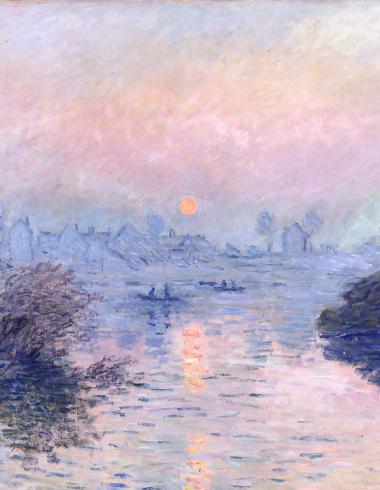
“Soleil couchant sur la Seine à Lavacourt, effet d’hiver” by Claude Monet


The austere sun descends above the fen,

an orange cyclops-eye, scorning to look

longer on this landscape of chagrin;

feathered dark in thought, I stalk like a rook,

brooding as the winter night comes on.


Last summer’s reeds are all engraved in ice

as is your image in my eye; dry frost

glazes the window of my hurt; what solace

can be struck from rock to make heart’s waste

grow green again? Who’d walk in this bleak place?

The Second Day of Christmas: Old, Familiar Carols

I’m spending Christmas in Marseille this year with friends who have made a cozy home here for their family and anyone else in need of one for the season. Eleven stockings were hung by the old French fireplace and we had so many amazing meals in the last couple of days I’m not sure which one was supposed to be “the holiday meal.” Every time I walk into the kitchen someone is frying up lardons and the collections of bottles and candy wrappers hand-carried here from around the globe have mysteriously multiplied. At a civilized 9 o’clock or so this morning-after our host is putting on the coffee before he runs to pick up some fresh croissants for breakfast. The kids are wrapping the dining table in the festive scraps of paper from yesterday in preparation for an elaborate, cooperative painting project received as a gift yesterday

Besides the food and the company and the respite of not having to do anything urgently for the first time in almost five months of transitioning to a new country, I will remember this about this Christmas: I heard the bells on Christmas Day. At odd times, for ten minutes at a time, then again in half an hour, playing no discernible carol, but wild – uproarious, even. Untamed bells tumbling joyous proclamation into the windy streets. The only people out were attempting their business as usual – joggers on the promenade dodging the spray of the normally calm Mediterranean; Muslim men making a point of spending the day off smoking at the café like any other day; older folk navigating an unfamiliar pharmacie de garde to treat their old, familiar ailments; tourists at Notre Dame ignoring the holiday in acts of devotion to their travel agendas.

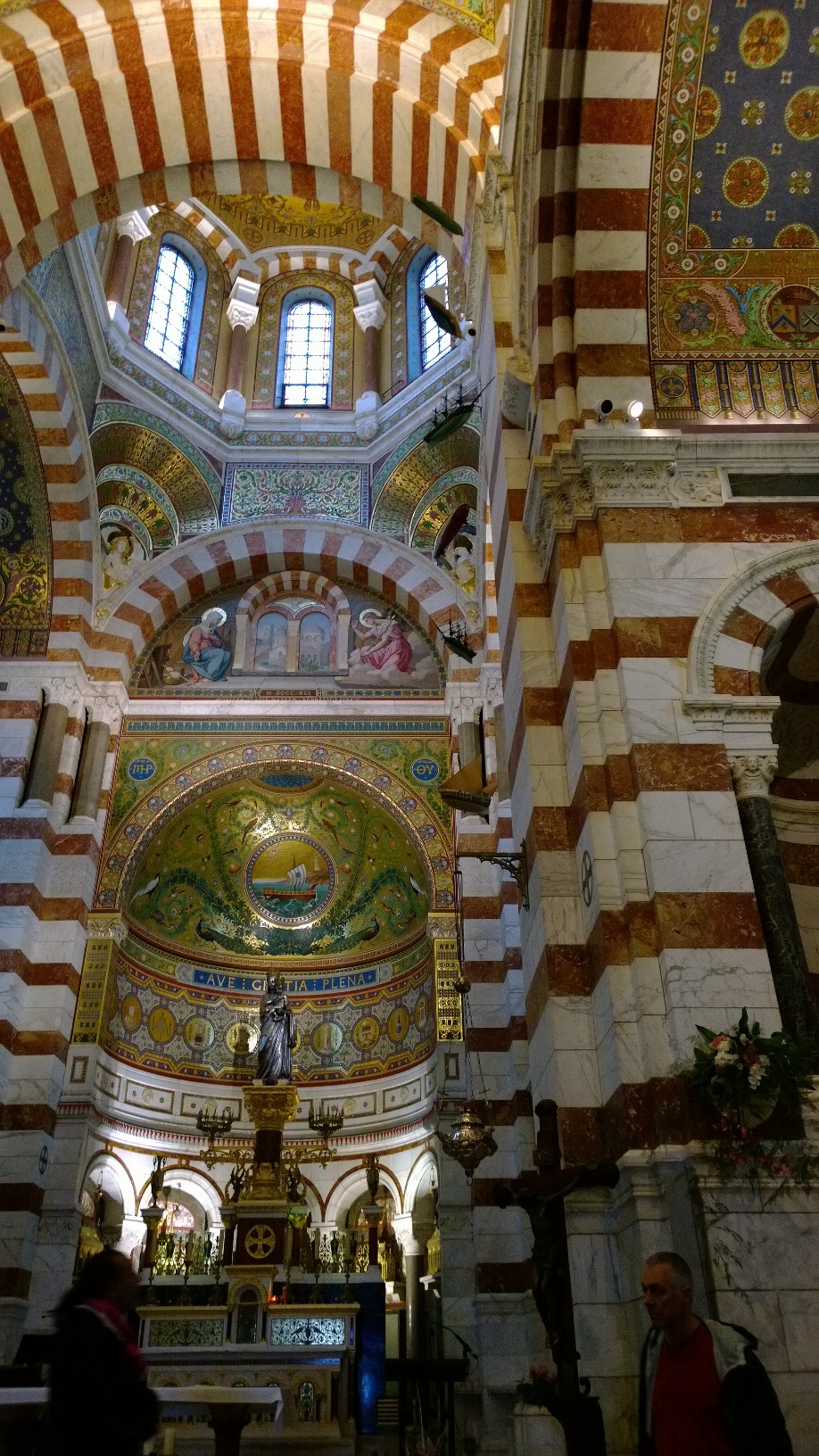
Notre Dame de la Garde, Marseille

Notre Dame de la Garde, Marseille

While parts of the church have rediscovered Advent, reclaiming this season of anticipation in the midst of our culture’s frenzy of consumption, for most of us Christmas begins and ends with a flurry of paper, and when the presents are done, it’s over, back to business as usual. This year I’m thinking more about Christmas as a season, the twelve days that began yesterday and end in Epiphany. I’m new to this, so I sincerely hope this won’t be last my last and final reckoning with the significance of the Christmas season, but today it strikes me that it’s about living prophetically into the world’s business as usual.
Longfellow’s poem “Christmas Bells” acknowledges the phenomenon of celebrating a day that changed history, that forever altered the topography of the spiritual playing fields of reality, and finding nothing changed. It’s the same old songs of peace, love and joy sung by people who remain as contentious, difficult and miserable as ever. We sing carols of this miraculous event that revealed God to and with us in ways hardly imagined before and we look forward to doing it again next year. That’s what the church calendar does – takes mind-blowing unique births, deaths, resurrections and revelations and works them into the rhythm of our lives to be remembered, observed, and re-lived again and again. And so Christmas is the season of going back to the fields rejoicing with angelsong still ringing in our ears, knowing that unto us a son and savior has been given. Christmas is the time of pondering in our hearts what all these promises that have come true mean, because there he lies, the Lord of all, bound in rags, and he needs to be fed and changed again. We have come to worship, found it all to be just as it was said, and now it is time to return home another way, knowing what we know now about the dark politics of the place of his birth, maybe never hearing news of the place again. We make our way back to real life listening to those louder, deeper bells ringing that “God is not dead, nor doth he sleep.”

“Christmas Bells” by Henry Wadsworth Longfellow

I heard the bells on Christmas Day
Their old familiar carols play,
And wild and sweet
The words repeat
Of peace on earth, good-will to men!

And thought how, as the day had come,
The belfries of all Christendom
Had rolled along
The unbroken song
Of peace on earth, good-will to men!

Till, ringing, singing on its way,
The world revolved from night to day,
A voice, a chime
A chant sublime
Of peace on earth, good-will to men!

Then from each black accursed mouth
The cannon thundered in the South,
And with the sound
The carols drowned
Of peace on earth, good-will to men!

It was as if an earthquake rent
The hearth-stones of a continent,
And made forlorn
The households born
Of peace on earth, good-will to men!

And in despair I bowed my head;
“There is no peace on earth,” I said;
“For hate is strong,
And mocks the song
Of peace on earth, good-will to men!”

Then pealed the bells more loud and deep:
“God is not dead; nor doth he sleep!
The Wrong shall fail,
The Right prevail,
With peace on earth, good-will to men!”

Holy Days are Here Again: Christmas Edition

 “In recent years the church itself has become the target of a good deal of criticism and, for many, has simply been dismissed as a meaningful player in contemporary culture. And yet, all the while, as we have seen, there is an increasingly urgent desire for images that capture something of the depth and beauty of life, for practices that can structure one’s life and spark affection. Religion has always been the custodian of such symbols, and they were the center of the church’s life from the beginning. Yet the sad fact is that few people turn to the church for such symbols today.”[1]

Dietrich Bonhoeffer famously claimed that “the church is only the church when it exists for others.”[2] That means the things we do in and as a church are deeply motivated by the people outside of the church. This kind of talk sometimes devolves into a sense that we should warp all the things we do in support of our own spiritual walks and lives to accommodate a random, idealized person who is not yet interesting in living a Christian life. That’s the sort of thing that ends in worship services where we don’t talk about Jesus for fear of alienating someone not in the room. That is not what it means to be the church for others.

In order to be the church for others we must first be the Church. There must be something going on in our midst for the seeker to find. It is both considerate and constructive to consider often what others interested but uninitiated in our language and practices would take away from observing them. Do they extend the welcome of Christ? The Church talking about how best to minister to people where they’re at is one of the most Christ-like things we could be doing. The conversation about whether we do certain things or talk amongst ourselves in certain ways because they’re “churchy” or because they’re significant to us and to living out our faith should be ongoing. The best way to be sensitive to people who have not completely bought into our community’s vision of God, however, is not to make it blander and presumably more palatable, but rather to offer sacrificial hospitality, complete translucence, and the richest of fare to the best of our abilities.[3] People don’t go on spiritual quests looking for superficiality, but depth. It’s worth discussing what might make people think to include our church on their quest and what offputtingly shallow practices, attitudes, and lingo they might encounter here if they do.

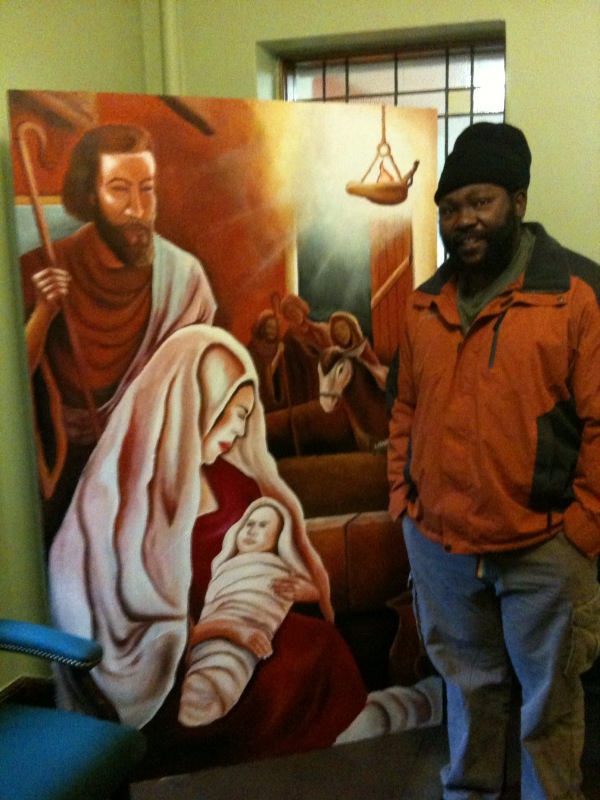
Bigga Gonzalez with the mural he painted during worship for Advent 2010. Each week the sermon and music focused on a different character in the Christmas story and so did the painting. Photograph by Jenn Cavanaugh.

Bigga Gonzalez with the mural he painted during worship for Advent 2010. Each week the sermon and music focused on a different character in the Christmas story and so did the painting. Photograph by Jenn Cavanaugh.

We often talk like we expect people to just wander in off the street in search of a place to encounter God. Remarkably, that does happen almost every time we open our doors, but it’s more of a symptom of desperate spiritual starvation than an indicator that they’re ready to throw in their lot with us on this journey. Consider the kind of confidence and trust we’re asking of people: to lose themselves in the worship of God in the company of strangers. Perhaps some word-of-mouth or outward sign will mark it as a place that is safe and trustworthy enough to enter, but increasingly the church building itself is not a sufficient sign of such. It may be that the sights, sounds and actions of our worship, ministry and community, visible from street level, audible through the open doors and perceptible in our neighbors’ daily lives could serve as such signs. Even then – even if people wander in for the music or the art or the safety itself – there’s no guarantee you have drawn them into worship. On the other hand, the symbolic act of walking into a church may be for them a greater step toward acknowledging God as God than most of your regular attenders take on an average Sunday.

Holy days are prime opportunities to be church for the world. It seems that people who do not normally attend church feel freer to come by. They are also the best times to revisit, and occasionally reinvent, our most significant traditions. It honors and blesses visitors and regulars alike to take breaks from our regular programming to dive deep into the festivals of the Christian year. What if Christmas in the church were as cozy and low-key as the secular versions most of us remember fondly as the best Christmas ever, the one that restored our souls and fostered our sense of family?

Homemade Christmas

The holidays wreak havoc on schedules. The churchy modus operandi entails planning extra, elaborate, once-a-year activities and services with only a skeleton crew to run them. Under these conditions, most proposed new traditions happen exactly once. Here’s an idea for a new tradition that may be more significant for the community, but probably less work for any one person than anything else you’ve done for Christmases past.

Sometime before Thanksgiving recruit nine volunteers who know they will be in town for Christmas Eve. Try to include a good cross-section of the church: young and old, male and female, starving artists and software engineers, different ethnicities. Assign them each a passage of scripture for a traditional lessons and carols service . Let them each plan a “lesson and carol” movement with a talk or a reading or an interpreted work of art and a song or activity for the congregation to respond with. Make sure you have at least one musician at their disposal for the singing. They each need to have their plans in writing a week prior to Christmas Eve so you can be sure not everyone is planning to sing Away in a Manger. Nine people who may not normally have much of a voice in church will have just blessed your congregation and twice-a-year visitors and made them feel like family.

To file in the "not less work, but great fun" category: the Christmas Arts & Crafts Bazaar. In recent years we've taken a break from making it so sales focused and simply spent the day making art together.

To file in the “not less work, but great fun” category: the Christmas Arts & Crafts Bazaar. In recent years we’ve taken a break from making it so sales focused and simply spent the day making art together.


[1] William A. Dyrness, Poetic Theology: God and the Poetics of Everyday Life (Grand Rapids: William B. Eerdmans Publishing Co., 2011), 220.

[2] Dietrich Bonhoeffer, Letters and Papers from Prison, 1997, 1953:282 [Ethics]

[3] One of the most powerful forms of translucence is acknowledging the limit of our powers and abilities. Instead of presenting our efforts as the end-all-be-all, what if we offered them as offerings and articulated whenever asked our experience that there is more and greater than we can do or say? This allows us to work toward God’s will being done without limiting God in others’ minds.

Christmas/ Incarnation

from “Feast Days: Thanksgiving – Christmas”
by Annie Dillard

Let me mention
one or two things about Christmas.
Of course you’ve all heard
that the animals talk
at midnight:
a particular elk, for instance,
kneeling at night to drink,
leaning tall to pull leaves
with his soft lips,
says, alleluia.

That the soil and fresh-water lakes
also rejoice,
as do products
such as sweaters
(nor are plastics excluded
from grace),
is less well known.
Further:
the reason for some silly-looking fishes,
for the bizarre mating
of certain adult insects,
or the sprouting, say,
in a snow tire
of a Rocky Mountain grass,
is that the universal
loves the particular,
that freedom loves to live
and live fleshed full,
intricate,
and in detail.

God empties himself
into the earth like a cloud.
God takes the substance, contours
of a man, and keeps them,
dying, rising, walking,
and still walking
wherever there is motion.

Icons-of-the-incarnation-im

Art from Sophie Hacker’s Icons of the Incarnation

Advent Reflection – Day 10

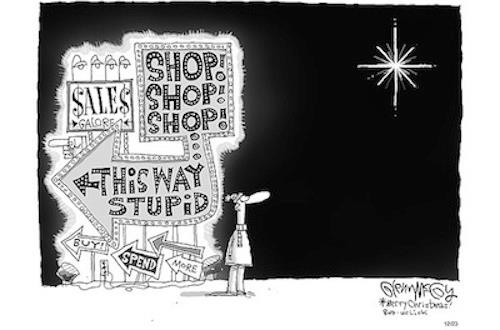
shop star

This was my inbox this morning…

“It might be easy to run away to a monastery, away from the commercialization, the hectic hustle, the demanding family responsibilities of Christmas-time. Then we would have a holy Christmas. But we would forget the lesson of the Incarnation, of the enfleshing of God—the lesson that we who are followers of Jesus do not run from the secular; rather we try to transform it. It is our mission to make holy the secular aspects of Christmas just as the early Christians baptized the Christmas tree. And we do this by being holy people—kind, patient, generous, loving, laughing people—no matter how maddening is the Christmas rush….”

– Fr. Andrew Greeley

Advent Reflection – Day 7

From “December 24, 1971”

Emptiness. But as soon as you think it

you see something like light out of nowhere.

kreileder sun against my eyes

As if knowing the stronger Herod is,

the more certain, the more inescapable the wonder.

The constancy of this relationship

is the fundamental mechanism of Christmas.

– Joseph Brodsky, trans. Jenn Cavanaugh

image: “Sun Against My Eyes” by Jürgen Kreileder

Advent Reflection – Day 5

A little change of tempo for today’s reflection….

Dave Brubeck died yesterday, old and full of years. Today would have been his 92nd birthday. He was a jazz great who knew his classical stuff and a consummate performer to the end. He never planned to be a musician. He went to school to study veterinary science until the head of the program convinced him to transfer to the conservatory, even though he didn’t read music. He was ordered to form his first band while serving under Patton in WWII. Coming home from the war he decided “something should be done musically to strengthen man’s knowledge of God.” He joined the Catholic Church after a full orchestration of the Lord’s Prayer setting he was working came to him in a dream. Brubeck brought all the joy and freedom of his jazz stylings and innovative time signatures to bear in his sacred works. His wife handled the texts. Together they wrote one of my favorite Christmas songs. It’s much more a Christmas Day celebration than an Advent reminder to wait, but musically and lyrically it wells with the hope we’re invited to live into and celebrate this week.

The music in the video is actually two pieces from Brubeck’s La Fiesta de la Posada – the finale, called “La Piñata,” followed by “God’s Love Made Visible.” Some of the lyrics by Iola Brubeck:

God’s love made visible!  Incomprehensible! He is invincible!
His Love shall reign!
From love so bountiful, blessings uncountable make death surmountable!
His Love shall reign!


Advent Reflection – Day 3

               Advent

The wind in the winter wood

Drives the snowflake flock like a shepherd.

A fir tree, sensing how soon

She will be lit with holiness,

Strains to listen. She stretches wide

Her branches to the white paths,

Braced to brave the wind, growing

Toward that glorious night.

– Rainer Maria Rilke, born this day in 1875,

     translated by Jenn Cavanaugh

Advent Reflection – Day 2

“Hope” by Thiago Elias

“Hope is a state of mind, not of the world. Either we have hope or we don’t; it is a dimension of the soul, and it’s not essentially dependent on some particular observation of the world or estimate of the situation. Hope is not prognostication. It is an orientation of the spirit, and orientation of the heart; it transcends the world that is immediately experienced, and is anchored somewhere beyond its horizons…. Hope, in this deep and powerful sense, is not the same as joy that things are going well, or willingness to invest in enterprises that are obviously heading for success, but rather an ability to work for something because it is good, not just because it stands a chance to succeed. The more propitious the situation in which we demonstrate hope, the deeper the hope is. Hope is definitely not the same thing as optimism. It is not the conviction that something will turn out well, but the certainty that something makes sense, regardless of how it turns out.”

– Vaclav Havel