Lenten Calendar: Holy Saturday

It happened today on my start screen calendar. I watched it flip from Good Friday directly to Easter (tomorrow), with nary a Holy Saturday in between. One of the earliest Christian heresies was that Jesus didn’t really die. There were variations on the theme — he merely swooned, or he was never so human or incarnate or mortal as to be able to manage it.

To be fair, it really is hard to reconcile the fully God and fully human thing with being fully dead and then fully capable of doing something about it. Go ahead and try for a minute; I’ll wait.

There has been much written on the scandal of the cross, but to a large degree, that’s just human nature and divine nature played out to their fullest. Of course if God shows up to restore justice we’re going to crucify him. And of course God will let us.

What’s truly shocking is the day after that, and the day after that. Death and resurrection are the true scandals. That we could stop the pulse of the one who set the planets in motion. That God would come back to us afterward, promising life abundant.

The church calendar doesn’t skip from Good Friday to Easter. It makes space for a great silence, a deep reckoning and wrestling with the consequences of what we have done. The people in Jesus’s life have followed him, loved him, betrayed him, mocked him, and killed him. And today they mourn him.
20200310_194606953_iOS

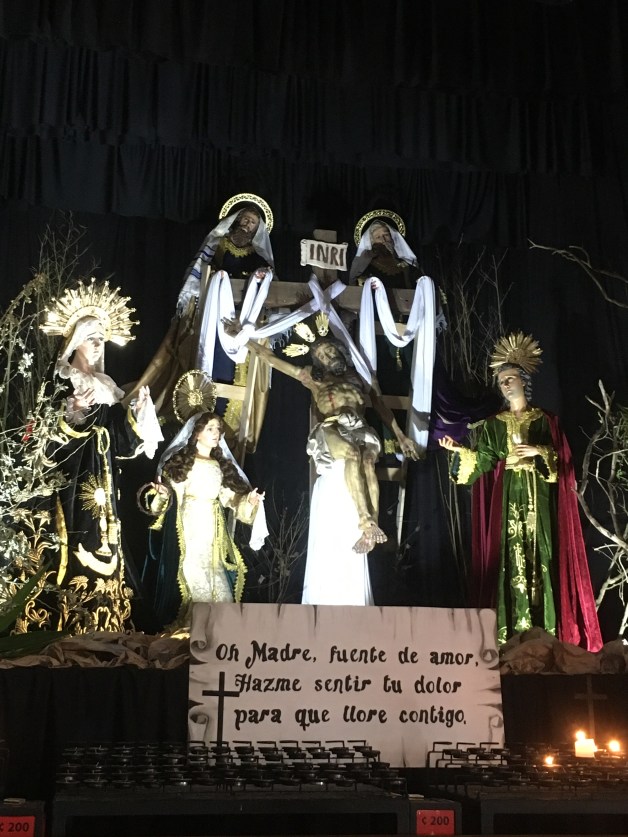
“Oh Mother, fountain of love, cause me to feel your pain, so that I may cry with you.”                                                                                                           photo by Jenn Cavanaugh

This Lent, we have walked together alone through unrelenting cycles of grief and confusion. Today we have been given a day to name and mourn our losses, to feel and so clarify our feelings. Sometimes we only recognize what we truly love for what it truly is when it has been taken away from us.

Your absence has gone through me
Like thread through a needle.
Everything I do is stitched with its color.
— “Separation” by W. S. Merwin

This is a season of apocalypse, not in that the world is ending, but in that one superficial layer of it has been pulled back to reveal another layer of depth. What have you seen that you can’t unsee? Make a note of it, because there will be a temptation to snap out of this weirdness and revert to a version of “reality” that merely glossed over what is real.

We are living in a time in which the old has passed away and new has not yet come. For today, let’s just sit here a spell and reckon with it. We might feel like we’re stuck in Stephen King’s novel The Stand (for which he is, apparently sorry), but it’s a line and image from his Pet Sematary that should stick with us now: “Sometimes, dead is better.” We didn’t go through all of this for that kind of twisted at-all-costs reanimation, did we?

This is the time to sift between the habits we miss because they brought consolation to the world and those that simply made us comfortably numb to it.

It’s okay to grieve the loss of normalcy, to admit that it hurts to give up the things that make us happy. I, for one, should be traveling next week, not making sack lunches for homeless teens with nowhere to be during the day.

Or should I?

This is not the fast we would have chosen, but if we can see it through in the spirit of the fast God chooses, then we and the world will ultimately be better for it.

Yesterday we buried our dead. Today we mourn. Tomorrow we will have the holy task of ushering back to life what is worthy of our love and devotion and co-creating the world anew.
Lenten Calendar: Godly Sorrow

I am earworm-prone at the best of times. Musically, tunes often get stuck for no rhyme or reason and threaten to drive me out of my own mind. Lyrically, however, the lines I latch onto tend to be significant indicators of my mental state. Of course, in the worst of times, the mind races, and all these phrases become less helpful as they overlap at higher and higher rpms. I have to unspool and untangle them to make sense of them and self-diagnose.

Today’s first earworm is actually the title of a Harvard Business Review article: That Discomfort You’re Feeling is Grief. I absolutely recommend you read it right now, if you need to hear that it’s okay to be a “swirling, curling storm” (ay, there’s the lyric) of all the feels and how to weather that storm. This one has the prosaic advantage of directness and requires little to no unpacking. But it’s proving deadly accurate. Just about every conflicted emotion and thought of the day held up against that statement confirms it. That Discomfort You’re Feeling is Grief. Why, yes, yes it is, now that you mention it. That seems premature, but [several beats here while I actually read the article instead of just having the portentous, disembodied headline echoing in my head] yes.

Most of us have lost something of value at this point, and it only compounds our anxiety that there is no consensus about how much more we stand to lose or for how long. Not only is the ground is shifting beneath us, but the fissures and faults in the lay of the land are also being laid bare.

With my brain currently functioning as sort of sloppy concordance on the themes, it’s struck me recently how Scripture distinguishes between different forms of grief, sorrow, and distress; there are times they are appropriate and times they are inappropriate; ways they can harm us and ways they can be redemptive. “In fact, to be distressed in a godly way causes people to change the way they think and act and leads them to be saved. No one can regret that. But the distress that the world causes brings only death” (2 Corinthians 7:10, God’s Word Translation).

Repentance, in today’s world, is for suckers. It involves self-incrimination in a culture that constantly reminds of our rights to remain silent, plead the fifth, and shift the blame. Feeling guilty without admitting guilt and anxiety without corrective action are forms of worldly sorrow. Admitting guilt is what allows us to stop wallowing in it. Responding properly to the conviction that we’ve done wrong is an opportunity to find redemption in the consequences. In her chapter on Lent in The Circle of Seasons: Meeting God in the Church Year, Kimberlee Conway Ireton writes

“There is nothing self-flagellating about repentance. In fact, true repentance is just the opposite: it frees us…. Like fasting, repentance creates space in our lives; it allows us to hear the voice of God speaking to our hearts. Through repentance we become reacquainted with our truest selves, the selves God created in his own image” (p. 78).

Or, as the old-school version of 2 Corinthians 7:10 on repeat in my head goes, “godly sorrow produces repentance leading to salvation” (NKJV). I love the bounds that makes in so few words, from distress to rescue.

Which brings me to my final earworm, courtesy of Bastille’s “Pompeii.”

2020-03-24 (2)

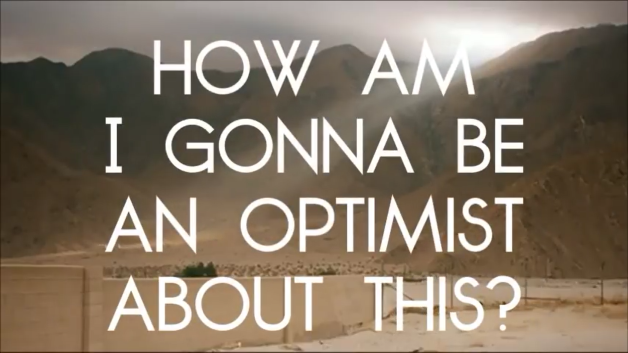
Where on earth did that question come from? I mean, the obvious answer is that I’m not. I don’t get to be optimistic before anyone, much less myself, has any idea of what we’re dealing with here. I’m in the held breath calm before a storm of utterly uncertain size, and grinning about how it’s all going to be okay when they’re using exhibition centers as field hospitals and ice rinks as morgues in Madrid would be downright creepy.

And yet, in the midst of coming to terms with my small personal losses, empathizing with friends with larger concerns, and mourning with those dealing with ultimate concerns, the hope- and future-oriented pinwheels of my racing mind are spinning as well.

That discomfort we’re feeling is grief, but in response to it, the Harvard Business Review is urging us to “stock up on compassion.” And a lot of people are doing so, eagerly.

There’s something encouraging in the collective grief of facing how precariously most of us really live. God can make use of that kind of sorrow. That kind of conviction can lead to the kind of repentance that makes real change possible.

“See what this godly sorrow has produced in you: what earnestness, what eagerness to clear yourselves, what indignation, what alarm, what longing, what concern, what readiness to see justice done.” 2 Corinthians 7:11a (NIV) 

We are, beyond a doubt, alarmed, but it’s making us listen again. We’re hearing more good faith explorations of ethical questions, bordering at times on my vague memories of civil discourse. We’re collectively confronting the quandary of whom to save in the trolley dilemma, and questioning a system that seems most concerned with saving the trolley. It’s appalling to witness, but some scales fall away from our eyes when our elected officials propose literal human sacrifice on the altar of capitalism to appease the gods of the market.

None of this is cause for optimism, per se. “To be an optimist about this” has nothing do with expressing blind faith in human capabilities or pretending a deadly virus is a godsend. It doesn’t mean disregarding disheartening realities; it means letting our godly sorrow change the way we think and act in the face of them. It means devoting ourselves less to clawing our way back to a broken status quo and more to cultivating an earnest readiness, longing, and concern to see justice established where it was not before.

Lenten Calendar: Cloistered

Does anyone else feel like this Lent has taken an extra poignancy? A great many of us are essentially cloistered, reordering our lives, hyper-aware of the collective significance of our everyday practices, and actively defining what is essential. What would it look like to embrace this worldly detachment as an opportunity for new forms of service and practicing the presence of God?

This passage has also taken on an extra poignancy lately. Good writing does that – rises to the occasion. So may we all as we wait for the Risen One.

a-corner-in-the-old-kitchen-of-the-mittenheim-cloister-1883 steele

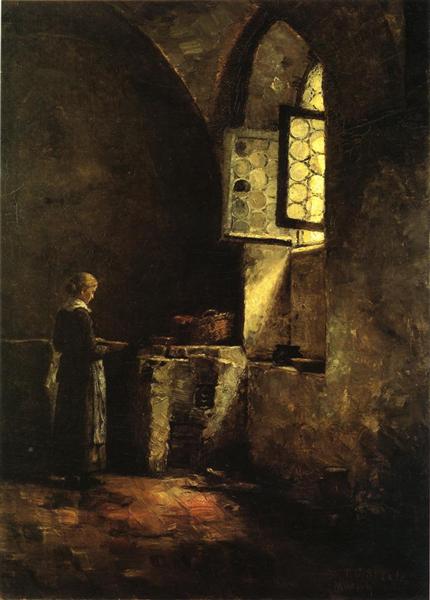
A Corner in the Old Kitchen of the Mittenheim Cloister, 1883 by T.C. Steele

This Wednesday is a long way from Ash Wednesday,
but all our Wednesdays are marked by ashes —
we begin this day with that taste of ash in our mouth:
of failed hope and broken promises,
of forgotten children and frightened women,
we ourselves are ashes to ashes, dust to dust;
we can taste our mortality as we roll the ash around on our tongues.

We are able to ponder our ashness with
some confidence, only because our every Wednesday of ashes
anticipates your Easter victory over that dry, flaky taste of death.

On this Wednesday, we submit our ashen way to you —
you Easter parade of newness.
Before the sun sets, take our Wednesday and Easter us,
Easter us to joy and energy and courage and freedom;
Easter us that we may be fearless for your truth.
Come here and Easter our Wednesday with
mercy and justice and peace and generosity.

We pray as we wait for the Risen One who comes soon.

– from Prayers for a Privileged People by Walter Brueggemann

Lenten Calendar: Telling

This week’s lectionary readings play with the conceit of the rock that Moses struck to provide the newly liberated Israelites with fresh “living” water. “Strike the rock,” God says, “and water will come out of it, so that the people may drink.” Moses did so, in the sight of the elders of Israel. He called the place Massah and Meribah, because the Israelites quarreled and tested the LORD, saying, “Is the LORD among us or not?” (Exodus 17:6b-7)

“Is the LORD among us or not?” seems like a perfectly reasonable and non-rhetorical question. Some questions are mysteries to sit with and ponder, invitations to meditation, but this is the kind of question that demands an answer. It’s one that God answers when asked, even when the answer isn’t what the people expected. It’s one that Jesus answers even when he’s not asked. God wants us to know joy in “the rock of our salvation” (Psalm 95:1), and hope “because God’s love has been poured into our hearts” (Romans 5:5), and then to pass on this knowledge. Jesus tells the woman at the well that if she “knew the gift of God” she would have approached him asking for a drink, instead of the other way around (John 4:10). He tells her that this living water will become in those that drink it “a spring of water gushing up to eternal life” (John 4:14). Then he tells her everything she’s ever done and who he is, and she tells everyone else.

She and they and we become springs fed by the source: the rock that was struck.

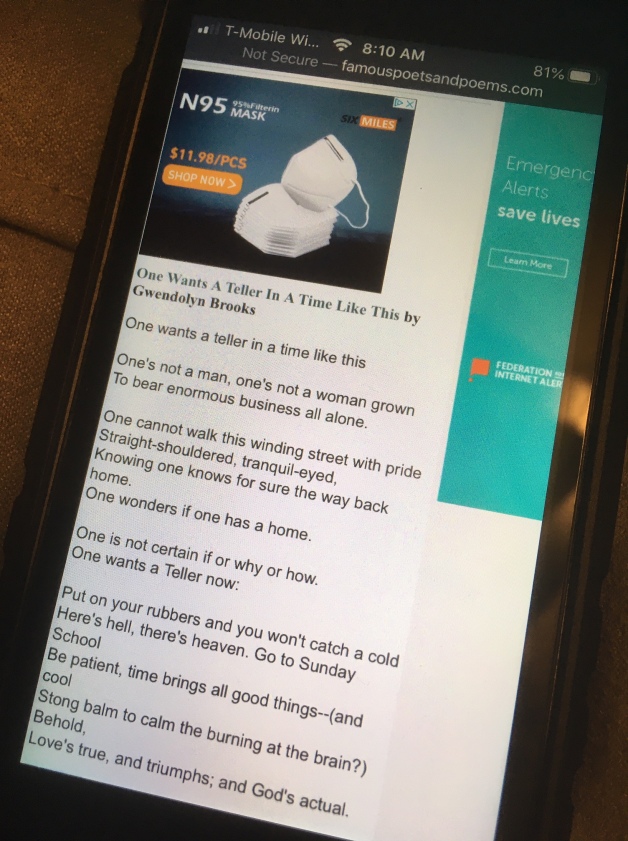
In uncertain times, Gwendolyn Brooks names our desire to just be told what to do to so that everything will be okay. At first the answers given seem equally simplistic. Wear your boots [read: wash your hands!] and you won’t get sick! But then at some point — I’m not sure which point; I imagine it’s subjective by design — the simplistic answers seem to acquire a simple wisdom and move from the immediate to the important, from the actionable to the true and actual.

brooks teller

“One Wants a Teller in a Time Like This” by Gwendolyn Brooks   –  photo by Jenn Cavanaugh

[I couldn’t help but notice that not even the famous poets and poems are secure]