Lenten Calendar: Holy Saturday

It happened today on my start screen calendar. I watched it flip from Good Friday directly to Easter (tomorrow), with nary a Holy Saturday in between. One of the earliest Christian heresies was that Jesus didn’t really die. There were variations on the theme — he merely swooned, or he was never so human or incarnate or mortal as to be able to manage it.

To be fair, it really is hard to reconcile the fully God and fully human thing with being fully dead and then fully capable of doing something about it. Go ahead and try for a minute; I’ll wait.

There has been much written on the scandal of the cross, but to a large degree, that’s just human nature and divine nature played out to their fullest. Of course if God shows up to restore justice we’re going to crucify him. And of course God will let us.

What’s truly shocking is the day after that, and the day after that. Death and resurrection are the true scandals. That we could stop the pulse of the one who set the planets in motion. That God would come back to us afterward, promising life abundant.

The church calendar doesn’t skip from Good Friday to Easter. It makes space for a great silence, a deep reckoning and wrestling with the consequences of what we have done. The people in Jesus’s life have followed him, loved him, betrayed him, mocked him, and killed him. And today they mourn him.
20200310_194606953_iOS

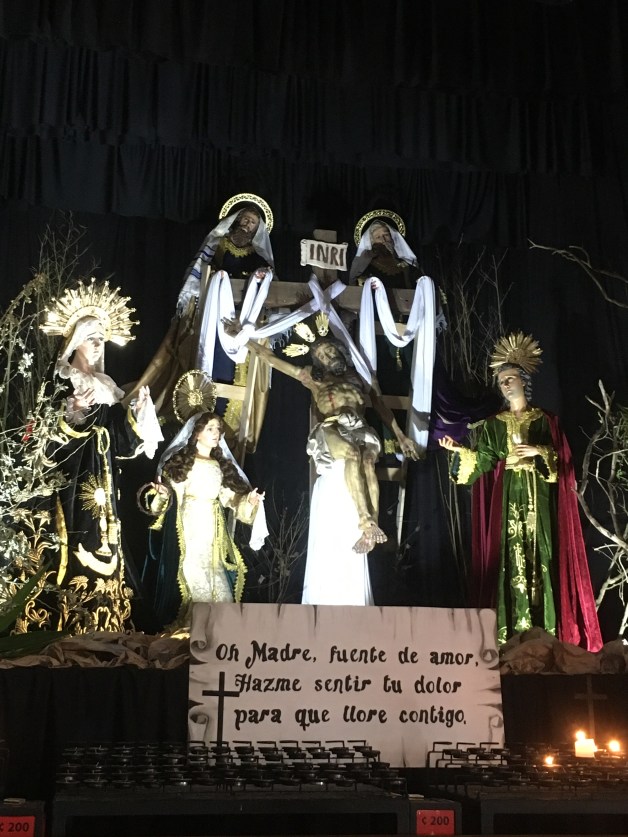
“Oh Mother, fountain of love, cause me to feel your pain, so that I may cry with you.”                                                                                                           photo by Jenn Cavanaugh

This Lent, we have walked together alone through unrelenting cycles of grief and confusion. Today we have been given a day to name and mourn our losses, to feel and so clarify our feelings. Sometimes we only recognize what we truly love for what it truly is when it has been taken away from us.

Your absence has gone through me
Like thread through a needle.
Everything I do is stitched with its color.
— “Separation” by W. S. Merwin

This is a season of apocalypse, not in that the world is ending, but in that one superficial layer of it has been pulled back to reveal another layer of depth. What have you seen that you can’t unsee? Make a note of it, because there will be a temptation to snap out of this weirdness and revert to a version of “reality” that merely glossed over what is real.

We are living in a time in which the old has passed away and new has not yet come. For today, let’s just sit here a spell and reckon with it. We might feel like we’re stuck in Stephen King’s novel The Stand (for which he is, apparently sorry), but it’s a line and image from his Pet Sematary that should stick with us now: “Sometimes, dead is better.” We didn’t go through all of this for that kind of twisted at-all-costs reanimation, did we?

This is the time to sift between the habits we miss because they brought consolation to the world and those that simply made us comfortably numb to it.

It’s okay to grieve the loss of normalcy, to admit that it hurts to give up the things that make us happy. I, for one, should be traveling next week, not making sack lunches for homeless teens with nowhere to be during the day.

Or should I?

This is not the fast we would have chosen, but if we can see it through in the spirit of the fast God chooses, then we and the world will ultimately be better for it.

Yesterday we buried our dead. Today we mourn. Tomorrow we will have the holy task of ushering back to life what is worthy of our love and devotion and co-creating the world anew.

Dead Can Dance: A Meditation and Playlist for Holy Saturday

The Dance of Death (1493) by Michael Wolgemut, from the Liber chronicarum by Hartmann Schedel

“[Jesus] was dead, to begin with. There was no doubt about that. The register of his burial was signed by the clergyman, the clerk, the undertaker, and the chief mourner…. [Jesus] was as dead as a door-nail…. There is no doubt that [Jesus] was dead. This must be distinctly understood, or nothing wonderful can come of the story I am going to relate.” adapted from Dickens’ _A Christmas Carol_

Christians are sorely tempted to gloss over or spiritualize the death of Christ. After all, how dead can we imagine the Source of all life? At what point do our imaginations fail to allow for his return to life? If we find Jesus’ resurrection easy to believe, might it be at the expense of our belief in Jesus’ death? Our scriptures and our creeds stress that Jesus did not just die, he was buried. He was counted and fully identified with the dead. He took kenosis, humanity, and mortality to their furthest limits and poured himself out even to death. Christ’s earliest followers wanted to impress upon all who would listen that he did not faint, lose consciousness, or swoon. He was not “mostly dead.” He was as dead as dead gets, deader than we’ll ever be, as ultimate in death as in life, not only the firstborn of all creation, but also the jigging and grinning leader and Lord of the danse macabre that ultimately unites us all regardless of who we were and what we believed. Wherever we go when we die, he went there, and conquered it in his own name. Harrowing of Hell - from a 15th century French Book of Hours at the Huntington Library

Death couldn’t hold him any more than heaven or earth could. Holy Saturday makes room in our theology for the death of God, and a God beyond Being, and all the contributions of William Blake and John of the Cross, Hegel and Nietchze, Caputo and Zizek. We are given a time to mourn him and celebrate his life, time for a proper wake, granted an interval to contemplate the horror of life without him, an opportunity to come together and make sense of and respond to what he was on about in life.

It’s a time to allow our perspectives to shift, like Robert DeLong sings about in “Global Concepts.”

After I die, I’ll re-awake,
redefine what was at stake
from the hindsight of a god.

Whether or not you believe Jesus completely grasped the entirety of who he was and what he came to do before he died, it’s quite obvious that his disciples did not. Only in losing him and in his return did they begin to understand the magnitude of what was at stake. Even those who believed he was the Messiah had a limited notion of what that meant before Christ’s death and resurrection. To John’s disciples who wondered if he was the One, he replied “that the blind see, the lame walk, the lepers are cleansed, the deaf hear, the dead are raised, the poor have the gospel preached to them” (Luke 7:22), and to the crowds he wondered aloud, if John’s preaching and my healing can’t do it, what’s it going to take to get you people mourning and dancing? What did you go out into the desert to see? A reed in the wind? A man in soft clothes? A prophet? What will you make of me coming to eat and drink with you?

Did I make money? Was I proud?
Did I play my songs too loud?
Did I leave my life to chance
or did I make you f***ing dance?

Holy Saturday redefines death, life, and power. The dance of the dead is not a sign of futility or defeat, but of completion, hope in more than this life, and victory.

Should I close my eyes and prophesize
Hoping maybe someday come?
Should I wet the ground with my own tears
Crying over what’s been done?

Should I lift the dirt and plant the seed
Even though I’ve never grown?
Should I wet the ground with the sweat from my brow
And believe in my good work?

Hey there, I’m flying up above
Looking down on the tired earth
I can see, I can see potential
Speaking through you, speaking to you
From all of heaven’s possibility

Power, hey, do know how it work?
Hey, do you know that the meek
They shall inherit the earth?
You should work, you should work
Yeah, for the self and the family

Should I hit the water or stay on dry land
Even though I’ve never swam?
Take machete, take them into the brush
Though at first there is no path

Taste the war paint on my tongue
As it’s dripping with my sweat
Place my gaze in the future’s path
Seeing things that ain’t come yet

Hope to watch the victory dance
After the day’s work is done
Hope to watch the victory dance
In the evening’s setting sun

Need more for your playlist? Try Elbow’s “The Night Will Always Win” (imagine Peter and Judas singing that for their various reasons), Dave Matthews’ “The Space Between” and The Waterboys’ “Song for the Life” along with, of course the Dead Can Dance’s eponymous album from way back when for atmosphere. Interestingly enough they put out an album called Anastasis (=resurrection) last year that I’ll be listening to tomorrow.

I’ll close with a poem that leads a great post on the subject of Holy Saturday by Christine Valters Paintner

Don’t surrender your loneliness so quickly.
Let it cut more deep.
Let it ferment and season you as few human
Or even divine ingredients can.
Something missing in my heart tonight
Has made my eyes so soft,
My voice so tender,
My need of God
Absolutely clear
.

~ Hafiz