
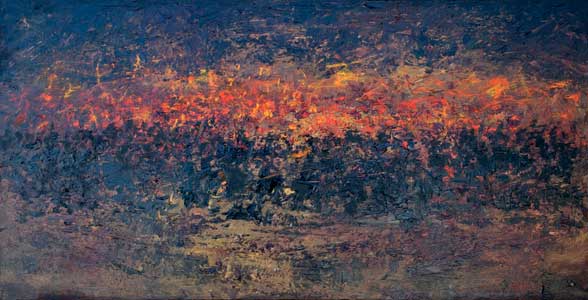
Pentecost by Hyatt Moore
Martin Luther King, Jr. wrote these words from a Birmingham jail on Good Friday, 1963… it would seem for us on Pentecost, 2020. As I’ve said before, it’s been a long Lent… and Easter… and 57 years, and yet MLK’s words are still frustratingly apt.
“the present tension… is a necessary phase of the transition from an obnoxious negative peace… to a substantive and positive peace, in which all men will respect the dignity and worth of human personality. Actually, we who engage in nonviolent direct action are not the creators of tension. We merely bring to the surface the hidden tension that is already alive. We bring it out in the open, where it can be seen and dealt with. Like a boil that can never be cured so long as it is covered up but must be opened with all its ugliness to the natural medicines of air and light, injustice must be exposed, with all the tension its exposure creates, to the light of human conscience and the air of national opinion before it can be cured.
In your statement you assert that our actions, even though peaceful, must be condemned because they precipitate violence. But is this a logical assertion? Isn’t this like condemning a robbed man because his possession of money precipitated the evil act of robbery? Isn’t this like condemning Socrates because his unswerving commitment to truth and his philosophical inquiries precipitated the act by the misguided populace in which they made him drink hemlock? Isn’t this like condemning Jesus because his unique God consciousness and never ceasing devotion to God’s will precipitated the evil act of crucifixion…? Such an attitude stems from a tragic misconception of time, from the strangely irrational notion that there is something in the very flow of time that will inevitably cure all ills. Actually, time itself is neutral; it can be used either destructively or constructively. More and more I feel that the people of ill will have used time much more effectively than have the people of good will. We will have to repent in this generation not merely for the hateful words and actions of the bad people but for the appalling silence of the good people. Human progress never rolls in on wheels of inevitability; it comes through the tireless efforts of men willing to be co workers with God, and without this hard work, time itself becomes an ally of the forces of social stagnation. We must use time creatively, in the knowledge that the time is always ripe to do right. Now is the time to make real the promise of democracy and transform our pending national elegy into a creative psalm of brotherhood. Now is the time to lift our national policy from the quicksand of racial injustice to the solid rock of human dignity.”
Now, at the feast of Pentecost, we celebrate the coming of the Holy Spirit, and the season of the Church. What on earth is so-called Ordinary Time going to look like in a year like this?
When pressed, Jesus answered that there really are only two commandments, and they are both to love. It’s a simple, but a narrow and easily obscured path. In this season of the Church, we need the Spirit of Counsel to help us discern how best to love God and neighbor in areas where the Church has historically failed to do so. We need the Spirit of Christ who makes all things new, even us, as we confess and repent.
There is no static faith that will result in us or our neighbors or the world becoming all God created us to be. We need the Spirit of Power who makes true change and true peace possible, the Spirit of God who promises a hope and a future when we feel doomed to repeat history.
Come Holy Spirit!

 Homespun