Holy Days are Here Again: Christmas Edition

 “In recent years the church itself has become the target of a good deal of criticism and, for many, has simply been dismissed as a meaningful player in contemporary culture. And yet, all the while, as we have seen, there is an increasingly urgent desire for images that capture something of the depth and beauty of life, for practices that can structure one’s life and spark affection. Religion has always been the custodian of such symbols, and they were the center of the church’s life from the beginning. Yet the sad fact is that few people turn to the church for such symbols today.”[1]

Dietrich Bonhoeffer famously claimed that “the church is only the church when it exists for others.”[2] That means the things we do in and as a church are deeply motivated by the people outside of the church. This kind of talk sometimes devolves into a sense that we should warp all the things we do in support of our own spiritual walks and lives to accommodate a random, idealized person who is not yet interesting in living a Christian life. That’s the sort of thing that ends in worship services where we don’t talk about Jesus for fear of alienating someone not in the room. That is not what it means to be the church for others.

In order to be the church for others we must first be the Church. There must be something going on in our midst for the seeker to find. It is both considerate and constructive to consider often what others interested but uninitiated in our language and practices would take away from observing them. Do they extend the welcome of Christ? The Church talking about how best to minister to people where they’re at is one of the most Christ-like things we could be doing. The conversation about whether we do certain things or talk amongst ourselves in certain ways because they’re “churchy” or because they’re significant to us and to living out our faith should be ongoing. The best way to be sensitive to people who have not completely bought into our community’s vision of God, however, is not to make it blander and presumably more palatable, but rather to offer sacrificial hospitality, complete translucence, and the richest of fare to the best of our abilities.[3] People don’t go on spiritual quests looking for superficiality, but depth. It’s worth discussing what might make people think to include our church on their quest and what offputtingly shallow practices, attitudes, and lingo they might encounter here if they do.

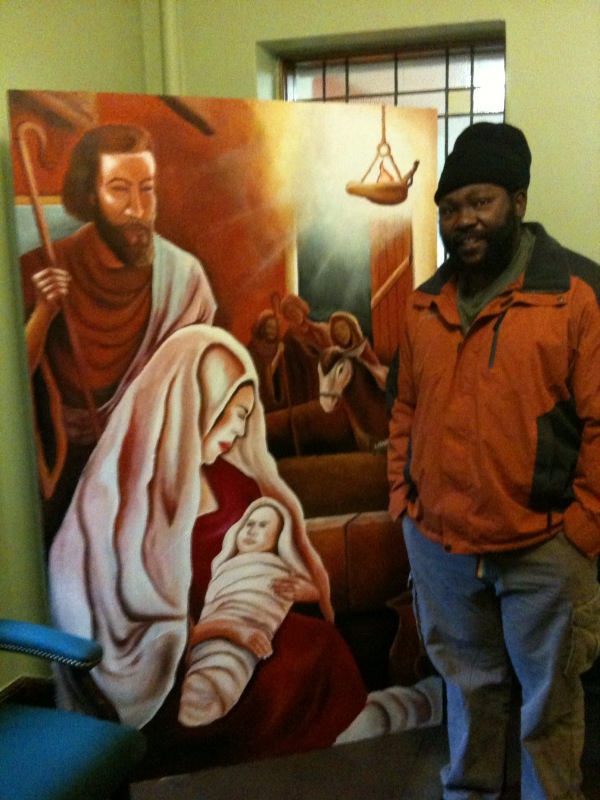
Bigga Gonzalez with the mural he painted during worship for Advent 2010. Each week the sermon and music focused on a different character in the Christmas story and so did the painting. Photograph by Jenn Cavanaugh.

Bigga Gonzalez with the mural he painted during worship for Advent 2010. Each week the sermon and music focused on a different character in the Christmas story and so did the painting. Photograph by Jenn Cavanaugh.

We often talk like we expect people to just wander in off the street in search of a place to encounter God. Remarkably, that does happen almost every time we open our doors, but it’s more of a symptom of desperate spiritual starvation than an indicator that they’re ready to throw in their lot with us on this journey. Consider the kind of confidence and trust we’re asking of people: to lose themselves in the worship of God in the company of strangers. Perhaps some word-of-mouth or outward sign will mark it as a place that is safe and trustworthy enough to enter, but increasingly the church building itself is not a sufficient sign of such. It may be that the sights, sounds and actions of our worship, ministry and community, visible from street level, audible through the open doors and perceptible in our neighbors’ daily lives could serve as such signs. Even then – even if people wander in for the music or the art or the safety itself – there’s no guarantee you have drawn them into worship. On the other hand, the symbolic act of walking into a church may be for them a greater step toward acknowledging God as God than most of your regular attenders take on an average Sunday.

Holy days are prime opportunities to be church for the world. It seems that people who do not normally attend church feel freer to come by. They are also the best times to revisit, and occasionally reinvent, our most significant traditions. It honors and blesses visitors and regulars alike to take breaks from our regular programming to dive deep into the festivals of the Christian year. What if Christmas in the church were as cozy and low-key as the secular versions most of us remember fondly as the best Christmas ever, the one that restored our souls and fostered our sense of family?

Homemade Christmas

The holidays wreak havoc on schedules. The churchy modus operandi entails planning extra, elaborate, once-a-year activities and services with only a skeleton crew to run them. Under these conditions, most proposed new traditions happen exactly once. Here’s an idea for a new tradition that may be more significant for the community, but probably less work for any one person than anything else you’ve done for Christmases past.

Sometime before Thanksgiving recruit nine volunteers who know they will be in town for Christmas Eve. Try to include a good cross-section of the church: young and old, male and female, starving artists and software engineers, different ethnicities. Assign them each a passage of scripture for a traditional lessons and carols service . Let them each plan a “lesson and carol” movement with a talk or a reading or an interpreted work of art and a song or activity for the congregation to respond with. Make sure you have at least one musician at their disposal for the singing. They each need to have their plans in writing a week prior to Christmas Eve so you can be sure not everyone is planning to sing Away in a Manger. Nine people who may not normally have much of a voice in church will have just blessed your congregation and twice-a-year visitors and made them feel like family.

To file in the "not less work, but great fun" category: the Christmas Arts & Crafts Bazaar. In recent years we've taken a break from making it so sales focused and simply spent the day making art together.

To file in the “not less work, but great fun” category: the Christmas Arts & Crafts Bazaar. In recent years we’ve taken a break from making it so sales focused and simply spent the day making art together.


[1] William A. Dyrness, Poetic Theology: God and the Poetics of Everyday Life (Grand Rapids: William B. Eerdmans Publishing Co., 2011), 220.

[2] Dietrich Bonhoeffer, Letters and Papers from Prison, 1997, 1953:282 [Ethics]

[3] One of the most powerful forms of translucence is acknowledging the limit of our powers and abilities. Instead of presenting our efforts as the end-all-be-all, what if we offered them as offerings and articulated whenever asked our experience that there is more and greater than we can do or say? This allows us to work toward God’s will being done without limiting God in others’ minds.

A Mother’s Day Festivus for the Rest of Us: Some Inclusive Alternatives for Church Observance

Most reflective congregations will already be aware of the dividing walls between those settled in “traditional” families and those who are not. Do we want to religiously observe a day that builds up those walls or one that breaks them down and builds us all up together? I believe the Church does her best work when we regard one another primarily as brothers and sisters and act together as children of God. The Church is the family into which God has set each one of us. How might some different approaches to Mother’s Day establish rather than undermine that truth in our midst? Motherhood is one role/ ministry/ calling among many. As such, it should be honored within the Church, but not above or at the expense of other roles, ministries, and callings. How might we affirm, support, and challenge each other on Mother’s Day?

1. Skip it.

Everyone knows that it’s Mother’s Day. Multiple industries are working day and night to ensure this is known. Honoring mothers is a fine thing (honoring one another at any time is a fine thing), but churches are in no way required to drop everything to issue a statement on the subject of motherhood this morning in particular. This can be an emotionally charged day for people, but it is not a national crisis and needn’t override regularly scheduled programming.

Being asked to stand is not such a significant a form of recognition that anyone with a mother’s heart wouldn’t willingly give it up to spare her single-and-hating-it sister pain. None of us wants to win a potted plant for having the most children if it means another woman in the room is forced to wonder if her miscarried or stillborn or aborted or adopted out children “count.” Does she still “have” the child if he died or disowned her or if her parental or custodial rights were terminated? No one needs an African violet that badly.

Allow the congregation to relate to one another organically and appropriately during the natural times of greeting before, during, and after the service. Trust that your people will recognize and rejoice with any woman in your midst beaming with a pregnancy-rounded glow, or distracted by devotion to her newborn, or visibly chuffed in the company of her adult children who don’t normally join her in the pews. By not directing these times the congregation will also have the freedom to support the women around them for whom this day represents loss, whether that’s through a hug in silent acknowledgement of a mother’s recent passing or a more private grief, or by checking in with offers of practical support for those caring for mothers who are fading away, or by directing the conversation toward rousing speculation about the NBA draft because this marks another year that this day must simply be borne, and not celebrated.

If the fancy hat brigade asks why you "skipped" Mother's Day, tell them. They're moms. They'll understand

If the fancy hat brigade asks why you “skipped” Mother’s Day, tell them. They’re moms. They’ll understand

2. Address it.

Just know that it can’t be a one-size-fits-all gloss. Build language into your corporate prayer time in the service that contends with the struggles of the day as well as the joys. There is an excellent example here along with some potentially relevant editorial suggestions immediately following in the comments section and a lovely follow-up here.

As a matter of personal taste, I would reframe it as a prayer rather than a message, as a time of coming before God as one people with all these experiences. But then, I like to think that everyone in the church already knows they’re welcome there. If you preceive the message that we are all in this together needs to be heard, say it loud and clear.

3. Preach it.

But please, no sermons about following Jesus while raising children, especially if it’s romanticized as some greatest calling, and even if it’s gritty as all get out. As gratifying as it can be to hear someone publicly recognize the difficulty of maintaining a spiritual life while housebreaking small humans, I reckon doctors have to pray while surrounded by others’ bodily fluids as much or more than most mothers, and I know my friends in customer service and corporate America get pooped on more times in a week than I do. What other week of the year – besides Father’s Day, of course – do we choose to preach to a fraction of the congregation? If there are any families in your church you probably have better and more meaningful ways of supporting them that aren’t potentially heart-rending to the rest of your congregants. I don’t need my church to honor me for my fertility, especially when dear friends who I know to the core of my being would make better mothers than I am are struggling to conceive or adopt. I don’t want to be honored as a mother on general principle by someone who, chances are, has no idea how I’ve interacted with my kids over the last week. Give me an exhortingly honest contingent of other parents and friends privy to the sordid details over hollow praise any day. Parents need more support than an annual sermon, and non-parents need to know they are integral to the life of the church every week of the year.

If you choose to preach a Mother’s Day sermon, preach about the inconvenient and unifying fact that we all have mothers and talk about the work of relating to our universally messed-up families of origin in all their weird permutations and uncannily entrenched patterns. Preach the texts in which God longs to mother us, gathering us up, teaching us to walk, modeling flight and catching us when we fall, then tie in the physical impossibility of forgetting the children one has borne. Help us all see God as a loving mama with our names tattooed on her hands, who will always get a little misty-eyed thinking of us when we’re far away, even if it’s because we’re in juvie or run-off with a bad crowd. Who always has a room for us even when we call her names and can’t make the token $100 she charges us in rent. Who swells with pride for our every little achievement even when we have convinced ourselves we have done well in spite of our upbringing. If your congregation is into carnations give everyone a red one on the way out as a reminder that we all have a loving and living Mother who would rather die than see us hurt.

4. Re-radicalize it.

Mother’s Day in America only goes back a hundred years or so, and most of its early supporters envisioned a day that had more to do with community organizing and peace-making than with thanking women for having children. When it became a national holiday it was to honor women who had lost children to war. “Decorative” clay handprints and poorly executed breakfasts in bed were not the original intent. What if Mother’s Day became a rallying cry for fighting for everyone’s children? Revving up the fierce side of our collective maternal instinct and living into that day when war will no longer be taught by declaring that day begins now? Something along the lines of Julia Ward Howe’s Mother’s Day Proclamation?

Despite the assumptions of physical force, the mother has a sacred and commanding word to say to the sons who owe their life to her suffering. That word should now be heard, and answered to as never before.

Arise, then, Christian women of this day! Arise, all women who have hearts whether your baptism be that of water or of tears! Say firmly: We will not have great questions decided by irrelevant agencies. Our husbands shall not come to us, reeking with carnage, for carresses and applause. Our sons shall not be taken from us to unlearn all that we have been able to teach them of charity, mercy and patience. We, women of one country, will be too tender of those of another country, to allow our sons to be trained to injure theirs.

Identify the social ill that breaks the hearts of your congregants and go at it like a mother protecting her young. Unleash your church’s inner mama bear on planning a clothes drive or activity for foster kids. Fund additional shelter beds in your town because everybody’s somebody’s baby. Scour the local middle school bathroom stalls and desks of cell numbers to call for a good time.

Mother’s Day was originally a day to mourn with those who mourn, but it is so much easier to rejoice with those who rejoice. How do we do both? What is your church doing for Mother’s Day? What ideas do you have?

Dead Can Dance: A Meditation and Playlist for Holy Saturday

The Dance of Death (1493) by Michael Wolgemut, from the Liber chronicarum by Hartmann Schedel

“[Jesus] was dead, to begin with. There was no doubt about that. The register of his burial was signed by the clergyman, the clerk, the undertaker, and the chief mourner…. [Jesus] was as dead as a door-nail…. There is no doubt that [Jesus] was dead. This must be distinctly understood, or nothing wonderful can come of the story I am going to relate.” adapted from Dickens’ _A Christmas Carol_

Christians are sorely tempted to gloss over or spiritualize the death of Christ. After all, how dead can we imagine the Source of all life? At what point do our imaginations fail to allow for his return to life? If we find Jesus’ resurrection easy to believe, might it be at the expense of our belief in Jesus’ death? Our scriptures and our creeds stress that Jesus did not just die, he was buried. He was counted and fully identified with the dead. He took kenosis, humanity, and mortality to their furthest limits and poured himself out even to death. Christ’s earliest followers wanted to impress upon all who would listen that he did not faint, lose consciousness, or swoon. He was not “mostly dead.” He was as dead as dead gets, deader than we’ll ever be, as ultimate in death as in life, not only the firstborn of all creation, but also the jigging and grinning leader and Lord of the danse macabre that ultimately unites us all regardless of who we were and what we believed. Wherever we go when we die, he went there, and conquered it in his own name. Harrowing of Hell - from a 15th century French Book of Hours at the Huntington Library

Death couldn’t hold him any more than heaven or earth could. Holy Saturday makes room in our theology for the death of God, and a God beyond Being, and all the contributions of William Blake and John of the Cross, Hegel and Nietchze, Caputo and Zizek. We are given a time to mourn him and celebrate his life, time for a proper wake, granted an interval to contemplate the horror of life without him, an opportunity to come together and make sense of and respond to what he was on about in life.

It’s a time to allow our perspectives to shift, like Robert DeLong sings about in “Global Concepts.”

After I die, I’ll re-awake,
redefine what was at stake
from the hindsight of a god.

Whether or not you believe Jesus completely grasped the entirety of who he was and what he came to do before he died, it’s quite obvious that his disciples did not. Only in losing him and in his return did they begin to understand the magnitude of what was at stake. Even those who believed he was the Messiah had a limited notion of what that meant before Christ’s death and resurrection. To John’s disciples who wondered if he was the One, he replied “that the blind see, the lame walk, the lepers are cleansed, the deaf hear, the dead are raised, the poor have the gospel preached to them” (Luke 7:22), and to the crowds he wondered aloud, if John’s preaching and my healing can’t do it, what’s it going to take to get you people mourning and dancing? What did you go out into the desert to see? A reed in the wind? A man in soft clothes? A prophet? What will you make of me coming to eat and drink with you?

Did I make money? Was I proud?
Did I play my songs too loud?
Did I leave my life to chance
or did I make you f***ing dance?

Holy Saturday redefines death, life, and power. The dance of the dead is not a sign of futility or defeat, but of completion, hope in more than this life, and victory.

Should I close my eyes and prophesize
Hoping maybe someday come?
Should I wet the ground with my own tears
Crying over what’s been done?

Should I lift the dirt and plant the seed
Even though I’ve never grown?
Should I wet the ground with the sweat from my brow
And believe in my good work?

Hey there, I’m flying up above
Looking down on the tired earth
I can see, I can see potential
Speaking through you, speaking to you
From all of heaven’s possibility

Power, hey, do know how it work?
Hey, do you know that the meek
They shall inherit the earth?
You should work, you should work
Yeah, for the self and the family

Should I hit the water or stay on dry land
Even though I’ve never swam?
Take machete, take them into the brush
Though at first there is no path

Taste the war paint on my tongue
As it’s dripping with my sweat
Place my gaze in the future’s path
Seeing things that ain’t come yet

Hope to watch the victory dance
After the day’s work is done
Hope to watch the victory dance
In the evening’s setting sun

Need more for your playlist? Try Elbow’s “The Night Will Always Win” (imagine Peter and Judas singing that for their various reasons), Dave Matthews’ “The Space Between” and The Waterboys’ “Song for the Life” along with, of course the Dead Can Dance’s eponymous album from way back when for atmosphere. Interestingly enough they put out an album called Anastasis (=resurrection) last year that I’ll be listening to tomorrow.

I’ll close with a poem that leads a great post on the subject of Holy Saturday by Christine Valters Paintner

Don’t surrender your loneliness so quickly.
Let it cut more deep.
Let it ferment and season you as few human
Or even divine ingredients can.
Something missing in my heart tonight
Has made my eyes so soft,
My voice so tender,
My need of God
Absolutely clear
.

~ Hafiz

Advent Reflection – Day 19

Advent by Rae Armantrout

In front of the craft shop,

a small nativity,

mother, baby, sheep

made of white

and blue balloons.

skygodgirl


               *

Sky

           god

                      girl.


Pick out the one

that doesn’t belong.

             * 

Some thing


close to nothing

                               flat

from which,


fatherless,

everything has come.

Advent Reflection – Day 14

I have a soft spot for carols that acknowledge that not all was perfect, peaceful, silent, or holy when Jesus was born, that the messiness of his birth and the world he was born into is part of the point of him being born at all. He comes to those who need him in a world that needs him. Pretty fables of all being calm and bright comfort me less than knowing the light shines in the darkness.

“He Came with His Love” performed by the Schola Cantorum of St. Peter’s in the Loop

First Coming

He did not wait till the world was ready,
till men and nations were at peace
He came when the Heavens were unsteady
and prisoners cried out for release.

He did not wait for the perfect time.
He came when the need was deep and great.
He died with sinners in all their grime,
turned water into wine. He did not wait

till hearts were pure. In joy he came
to a tarnished world of sin and doubt.
To a world like ours, of anguished shame
He came, and his Light would not go out.

He came to a world which did not mesh,
to heal its tangles, shield its scorn.
In the mystery of the Word made Flesh
the Maker of the stars was born.

We cannot wait till the world is sane
to raise our songs with joyful voice,
for to share our grief, to touch our pain,
He came with Love: Rejoice! Rejoice!

– Madeleine L’Engle