
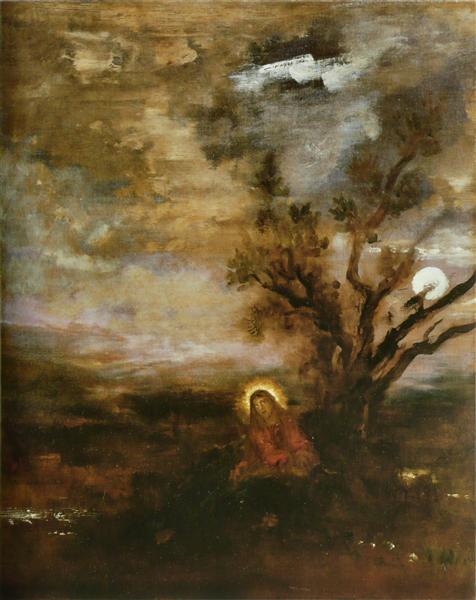
Lenten Calendar: Maundy Thursday


christ-in-the-garden.jpg!Large gustave moreau

Le Christ au jardin des Oliviers   — Gustave Moreau

Descending Theology: The Garden

We know he was a man because, once doomed,

he begged for reprieve. See him

grieving on his rock under olive trees,

his companions asleep

on the hard ground around him

wrapped in old hides.

Not one stayed awake as he’d asked.

That went through him like a sword.

He wished with all his being to stay

but gave up

bargaining at the sky. He knew

it was all mercy anyhow,

unearned as breath. The Father couldn’t intervene,

though that gaze was never

not rapt, a mantle around him. This

was our doing, our death.

The dark prince had poured the vial of poison

into the betrayer’s ear,

and it was done. Around the oasis where Jesus wept,

the cracked earth radiated out for miles.

In the green center, Jesus prayed for the pardon

of Judas, who was approaching

with soldiers, glancing up – as Christ was – into

the punctured sky till his neck bones

ached. Here is his tear-riven face come

to press a kiss on his brother.

–Mary Carr

The American Church in Paris just posted a short film for Maundy Thursday. The voiced-over reflections by youth and young adults from the congregation capture the spirit of the times, both now and then: a gathering of disciples processing the events of the last few weeks, discussing how the world has changed and what the future may hold, trying to find meaning and make sense of it all without the benefit of hindsight; denial and admission of fear; incredulity in the face of death.

Lenten Calendar: Betrayal

“Very truly, I tell you, one of you will betray me.” – Jesus (John 13:21)

“Well, did you trust your noble dreams and gentle expectations to the mercy of the night? The night will always win.”

Worse yet, Jesus, did you trust your noble dreams and gentle expectations to the mercy of your followers? Well, then you will always be betrayed. Even if we regret it in the morning. Even if we miss “your stupid face” and “bad advice” when we’ve done everything in our power to flee your presence.

The disciples each had to ask if he would be the one to betray you, Jesus, because they all knew deep down that they were capable of it. More than that, they had absorbed years of your teaching and knew their incapability of living up to it. Judas just knew it better than any of them. Recognized the foolishness of filling all these earthen vessels and tried to shift the onus back on you and your divinity to usher in the kingdom of God. He wasn’t wrong in thinking us unequal to the task.

Even in our attempts to be faithful, we try “to clothe your bones” with poor production values, to make you real to the world around us with unconvincing words that turn people off and trite music that falls flat.

“I throw this to the wind, but what if” Judas “was right” in a way — to just get it over with, and quickly? It was an honest betrayal of sorts, that literally gutted him, compared to Peter swearing up and down that he would never betray Jesus. We can only swear such a thing by the moon — “th’inconstant moon” that changes form and position constantly like our variable love (Romeo and Juliet, II:2).

Jesus knew this would happen all along, and yet he chose to trust, he chooses to entrust us with his message to the world, to include us in his intimate circle, to call us friends. Part of striving to live worthy of such a calling includes facing the inevitability of failing to do so. Jesus entrusting human beings with following the will of God means that yes, the night will always win. But the darkness will not have the last word. The day of the Lord is now, and coming. Jesus’s faithfulness in following the will of God means that the night will never triumph.