Lenten Calendar: Releasing Captives

Today’s lectionary text from Isaiah 42 describes the Lord’s chosen servant and the gentle and faithful justice he will mete. In verse 7, God charges him:

You will give sight to the blind,
                bring prisoners out of prisons,
                    and bring those who live in darkness
                        out of dungeons. (God’s Word Translation)

Jesus preached his first sermon on the first bit of Isaiah 61, and made it clear that he was that selfsame chosen servant. This is Jesus’s “life verse:”

The Spirit of the Lord God is upon Me,
Because the Lord has anointed Me
To preach good tidings to the poor;
He has sent Me to heal the brokenhearted,
To proclaim liberty to the captives,
And the opening of the prison to those who are bound;
To proclaim the acceptable year of the Lord (Isaiah 61:1-2a, NKJV)

In exegeting another text referring to this “acceptable time” of salvation, Paul makes it clear that we are also called to be the Lord’s servants, and NOW is the acceptable time (2 Corinthians 6:1-2). God’s favor is ongoing and we are to preach this same good news. And you know what?

There’s never been a better time to set some captives free.

I realize this feels like wading into the political, but the gospel does that sometimes. Sorry. I’m just a messenger.

Honestly, though, I think we might have more common ground here than we’re told we do. We all have to reconcile in our theologies the Biblical images of radical forgiveness and “eye for an eye” consequences. We might lean ideologically toward one end or the other of that spectrum, but we can generally agree that that is the spectrum. Punishments should fit the crime. We can support a correctional system, but not institutionalized cruelty. We seek peace and justice, not perpetuating cycles of violence and vengeance.

Any one of us could think of any number of crimes that could land a person in prison, but that don’t warrant the kind of Russian roulette to which mass confinement in a time of Covid-19 has now sentenced them.

Likewise, any one of us could think of detained populations that don’t deserve to be in heightened danger. Not all of them get as much air time as nursing home residents and cruise ship passengers, but they’re often in even tighter quarters, and in less control of crucial practices of basic hygeine. Political prisoners. Asylum-seekers. Hurting people caught in possession of drugs. Folks guilty of, or simply accused of, misdemeanorsPsychiatric patients committed “for their own safety” and youth remanded to juvenile detention “for their own good.” People in jail as part of “due process,” not as the result of it.

Let’s advocate for them. Demand their release. Sponsor them. Post bail for them. Write a letter on behalf of political prisoners. Request house arrest rather than solitary confinement for an inmate with a medical condition. At least make sure they have soap. Pray for them:
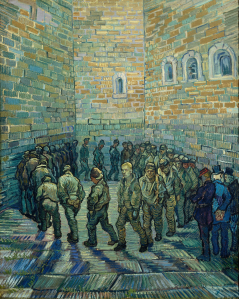
prisoners exercising van gogh

“Prisoners Exercising” by Vincent van Gogh

I call for you cultivation of strength in the dark.
Dark gardening
in the vertigo cold.
in the hot paralysis.
Under the wolves and coyotes of particular silences.
Where it is dry.
Where it is dry.
I call for you
cultivation of victory Over
long blows that you want to give and blows you are going to get.

Over
what wants to crumble you down, to sicken
you. I call for you
cultivation of strength to heal and enhance
in the non-cheering dark,
in the many many mornings-after;
in the chalk and choke.

 — “To Prisoners” by Gwendolyn Brooks
 

Lenten Calendar: Forsaken

Every hour of every day there are crucifixions,

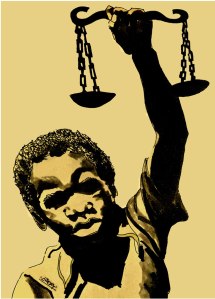
Justice Scales by Emory Douglas

Justice Scales by Emory Douglas

the Christ on trial in someone, somewhere,
judged in fear, condemned in ignorance,
mocked and beaten, imprisoned, killed,
while we watch at the foot of the cross
or from three cock crows away, and ask,
‘God, God, why have you forsaken them?’

The world is full of Good Fridays and Golgothas.
In the small arena of our lives,
there appears to be the same defeat of goodness
and it’s difficult to wear a bright smile
when the heart hangs heavy in a darkness
full of thorns and nails and swords.
Unable to see beyond dyings, we cry,
‘God, God, why have you forsaken us?’

from ‘Easterings’ by Joy Cowley


Justice requires attention and presence. Injustice demands we look or walk away. We sense this when we witness it — if God were only here, we think, this would never happen. Pray for somewhere that seems God-forsaken. Keep your eyes open for ways to shine God’s light in and on dark places.

Advent Again – day 18

Do not be afraid. Here’s what to do: Speak truth, do justice, make peace. Stop making life hard for each other….

“Good Bones” by Maggie Smith

Life is short, though I keep this from my children.

Life is short, and I’ve shortened mine

in a thousand delicious, ill-advised ways,

a thousand deliciously ill-advised ways

I’ll keep from my children. The world is at least

fifty percent terrible, and that’s a conservative

estimate, though I keep this from my children.

For every bird there is a stone thrown at a bird.

For every loved child, a child broken, bagged,

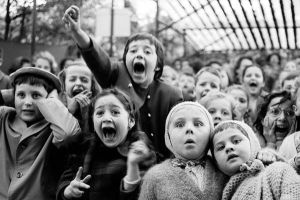
tous-les-visages-alfred

“Tous les visages des enfants à un spectacle de marionnettes au moment où le dragon est tué” by Alfred Eisenstaedt

sunk in a lake. Life is short and the world

is at least half terrible, and for every kind

stranger, there is one who would break you,

though I keep this from my children. I am trying

to sell them the world. Any decent realtor,

walking you through a real shithole, chirps on

about good bones: This place could be beautiful,

right? You could make this place beautiful.

Advent Week 1: Waiting with Hope

advent week 1 (2)

It’s been a bad week to be told to wait.

An especially frustrating – even demeaning – time to be told to wait for justice, for the world to be set right, that things will get better, things which are not entirely in our hands to fix, things that can only truly change through some odd and mystical combination of patience and systemic upheaval, accountability and radical forgiveness, quiet and cataclysm.

Waiting with hope is the antithesis of an escapism. Waiting with hope does not mean blithely ignoring or submitting to the status quo, but walking humbly enough to find oneself in the company of those most deeply threatened by it, who have no choice but to wait, because their lives depend on others acting justly. That’s deeply unsettling when you think about it: living at one another’s mercy. We all do it, but it’s a gamble with blatantly rigged odds. Sadly we don’t extend kindness or even the benefit of the doubt with anything resembling equality and no one is under any illusion that we can rectify that overnight. And so we wait, but in the hope that justice will be established, that power will protect the powerless, that the starving will have their fill of good things. We wait with those who wait. “You’re tired. But everyone’s tired./ But no one is tired enough.” So…

Wait

Wait, for now.
Distrust everything if you have to.
But trust the hours. Haven’t they
carried you everywhere, up to now?
Personal events will become interesting again.
Hair will become interesting.
Pain will become interesting.
Buds that open out of season will become interesting.
Second-hand gloves will become lovely again;
their memories are what give them
the need for other hands. And the desolation
of lovers is the same: that enormous emptiness
carved out of such tiny beings as we are
asks to be filled; the need
for the new love is faithfulness to the old.

Wait.
Don’t go too early.
You’re tired. But everyone’s tired.
But no one is tired enough.
Only wait a little and listen:
music of hair,
music of pain,
music of looms weaving all our loves again.
Be there to hear it, it will be the only time,
most of all to hear
the flute of your whole existence,
rehearsed by the sorrows, play itself into total exhaustion.

 – Galway Kinnell

from Selected Poems. © Houghton Mifflin, 1983