Lenten Calendar: Discipleship


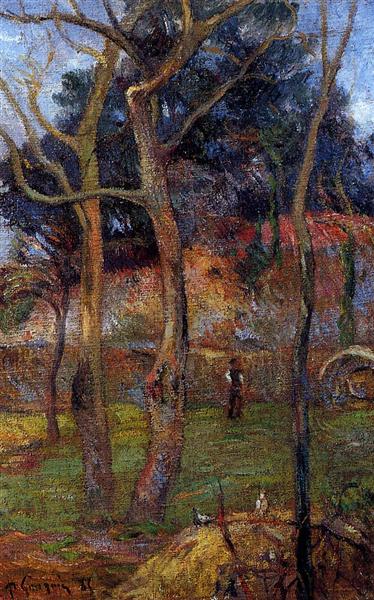
bare-trees-1885.jpg!Large

Bare Trees by Paul Gauguin


Hymn

I know if I find you I will have to leave the earth
and go on out
     over the sea marshes and the brant in bays
and over the hills of tall hickory
and over the crater lakes and canyons
and on up through the spheres of diminishing air
past the blackset noctilucent clouds
          where one wants to stop and look
way past all the light diffusions and bombardments
up farther than the loss of sight
     into the unseasonal undifferentiated empty stark

And I know if I find you I will have to stay with the earth
inspecting with thin tools and ground eyes
trusting the microvilli sporangia and simplest
     coelenterates
and praying for a nerve cell
with all the soul of my chemical reactions
and going right on down where the eye sees only traces

You are everywhere partial and entire
You are on the inside of everything and on the outside

I walk down the path down the hill where the sweetgum
has begun to ooze spring sap at the cut
and I see how the bark cracks and winds like no other bark
chasmal to my ant-soul running up and down
and if I find you I must go out deep into your
     far resolutions
and if I find you I must stay here with the separate leaves

— A. R. Ammons

Jesus is quickening the pace toward Jerusalem and the cross. What must you do to keep up?
 

Lenten Calendar – Quotidian

Lent is typically a time in which to rid ourselves of certain habits and try on new ones. This Lent we are all being called upon to develop a new normal. What of your activities do you most want to re-envision in order to keep? Which activities is this an opportunity to rest from? What new activities is this an invitation to build slowly into your everyday life? How can you curate your soul in planning your day?

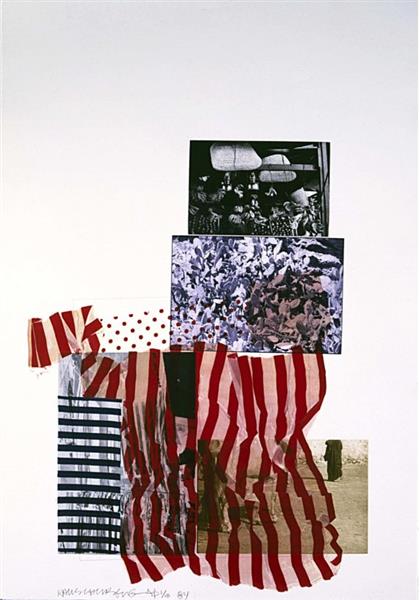
bazaar-1984.jpg!Large Robert Rauschenberg

“Bazaar” by Robert Rauschenberg

I should like to bring the routine of my daily life before You, O Lord, to discuss the long days and tedious hours that are filled with everything else but You.

Look at this routine, O God of Mildness. Look upon us men, who are practically nothing else but routine. In Your loving mercy, look at my soul, a road crowded by a dense and endless column of bedraggled refugees, a bomb-pocked highway on which countless trivialities, much empty talk and pointless activity, idle curiosity and ludicrous pretensions of importance all roll forward in a never- ending stream.

When it stands before You and Your infallible Truthfulness, doesn’t my soul look just like a market place where the second-hand dealers from all comers of the globe have assembled to sell the shabby riches of this world? Isn’t it just like a noisy bazaar, where I and the rest of mankind display our cheap trinkets to the restless, milling crowds?

…my soul has become a huge warehouse where day after day the trucks unload their crates without any plan or discrimination, to be piled helterskelter in every available corner and cranny, until it is crammed full from top to bottom with the trite, the commonplace, the insignificant, the routine.

What will become of me, dear God, if my life goes on like this? What will happen to me when all the crates are suddenly swept out of the warehouse?

-from Karl Rahner’s Encounters with Silence


Lenten Calendar: Transformation

My Cocoon tightens — Colors tease —
I’m feeling for the Air —
A dim capacity for Wings
Demeans the Dress I wear —

A power of Butterfly must be —
The Aptitude to fly
Meadows of Majesty implies
And easy Sweeps of Sky —

So I must baffle at the Hint
And cipher at the Sign
And make much blunder, if at last
I take the clue divine —

–Emily Dickinson

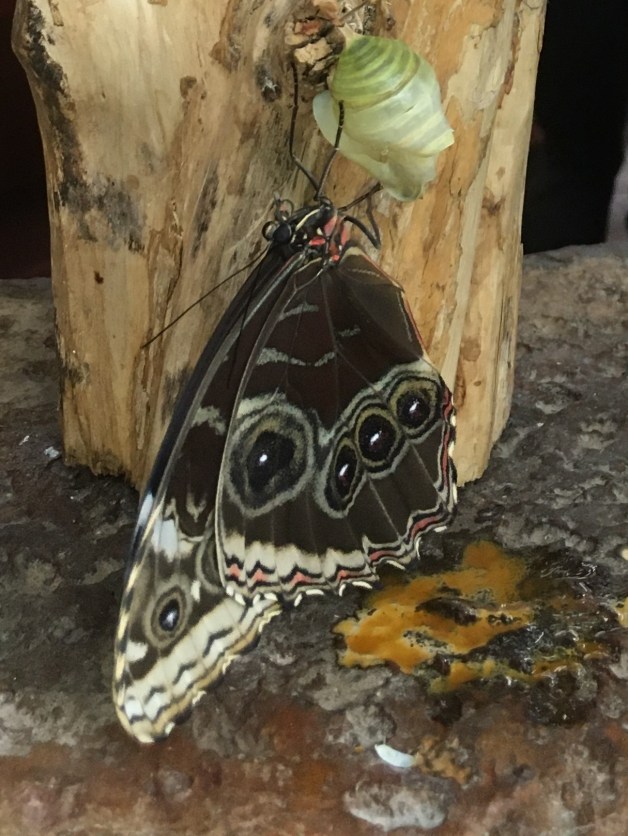
20200309_192924897_iOS (2)

photo by Jenn Cavanaugh

We romanticize the caterpillar’s transformation, and it’s easy to do because it’s hidden. And because we relish the concept of shedding a homely, crawling, bristly self for a soaring and beautiful one, but no one wants to undergo what the caterpillar does. It’s a real death and resurrection. Essentially, it digests itself. Breaks down into goo and reforms on a cellular level before a sticky and difficult rebirth.

I’m sure I’ve learned this fact half a dozen different times, because my imagination regularly rejects it and returns to my childhood image of the insect contortionist twisting and bending, unfolding to reveal what it always was inside.

It turns out that there’s some truth to that image as well, in that there are structures within the caterpillar that it has always carried within itself that emerge intact to become the exterior qualities of the butterfly. It doesn’t break down completely, just the parts that were inherent to the larval stage break down and reform around the structures of the mature and fully realized version of itself, which entomologists call the imago. The structures are called imaginal discs. They carry a “pre-pattern” of the butterfly’s final incarnation. Entomologists, whom I’ve never properly credited as the poetic souls they obviously are, can chart a “fate map” for an imago by studying these discs.

I wonder, can we do the same for ourselves? I suspect that outside perspective helps here, but what parts of your self that have always been hidden inside you do you suspect are ready to emerge like wings? What divine clues have you been given to your ultimate design?

If transformation were really all about contortion and twisting into an unfamiliar shape, it seems like the caterpillar would seek out a wide, open space in which to do it. Instead, it creates a small, confined and private space in which to let the hard carapace that protected it dissolve, to let its wings and antennae move to the surface. In our Lenten confinement, so may it be.

Lenten Calendar: Creative Withdrawal

On a day when more of us are systematically removing ourselves from public spaces, Christian Wiman reminds us that “all love demands withdrawal.” Giving others their space is not a novel way of demonstrating care. What’s new for most of us is negotiating the majority of our relationships at such a remove. Already, though, I have seen some intentional, beautiful, and creative examples of closeness growing without physical proximity, and I hope you are seeing some, too. Wiman also says that “all love demands imagination.” Let’s redeem the time imagining new ways of being with and for one another.

Wiman continues…

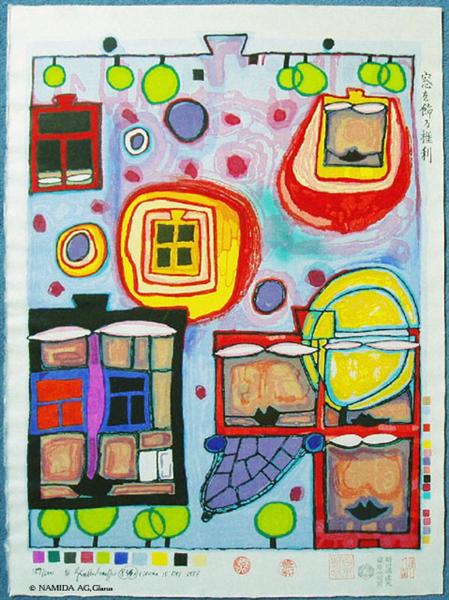
846A Window Right - Friedensreich Hundertwasser

846A Window Right by Friedensreich Hundertwasser

We must create the life creating us, and must allow that life to be —

and to be beyond, perhaps, whatever we might imagine.

I, too, am more (and less)

than anything I imagine myself to be.

“To know this,” says Simone Weil, “is forgiveness.”


It is an air you enter, not an act you make.

It is the will’s frustration, and is the will’s fruition.

It is to wade a blaze one night that I once crossed

— a young man, and lost —

to find a woman made of weather

sweeping the street in front of her shack.

It is another country.

It is a language I don’t know.

La por allá, la por allá, I repeat in my sleep.

The over there.


– from “The Parable of Perfect Silence” by Christian Wiman


Lenten Calendar: Be Food

The Way In

Sometimes the way to milk
     and honey is through the body.

the-spoonful-of-milk-1912.jpg!Large Marc Chagall

The Spoonful of Milk – Marc Chagall


Sometimes the way in is a song.
But there are three ways in
     the world: dangerous, wounding,
and beauty.
To enter stone, be water.
To rise through hard earth, be plant
desiring sunlight, believing in water.
To enter fire, be dry.
To enter life, be food.

— Linda Hogan

Lenten Calendar: Meek

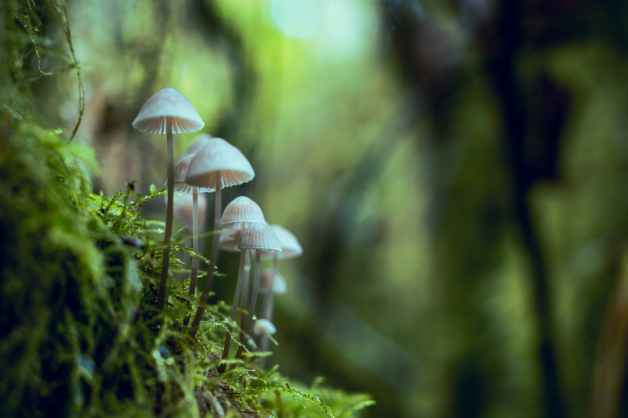
Consider the mushroom, it neither boasts nor vaunts itself above its fellows, and yet it grows in every environment. It knows the power of numbers working humbly and steadily in concert. Individually, they are fragile; together, they are inexorable.

shallow focus photography of mushrooms

Photo by Chris Gonzalez on Pexels.com

Mushrooms

Overnight, very
Whitely, discreetly,
Very quietly

Our toes, our noses
Take hold on the loam,
Acquire the air.

Nobody sees us,
Stops us, betrays us;
The small grains make room.

Soft fists insist on
Heaving the needles,
The leafy bedding,

Even the paving.
Our hammers, our rams,
Earless and eyeless,

Perfectly voiceless,
Widen the crannies,
Shoulder through holes. We

Diet on water,
On crumbs of shadow,
Bland-mannered, asking

Little or nothing.
So many of us!
So many of us!

We are shelves, we are
Tables, we are meek,
We are edible,

Nudgers and shovers
In spite of ourselves.
Our kind multiplies:

We shall by morning
Inherit the earth.
Our foot’s in the door.

— Sylvia Plath