
The Bible and James Baldwin on Racism: Cursing the Image of God

For the last decade or so, I have been an avid student of the essays of James Baldwin. Today would have been his 100th birthday, and I can’t help but wish he were still with us, talking beautifully phrased and reasoned sense in his uniquely winsome and challenging style of insider familiarity and outsider insight into the Scriptures, Western society, and the human condition.

Baldwin was raised in the church and even preached as a teenager, but he left both the pulpit and the church early in life, too fervent a believer in the gospel that steeped his childhood to allow the church in America’s racist and homophobic trappings to restrict his God-given freedom and identity. Though he gave up churchgoing, and many in the church gave him up for lost, he never gave up on the church. His essays are riddled with exhortations to believers to return to the way of Jesus and reclaim our responsibility to “the least of these.”
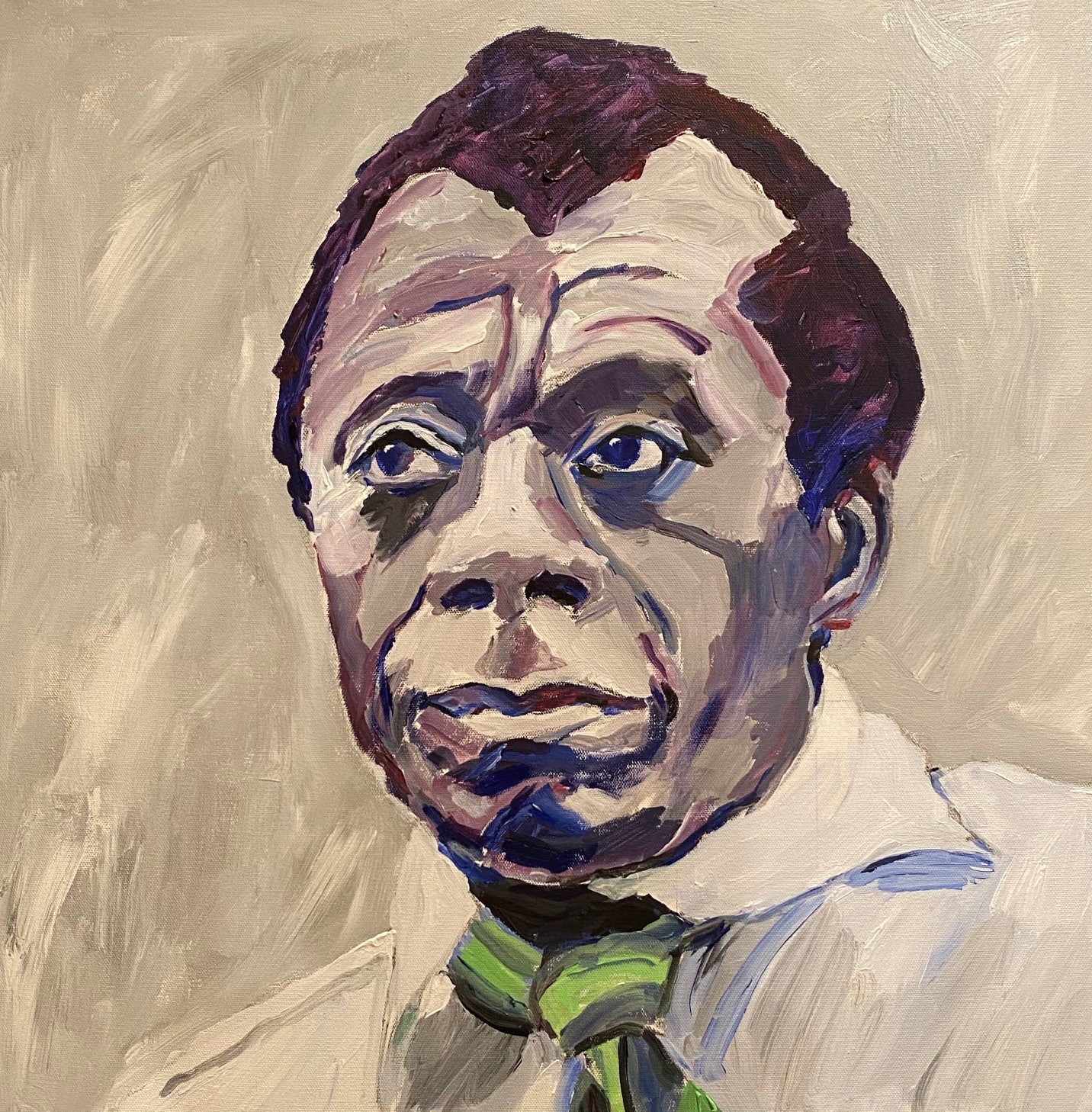
“James Baldwin” painting by Jeff Benesi

Racism: Cursing the Image of God

“With the tongue we praise our Lord and Father, and with it we curse human beings, who have been made in God’s likeness.” – James 3:9 (NRSV)

“I am saying that when a person, when a people, are able to persuade themselves that another group of people or breed of men are less than men, they themselves become less than men and have made it almost impossible for themselves to confront reality and to change it. If I deny what I know to be true, if I deny that that white child next to me I simply another child, and if I pretend that that child, because its colour is white deserves destruction, I have begun the destruction of my own personality.…

I tremble when I wonder if there is left in the Christian civilizations… the moral energy, the spiritual daring, to atone, to repent, to be born again; if it is possible, if there is enough leaven in the loaf, to cause us to discard our actual and historical habits, to cause us to take our places with that criminal Jew… put to death by Rome between two thieves, because He claimed to be the Son of God. That claim was a revelation and a revolution because it means that we are all the sons of God. That is a challenge, that’s the hope.”

— James Baldwin: White Racism or World Community?

Baldwin interpreted the unforgiveable sin against the Holy Spirit mentioned in Mark 3:29 to be the ways we treat one another as less than human, thereby desecrating the image of God the other represents. Baldwin consistently expressed how destructive racist systems were not only to the oppressed, but also to the oppressor. Into what categories might we sort others so that we can dismiss them as unworthy of consideration? What do we destroy in ourselves and others when we do so? The best way to claim our status as beloved children of God is to extend that status to others.

Call to Action: Is there someone in your life you’re having trouble seeing as a fellow child of God? Look for an opportunity today to affirm them, even if it’s something as small as LOLing their only social media post you actually find funny.

*This series of 8 devotions was featured, in slightly altered form, on our bible app in March 2022 as ‘the gospel according to james baldwin*

Pentecost and Protest

Pentecost by Hyatt Moore

Pentecost by Hyatt Moore

Martin Luther King, Jr. wrote these words from a Birmingham jail on Good Friday, 1963… it would seem for us on Pentecost, 2020. As I’ve said before, it’s been a long Lent… and Easter… and 57 years, and yet MLK’s words are still frustratingly apt.

“the present tension… is a necessary phase of the transition from an obnoxious negative peace… to a substantive and positive peace, in which all men will respect the dignity and worth of human personality. Actually, we who engage in nonviolent direct action are not the creators of tension. We merely bring to the surface the hidden tension that is already alive. We bring it out in the open, where it can be seen and dealt with. Like a boil that can never be cured so long as it is covered up but must be opened with all its ugliness to the natural medicines of air and light, injustice must be exposed, with all the tension its exposure creates, to the light of human conscience and the air of national opinion before it can be cured.

In your statement you assert that our actions, even though peaceful, must be condemned because they precipitate violence. But is this a logical assertion? Isn’t this like condemning a robbed man because his possession of money precipitated the evil act of robbery? Isn’t this like condemning Socrates because his unswerving commitment to truth and his philosophical inquiries precipitated the act by the misguided populace in which they made him drink hemlock? Isn’t this like condemning Jesus because his unique God consciousness and never ceasing devotion to God’s will precipitated the evil act of crucifixion…? Such an attitude stems from a tragic misconception of time, from the strangely irrational notion that there is something in the very flow of time that will inevitably cure all ills. Actually, time itself is neutral; it can be used either destructively or constructively. More and more I feel that the people of ill will have used time much more effectively than have the people of good will. We will have to repent in this generation not merely for the hateful words and actions of the bad people but for the appalling silence of the good people. Human progress never rolls in on wheels of inevitability; it comes through the tireless efforts of men willing to be co workers with God, and without this hard work, time itself becomes an ally of the forces of social stagnation. We must use time creatively, in the knowledge that the time is always ripe to do right. Now is the time to make real the promise of democracy and transform our pending national elegy into a creative psalm of brotherhood. Now is the time to lift our national policy from the quicksand of racial injustice to the solid rock of human dignity.”


Now, at the feast of Pentecost, we celebrate the coming of the Holy Spirit, and the season of the Church. What on earth is so-called Ordinary Time going to look like in a year like this? 

When pressed, Jesus answered that there really are only two commandments, and they are both to love. It’s a simple, but a narrow and easily obscured path. In this season of the Church, we need the Spirit of Counsel to help us discern how best to love God and neighbor in areas where the Church has historically failed to do so. We need the Spirit of Christ who makes all things new, even us, as we confess and repent.

There is no static faith that will result in us or our neighbors or the world becoming all God created us to be. We need the Spirit of Power who makes true change and true peace possible, the Spirit of God who promises a hope and a future when we feel doomed to repeat history.

Come Holy Spirit!