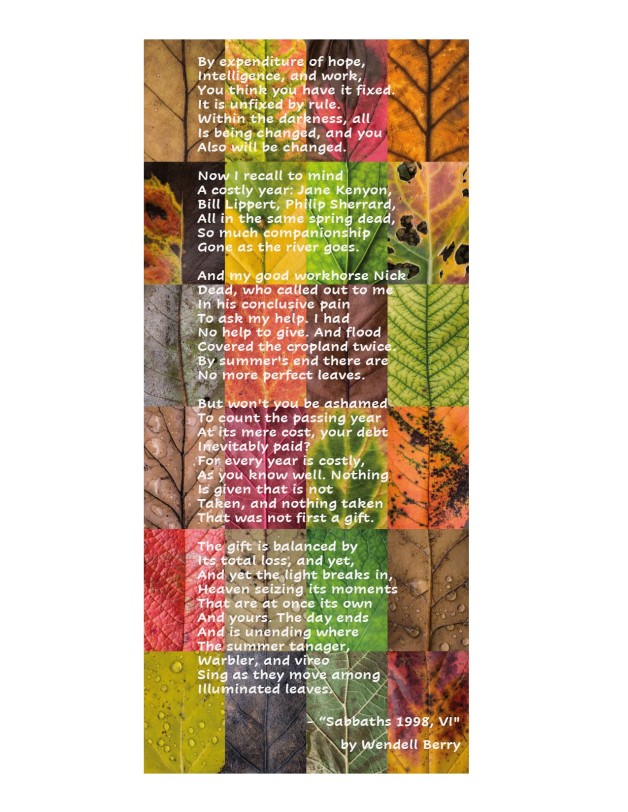
photos by Sepia, montage by Jenn Cavanaugh
photos by Sepia, montage by Jenn Cavanaugh
“aspire to live quietly”
from “Manifesto: The Mad Farmer Liberation Front” by Wendell Berry
Love the quick profit, the annual raise,
vacation with pay. Want more
of everything ready-made. Be afraid
to know your neighbors and to die.
And you will have a window in your head.
Not even your future will be a mystery
any more. Your mind will be punched in a card
and shut away in a little drawer.
When they want you to buy something
they will call you. When they want you
to die for profit they will let you know.

“Noche de los pobres” by Diego Rivera
So, friends, every day do something
that won’t compute. Love the Lord.
Love the world. Work for nothing.
Take all that you have and be poor.
Love someone who does not deserve it
….
Ask yourself: Will this satisfy
a woman satisfied to bear a child?
Will this disturb the sleep
of a woman near to giving birth?
….
I figured if I rambled through enough of my favorite Advent-related writings a theme or two for the season would emerge. I’m still circling around the articulation of it, but the first theme relates to the implicit question of how to handle our holy days and seasons in our day and age.
In Day 10’s post Andrew Greeley writes that “we who are followers of Jesus do not run from the secular; rather we try to transform it. It is our mission to make holy the secular aspects of Christmas just as the early Christians baptized the Christmas tree.” The English language harbors many words that have acquired self-contradictory meanings. We can count the word “holiday” in their number. Taking a holiday implies checking out, vacation, a break from the reality of the everyday. Greeley encourages Christians instead to make our holidays, by steadily embracing certain qualities and, I would add, fostering a certain quality of attention to the time and times. Which brings us to another ambiguous word that has been much on my mind: “secular.” The word originally referred to something “of a generation or time” – timely rather than timeless. The Church began using it to distinguish between worldly and heavenly matters, “secular” denoting that which is passing away. From there it has come to signify that which is not religious or spiritual. In common usage it sometimes functions as the opposite of sacred, which it is not. It refers to the religiously neutral aspects of a particular time and place, which may or may not be sacred. Most of our daily activities would be considered secular – work, conversation, meals, recreation – yet we can easily recognize the spiritual significance and sacred potential of each of them. Seasons like Advent and Lent invite us to do so. Greeley reminds us to make holy our work, our conversations, and meals and recreational activities. Wendell Berry says “There no unsacred places.” During Advent we remember that God has come to us in time, at just the right time, and we redeem our time waiting for Him to come again. We are waiting for the eternal to enter the secular. Here’s the context of that line from Berry:
How to be a Poet
(to remind myself)
i
Make a place to sit down.
Sit down. Be quiet.
You must depend upon
affection, reading, knowledge,
skill—more of each
than you have—inspiration,
work, growing older, patience,
for patience joins time
to eternity. Any readers
who like your work,
doubt their judgment.
ii
Breathe with unconditional breath
the unconditioned air.
Shun electric wire.
Communicate slowly. Live
a three-dimensioned life;
stay away from screens.
Stay away from anything
that obscures the place it is in.
There are no unsacred places;
there are only sacred places
and desecrated places.
iii
Accept what comes from silence.
Make the best you can of it.
Of the little words that come
out of the silence, like prayers
prayed back to the one who prays,
make a poem that does not disturb
the silence from which it came.
– Wendell Berry
We observe Advent the way poets observe: through the radical simplicity of sitting down, being quiet, and learning to speak of silence with disturbing it. We bend our resources and histories toward playing our own particular parts in a larger intention and story. Rather than loudly denouncing the world for stealing our holiday we observe it and make it holy and offer it again. We watch and work for the sacred to animate our secular lives and celebrations. As the hopes and fears of our times and desecrated places rise to the surface so easily this time of year, we acknowledge them as our own and expect Jesus.
 Homespun