Unknown's avatar

About Jenn Cavanaugh

B.A. Russian Language and Literature, Willamette University; M.A. Theology and the Arts, Fuller Seminary

Link

What a week. Every day another story of violence around the globe and close to home. And Sunday’s coming. How to respond in worship when we are feeling gutted, threatened, horrified, ravaged by the world, pushed beyond any rational response in measured tones? Remember our “rage belongs before God–not in the reflectively managed and manicured form of a confession, but as a pre-reflective outburst from the depths of the soul. This is no mere cathartic discharge of pent up aggression before the Almighty who ought to care. Much more significantly, by placing unattended rage before God we place both our unjust enemy and our own vengeful self face to face with a God who loves and does justice.” – Miroslav Volf. Click above for more from W. David O. Taylor’s blog, including a Prayer of Penitence excerpted from a Liturgy of Reconciliation and Restoration, produced by the Church of England.

It’s a lovely prayer, but much further down the spectrum toward a “reflectively managed and manicured… confession” than most people will walk in ready for. In fact, I think many of us are disoriented and overwhelmed. The world persists in being worse than we were prepared for. We need an opportunity to place that “unattended rage [despair, fear, etc.]before God.” Even if it’s something as simple as giving people a few quiet minutes of access to pen and paper to pour out their guts. What phrases keep running through your head? What images? What do you want to yell from the rafters? What do you want to spray paint on a wall? What do you need God to hear? What are you afraid God will know you are thinking? Get it down. Get it out. Have it out. Tack it face-down to a temporary wailing wall. This bit is between you and God. No one else will look at these, so don’t censor yourself. We can know that those pages will be all over the map and still bring them together before God to transition into corporate lament.

And what might that kind of corporate lament sound like this week? Click below for a powerful example which ends “We need new songs whispered into our ears, new rhythms to pound in our chests, so that we may join in the chorus of new life. God of love–you open our eyes to the suffering all around us. AND WE WILL SEE God of justice–you open our ears to those who cry out in pain. AND WE WILL HEAR God of healing–you open our hearts to expose our own pain and the pain of the world. AND WE WILL BEAR IT TOGETHER” – Ian Simkins.

After the lament we are prepared to recognize and repent of our own parts in the disorder of the world with that reflective prayer of confession. Let the music reflect this progression as well. Dwell on the stages of lament and avoid the temptation to rush to that “but it’s all good with Jesus” tune you like to end on. We can end declaring we have a hope and a future, but this service isn’t about cheering ourselves up.

Also this week, the sending is key. We cannot simply leave comforted or emotionally spent and numbed, content with our own individual consolation or private commitments to choose love over hate in the abstract, having made our peace with the world as it is. We hope to leave renewed, more sensitive than ever, with resolve, and charged to do the work of making peace with one another. In the words of Erin Wathen, “When hate gets this loud and violent, we are called beyond love. We are called to active compassion; prophetic speech; deep listening; transformative engagement”


Questions for Galatians, chapter 6

Click here to start with chapter 1

Click here for chapter 5

First reading: Read Galatians 6. What word, phrase, or verse stands out to you? Does it bring up a question? Speak to a question you’ve been having? Just resonate somehow? Is it confusing? Disturbing? Comforting? Make a note of it.


Keeping in mind the context of chapter 5 and of the book as a whole, what kind of transgressions do you think Paul might have been referring to in verse 1?


What individual and corporate responsibilities does Paul expect of those “who have received the Spirit?”


How do you reconcile “bear one another’s burdens” with “all must carry their own load?”


How can you “test your own work?” Are there any “tests” or “proofs” or “evidences” Paul offers in Galatians that would be helpful in this?


Can you think of any real life examples of reaping what you’ve sown?


What seems to be Paul’s overarching desire for the Galatians in the instructions he gives in verses 1-10?


What dichotomies does Paul establish and repeat in this chapter?


What roles do pride, boasting, work, and the flesh play in this chapter?


Have you ever felt someone pressuring you to do something to make him or her look good?


What do the cross and crucifixion seem to mean to Paul?


What rule is Paul referring to in verse 16?


What does he mean by the “Israel of God” and why would he use such a phrase?


What questions do you have about the chapter or the book as a whole? How would you summarize the main messages of Galatians?

Questions for Galatians, chapter 5

Click here for chapter 4

First reading: Read Galatians 5. What word, phrase, or verse stands out to you? Does it bring up a question? Speak to a question you’ve been having? Just resonate somehow? Is it confusing? Disturbing? Comforting? Make a note of it.

For this study, encourage others in your group to come with their own questions for the chapter or the book as a whole. Here were mine:
What kind of freedom is Paul talking about?

In verses 2-6, what are the negative consequences of giving up this freedom and what are the positive consequences of maintaining it?

You’re probably familiar with this list of the fruits of the Spirit, but might not have realized Paul composed it in this context. Why here? What does it have to do with the issue at hand?

Questions for Galatians, chapter 4

Click here for chapter 3

First reading: Read Galatians 4. What word, phrase, or verse stands out to you? Does it bring up a question? Speak to a question you’ve been having? Just resonate somehow? Is it confusing? Disturbing? Comforting? Make a note of it.

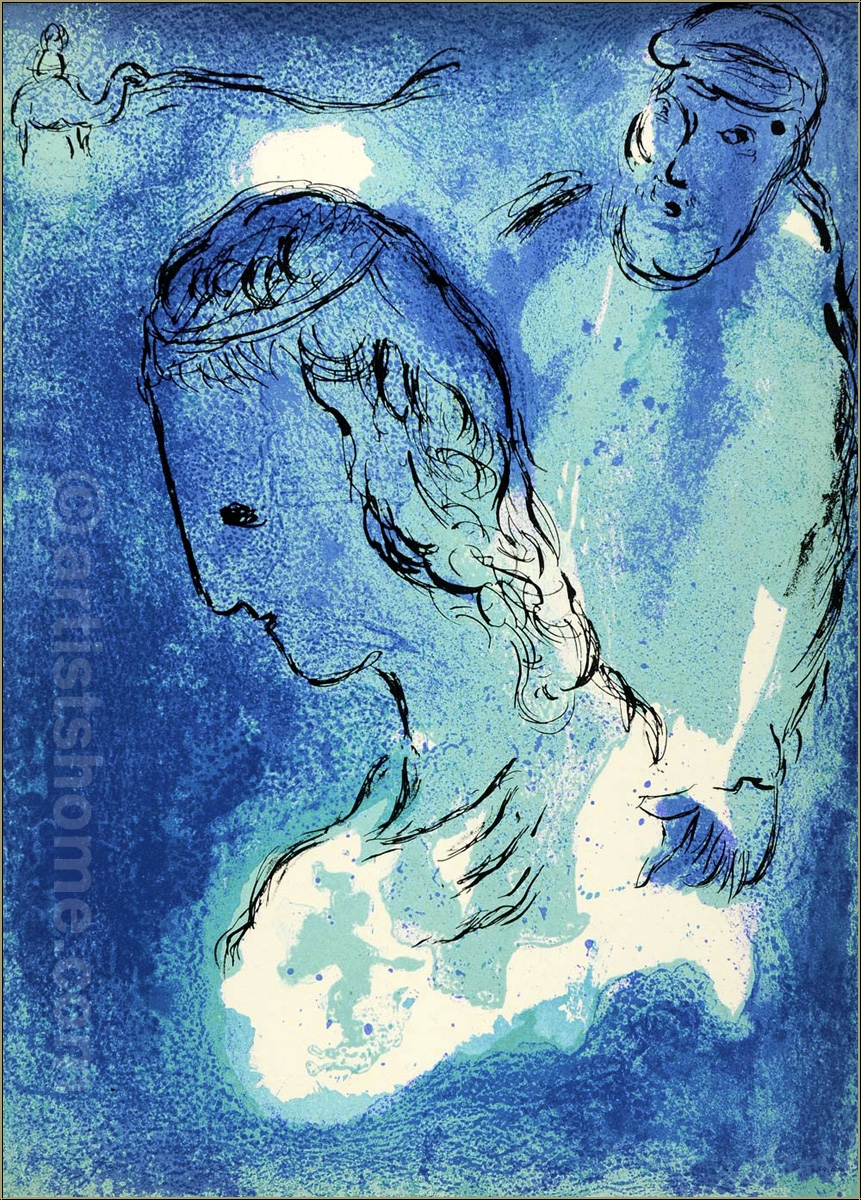
Marc Chagall: Abraham and Sarah, 1956, The Bible, Original Lithograph

Marc Chagall: Abraham and Sarah, 1956

Paul uses three different metaphors for the Law – which one or which combination of images most aides your understanding?


What slave-like conditions do young sons live under in verse 1-3? What rights to they enjoy when they grow up in verses 6-7?


From your own experiences, what are the differences between the relationship of a parent and a young child and that of a parent and a grown child?


How is the observance of the Law the same as pagan religion? How is different? How is life in the Spirit different?


What is the effect of the distinction Paul makes in verse 9: knowing God vs. being known by God?


What is the difference in tone between Paul’s appeal in verses 12-20 and his appeal in verses 21-31?


What does he mean when he says he became like them and what reasons does he give them to become like him?


What image does Paul use to contrast the selfishness of the false teachers?


How might the Judaizers have used the story of Hagar and Sarah and how does Paul use it?


Miss Vera Speaks


They ask how she grin through that face with that life.

I say I’s never shielded from nothing

‘Cept dying young.


People deep bruised by something

Talk like the world should end.

Won’t catch me dying every day like that.


‘Cause I seen them once

Just once – the cracks in the universe –

Thought I’d fall right through.


‘Stead I laughed – said some kind of God

Put up with a tattered-old place as here

Gotta have some grace for me.


– Jenn Cavanaugh

originally published in America, August 13, 2007

WP_20151111_001


Questions for Galatians, chapter 3

Click here for chapter 1

Click here for chapter 2

First reading: Read Galatians 3 in Eugene Peterson’s paraphrase The Message. What word, phrase, or verse stands out to you? Does it bring up a question? Speak to a question you’ve been having? Just resonate somehow? Is it confusing? Disturbing? Comforting? Make a note of it.

http://expressway.paulrands.com/oldsite/photogallery/signs/general/regulatory/images/wrongway.jpg

Image © Sam Laybutt (ozroads.com.au)

Comprehension & Reflection: Read the chapter again, answering the following:

Of what powerful images and experiences of God does Paul remind the Galatians in the first five verses? What is he trying to accomplish by reminding them?


In this version of verse 5, Eugene Peterson essentially defines miracles as the “Holy Spirit, working things in your lives you could never do for yourselves.” How would you define a miracle?


What experience have you had of miracles in your own life and the lives of those around you? Did they seem to correspond to any particular human action?


Paul argues his point first from the Galatians’ experiences, and then from the scriptures. Look up some of the references he makes and list his main points from scripture. [Genesis 15:6, 22:18, 26:4; Deuteronomy 27:26; Habakkuk 2:4; Leviticus 18:5; Deuteronomy 21:23]


What are the results of living by faith that cannot be gained from living by the law?


How would convincing the Galatians to think of themselves as descendants and inheritors of Abraham’s covenant protect them from the Judaizers’ demands? How was the Galatians’ initial faith like Abraham’s?


Restate in your own words the logic of Paul’s analogy of the ratified will in verses 15-20.


What does Paul say is the purpose of the law? What sort of roles does he assign to it?


In verse 28, what sort of general divisions does Paul say shouldn’t exist in Christ’s family? Do they still, in your experience? What error would Paul say these divisions indicate?

The Visions, Vibrations, and Tremors of Mary

For Advent, an ekphrastic poem of Mary’s secret thoughts on the annunciation – by Jenn Cavanaugh.

Source: The Visions, Vibrations, and Tremors of Mary

Questions for Galatians, chapter 2

Click here for chapter 1

First reading: Read Galatians 2. What word, phrase, or verse stands out to you? Does it bring up a question? Speak to a question you’ve been having? Just resonate somehow? Is it confusing? Disturbing? Comforting? Make a note of it.

Comprehension & Reflection: Read the chapter again, answering the following:

What do we know about Paul’s traveling companions, Barnabas and Titus, and what light do they shed on Paul’s ministry?

Why did Paul go to Jerusalem and what were the results of his visit? Describe Paul’s attitude toward the other apostles.

When Paul states his concern of “running in vain” in verse 2, what do you think he was worried about?

What is the larger significance of Titus not being compelled to be circumcised? What does Paul call those would have compelled him?

In verse 7, are there different gospels for the circumcised and the uncircumcised? Why might there be different apostles for the Jews and the Gentiles?

Why does Paul accuse Peter of hypocrisy? What led to it?

Try making some kind of visual outline of the distinctions Paul draws in verses 15-21 of justification through the law and through Christ (draw a picture or sketch a diagram or divide into columns). What do you notice?

What parts do grace and faith play in this chapter? In verse 16 the phrase “faith in Christ” could also be translated “the faith (or faithfulness) of Christ.” Read verses 15-21 again replacing “faith in” with “the faithfulness of.” Does it add anything to your reading?

Most of us cannot relate to the strong emotional, social, racial, and political divisions between Jew and Gentile at this time. Along what lines do we see the church dividing itself today?

Galatians details some rather unattractive struggles within the leadership of the early church. Why do you think these are included in our scriptures?

In this chapter, what are the signs of the true gospel and of the false?

Prayerful Reading (lectio divina): Ask 4 people in the group to be ready to read from the last few verses of the chapter.

Before the first reading take a moment as a group to quiet yourselves and prepare to listen deeply to the words being read and for the voice of God. Pray for God’s word to enter and work more deeply in your minds, hearts, and spirits. Read verses 19-21. Let the words soak in. Give them time.

For the second reading try to move from the intellectual exercise of study and enter into the truth of the words. Stop wrestling with them. Trust them and let them act on you. Read verses 19b(“I am crucified with Christ…)-20.

Let the third reading mark a time of silent prayer. Let your heart speak to God. Read verses 19b-20.

On the final reading rest in God’s presence. Let the Holy Spirit speak and transform your heart. Read verses 19b-20.

“Galatians 2:20. The Relinquished Life” by Mark Lawrence http://www.marklawrencegallery.com/products/the-relinquished-life

Click here for chapter 3


Questions for Galatians, chapter 1

This blog began as an attempt to make available to others some resources that I’d been involved in making, especially those that had a relatively high holy-sweat to beneficiary ratio the first time around. I’m currently leading a very small group in which exactly one participant really, really likes some concrete guidance as she prepares throughout the week for our Bible study. Now, I’ve been to seminary and you would think I would have some great stuff like that readymade and at my disposal. And I’m sure I do somewhere. In my library in storage on another continent. In a database I think I could still access if I could remember the password. Or my username. On some software on a bricked laptop. You get the picture. So these are for Marion, and – by the power of WordPress – for you, if they’re useful to you. They’re not so original that you should hesitate to bounce off them free-style and make them your own, but they’re original enough that if you are going print them off and hand them around to your own small group you should put my name and a link to this post at the bottom of the page. In teeny tiny print at least. Because you don’t want to go into this study with anything on your conscience – Paul’s in a mood. Enjoy. by Rich Wyld at theologygrams.wordpress.com

First reading: Read Galatians 1. What word, phrase, or verse stands out to you? Does it bring up a question? Speak to a question you’ve been having? Just resonate somehow? Is it confusing? Disturbing? Comforting? Make a note of it. Hold onto it prayerfully and see if it makes more sense to you at the end of this study.

Comprehension & Reflection: Read the chapter again, answering the following:

Who is writing and to whom?

What is an apostle?

How does Paul describe Christ’s work in verse 4?

What does he seem to consider his own work to be?

What has happened to occasion this letter?

What does “gospel” mean?

Paul doesn’t articulate this “different gospel” in this chapter. What can you guess about it based on what he does say?

According to this chapter, what are valid sources of the “gospel” and what are not?

What “traditions” do you think Paul is referring to in verse 14?

What credentials and details of his own life story does Paul present and why does he do so?

What misinformation does he seem to be trying to correct?

What dichotomies does Paul establish in this chapter?

What is the overall tone of this chapter?

Is the issue of “different gospels” still relevant for us today?

FOR ADDITIONAL STUDY/ CONTEXT:

  1. Where else in the Bible can we read about the churches or region of Galatia? Do these passages offer any further insight into Paul’s audience?
  2. Compare the salutation at the beginning of this epistle to some others. What similarities and differences do you notice?
  3. Compare Paul’s account of his travels with those in Acts.
  4. What additional information can you find about the historical background and setting of this letter?
  5. What other passages can you find dealing with teachings contrary to the gospel? How are they defined, described, etc.? What consequences, warnings, and instructions are issued relating to them?

Click here for chapter 2

No Fear of the World: The Sequel

Click here if you missed part 1

Any theology of culture will intertwine with an interpreter’s rational, theological, and ideological characterization of the present condition of humanity. If culture is a uniquely human creation, its status relies on our status. Does the image of God within us validate our good creations? Does our fallen state taint our works indelibly? Does our redemption transfer to the work of our hands and minds? Most theologies of culture cite the incarnation as a model. If Christ took on flesh and lived among us, we cannot follow God in the abstract or love our neighbor in only an otherworldly sense. In fact, the Trinity as a whole, not just the second person, exemplifies God’s commitment to humanity. God created, entered, and remains at large in this world and has commissioned and empowered the Church to walk to the ends of it to communicate that good news. Turning our back on the world is not an option for Christ’s body.

This is not to say that Christians should not be discerning consumers. Discernment is a constant process that constitutes a major portion of the Christian’s job description. This discernment process, however, occurs within the Christian community, not by forcing our vision on those outside of it. Ralph C. Wood advises we become “self-critical citizens of the world as well as self-critical confessors of the Faith.”[1] We learn to critique our cultures because, like it or not, they define a significant portion of our selves. If Christ did not come to condemn the world, why would he send us poor souls to do so? Or, as Paul once put it to the Corinthians, “What business is it of mine to judge those outside the church? Are you not to judge those inside?”[2] American Christians need to stop trying to enforce “Christian values”[3] outside of the body of Christ. If we concerned ourselves as much with keeping the Church and our own self-righteous selves on the straight and narrow as we currently do with perfect strangers who happen to act or sing for a living, we might wake up one morning to find we have a credible witness in the world.

When we come to terms with and gratitude for the fact that God has set us in our extended human families for our own good and for theirs, we begin to create within our cultures in order to bless them, rather than to curse. We stop trying to protect our own religious sensibilities and God himself by creating a safe cultural ghetto for ourselves. We can describe all our work in the world the way Tim Foreman of Switchfoot describes his band’s music: “Christian by faith, not by genre.”[4]

The apostle Paul validated what he found valid in the Athenian worldview, but sought to enlarge and inform it.  He served the Corinthians by becoming like them to win them over, for the sake of the gospel.[5]  The Church has traditionally patronized and sponsored the artistic tendencies of high culture.  Christians approve what is excellent, see nature (including human nature, in the form of the conscience) as a source of general revelation, and accept that what is true, beautiful, and good in human life represents God’s pervasive, common grace within all creation.  We can comfortably affirm ennobling tales of self-sacrifice, and the sentimental images, captured in oils, of devoted parents or a glowing sunset as echoes of God’s presence in our everyday lives. But what about Skins, Grand Theft Auto, and Here Comes Honey Boo Boo?  What of the superficial and frivolous, the gaudy and offensive? Should we consume such things? Contribute to their creation?

Not all the ideals of our culture will reflect our ideals, but our convictions of how things should be should not blind us to how things are. We must become conscious of the forces at work and play in our popular cultures that shape us or attempt to shape us. Being aware of the rules and ethos of Survivor, for example, allows us to recognize and resist social currents that might otherwise carry us along to unthinking engagement in behavior antithetical to the gospel.  While the language of voting people off the island, dismissing the weakest link, and pursuing entirely wrongheaded notions of winning becomes ingrained and normalized in our collective psyche, those in discerning Christian communities remind each other that the people of God are called to live into a different reality. What if Christians created everyday culture that reflected that reality? How can we do that if we’re not familiar with our culture as it actually exists? What if we occasionally took our kids to an “inappropriate” but important movie and talked to them about it instead of forbidding them to go? What if we listened to their music with them instead of insisting they turn it down or investing our energies in keeping them culturally ignorant? Once a week ask them to play you something and help you hear or see why it is significant to them.[6]

We all have different tastes. I’m not suggesting we feign a fondness for Glee where none exists, but do I become a better witness among my neighbors and co-workers by flaunting my complete ignorance of a show that informs and influences their lives?  Dick Staub counsels us to be “serious about faith, savvy about faith and culture, and skilled in relating the two…. Culturally savvy Christians follow the path of neither the cultural glutton nor the cultural anorexic. Instead, they are marked by their discretion and thoughtful discernment.”[7] Discernment is a form of wisdom Christ offers his Church through the Spirit to enable us to walk well in a world full of falling hazards and diversions. It is a gift and a tool that we become more adept at using as we practice it. Much of parenting consists of equipping our children to make good decisions then allowing them the freedom and responsibility to do so. God parents us in much the same way. We need to develop lifestyles of prayerfully listening to the Spirit to rightly and readily discern how to relate to particular aspects of our cultures, but God’s word equips us with some basic principles. Staub summarizes the relevant guidelines in Paul’s letters to the Romans and the Corinthians: all things are lawful, but not all are beneficial. We are not to be controlled by cultural goods or to use them to occasion another’s fall, but rather to do everything we do to the glory of God.[8] We are to remain in conversation with people who do not believe as we do. “Be wise in the way you act toward outsiders; make the most of every opportunity. Let your conversation be always full of grace, seasoned with salt, so that you may know how to answer everyone.”[9] Which response best stimulates that kind of conversation: “I don’t watch that show/ play that game/ listen to that music because I heard it was evil” or “I watched/ played/ listened to that a couple times, but I was so turned off by the glorified violence/ portrayal of women as objects/ the racist-sounding lyrics I just stopped. You obviously follow it more closely than I do, though. What about it appeals to you? What am I missing?”

Sometimes our neighbors and co-workers diversions will be just that: diversions – opportunities to check out from real life. Let’s not read too much into those or pretend we don’t have our own indefensible diversions. People who consistently try to convert others to a favorite movie or band or sport, however, have probably found something that moves them and relates to their desire for more out of life. In Your Neighbor’s Hymnal, Jeff Keuss talks about pop music as one of the many cultural forms in which we may find spiritual solace or expression; chances are our neighbors already have.

“True, there is pop music fandom that draws people into the trivial and mundane just as there are some Christian worship services that celebrate consumer culture more than critique it or provide an alternative. But the drive to find something larger than ourselves and make it public is a starting point – even a shallow faith is better than no faith at all. And in this we are to celebrate rather than too quickly denounce the fanboy faith that permeates the culture around us. Our neighbor’s hymnal is filled with pop songs that are sowing the seeds of faith and pushing for a form of life that is larger than the mundane and points to a transcendence worth paying attention to.”[10]

If we dismiss out of hand the cultural texts and goods that God may use to open our neighbor’s heart to something beyond this world, we squelch the prospect of discovering an addition to our playlist that works similarly on us; worse, we hazard quenching the Spirit, who – as the old song goes – moves in mysterious ways.

[1] Wood, Contending for the Faith: The Church’s Engagement with Culture (Waco, Tex.: Baylor University Press, 2003), 102.

[2] 1 Corinthians 5:12.

[3] Whatever those are; the fact that Christians can’t agree on them doesn’t bode well for their universal legislation anyway.

[4] qtd. in Andrew Beaujon, Bodypiercing Saved My Life: Inside the Phenomenon of Christian Rock (Cambridge, Mass.: Da Capo), 42.

[5] 1 Corinthians 9:9-13

[6] This will be a test, by the way. If they put themselves out to articulate something that matters to them and you only find fault with it, don’t expect them to play along next week. Even if a song or video turns you off completely, listen to your child’s heart and how media speaks to it and affirm that heart. Also, don’t expect their articulation to be particularly articulate or convincing at first. By having these conversations you may be giving them their first lessons in putting their spiritual lives into words; they’re not learning this in school. Listen for opportunities to augment their vocabulary for discussing soul issues without putting words in their mouths.

[7] Staub, The Culturally Savvy Christian: A Manifesto for Deepening Faith and Enriching Popular Culture in an Age of Christianity-Lite (San Francisco: Jossey-Bass, 2007), 1, 151.

[8] ibid. 152-153.

[9] Colossians 4:5-6, TNIV.

[10] Jeffrey F. Keuss, Your Neighbor’s Hymnal: What Popular Music Teaches Us about Faith, Hope, and Love (Eugene, Ore.: Cascade Books, 2011), 22.