Unknown's avatar

About Jenn Cavanaugh

B.A. Russian Language and Literature, Willamette University; M.A. Theology and the Arts, Fuller Seminary

No Fear of the World: Pop Culture in Worship

“Your beliefs will be the light by which you see, but they will not be what you see and they will not be a substitute for seeing.”[1]

“Popular culture” is often used as a shorthand reference to the faddish and fleeting. It flouts human wisdom to imagine that the eternal Divine, orchestrator of the heavens, who calls a universe into being with a word, cares about what is on the radio right now. God designed the intricacies of cellular biology from scratch, worked out a mathematical ratio to epitomize beauty and harmony, and built it into the most unexpected places in creation. We keep remarketing American Idol over and over and over again.

Doesn’t pop culture epitomize the world that is passing away and therefore constitute a colossal waste of time?  Following Ken Myers, Andy Crouch defines culture as “what we make of the world. Culture is, first of all, the name for our relentless, restless human effort to take the world as it’s given to us and make something else.”[2] What we make of the world that God created has obvious theological import.

Complete retreat from the world is not an option for the Church as a whole. Our churches represent places in which we may “withdraw from the situation, and attack the situation,”[3]  but never places in which we ignore the situation. Even while advocating a radical distinction between the Church and the world Stanley Hauerwas and William Willimon remind us that “the church is not out of the world. There is no other place for the church to be than here.”[4] That said, at various times we may find the steps prepared for us leading away from the consumption of certain cultural goods. New believers often feel led to trash their old music collections and start over more circumspectly. When I can’t volunteer to serve a meal to kids on the street because that’s the night my show is on, I realize something’s amiss. If I blew so much money on concerts last month that I can’t pay my rent and my tithe this month, I recognize this as a call to cut back. Regularly taking time away from our societal responsibilities so we can reconsider and reprioritize them in relative quiet reflects a healthy commitment to responsibility, not an abdication of it. Taking a month off from a particular radio station may help correct an over-identification with the rebellious and despondent spirits of the age. I daresay the occasional fast from social media would prove valuable to many of us. We embark on these fasts and retreats, however, not because we despair for our humanity and our world, but rather because of our ultimate hope in what God will accomplish in us in our humanity and in our world. A fast serves to devote time and space to listening and waiting on God, not as a judgment on food.

Too often Christians have tried to sever themselves from their humanity and human families or cultures for fear of defilement, forgetting that Christ became human to save us from sin and its effects. Jesus taught that sin does not enter through the pores or the mouth. Rubbing up against it does not contaminate us. It’s not a thing we ingest. In pop culture terms, the calls are coming from inside the house. This is why the Church’s experiments at creating separate cultures to compete with those around us have traditionally landed somewhere between rampant abuse and second-rate kitsch. The alternative, however, is not to dissolve indistinguishably into our various cultures, but to become mindful makers within them. Andy Crouch contends that “The only way to change culture is to create more of it.”[5]

[I]f we seek to change culture, we will have to create something new, something that will persuade our neighbors to set aside some existing set of cultural goods for our new proposal. And note well that there are a number of other possible strategies, none of which, by themselves, will have any effect on culture at all.[6]

These strategies include condemning, critiquing, copying and consuming culture.[7] All of these responses are appropriate at times, but they tend to shape us more than the cultures prevailing around us. Only after Christians adopt our rightful postures as cultural creators and cultivators do these other strategies become valid gestures that we can make with freedom and integrity.[8]

Obviously we cannot live in such a way as to remain indistinguishable from the world around us, but our conduct and community should communicate that distinction, not the style of music we listen to or our zip codes. Christ did not wage war on the world to conquer it. He loved, wooed, and transformed it. There is such a thing as loving people too much to leave them where they’re at, but one does not move one’s beloved through damning criticism. If we truly believe Jesus came to make our joy complete, we will find more constructive means of relaying that message of love and joy than indiscriminately trampling the things that make our friends and neighbors happy. Churches must learn to critique the cultures in which they operate without judgment and without relying on false distinctions of us versus them. We all live in cultural contexts and the more deeply we understand them, the better we can envision our proper place as Christians within them.

One way I’ve seen this dynamic play out in our church over the years is in the offertory. Fourteen years ago, my husband and I joined a 10-year-old Gen X church plant that met blocks from the Space Needle and lived by the motto of “real, relevant… and a little bit radical.” We met in a movie theater with reclining seats, cup holders, and no outside light. The smell of popcorn signaled the benediction. We sought to provide an authentic worship experience in a safely neutral worship environment for people who, for whatever reason, couldn’t picture themselves setting foot in a church. We hired professional musicians for the worship band and every Sunday they covered a non-Christian rock song for the offertory that tethered the sermon to relevancy. We reckoned that all truth is God’s truth and we would take it where we found it, even and especially from non-traditional sources. The corollary to this premise was that if no one was singing about it, it wasn’t a pressing enough question to preach on. Sometimes the message of the song and the message of the pastor represented a study in contrasts, underscoring the difference between the wisdom from above and wisdom from below, but it kept us in conversation with the world even in our windowless sanctuary. You listen to a song differently when you hear it in church (lyrics were printed in the bulletin, for easier study) and the process of doing this weekly warped us for life. Over the years we discovered another curious and welcome effect. You’d be shopping or working out or commuting when a song you first or last heard at church would come over the speakers and suddenly it’s like you’re in a worship service.

The offertory format survived the merger with a more traditional church on a different hill. At some point in the process of crafting a “transitional” service for the newly formed church, verbiage crept into the bulletin about how we played these secular songs to listen to “the world’s” take on or longings surrounding today’s theme. The actual phrasing has been lost to time, but it had strong overtones of us and them, with the implication that this portion of our church service had more to do with them than with us. Were we playing this music for people not in the room? I doubt it was the intention, but there was a subtle sense of introducing fallen music into our worship so that it could be preached at and corrected. And yet at the same time we were trending toward somewhat “safer” musical choices, occasionally by Christian artists, that were generally and often perfectly orthodox, which made even less sense. We tweaked the stock explanation a couple of times before changing the format again. At present one of our in-house hipsters contributes a paragraph outlining the band’s relevant biographical details along with doing most of the heavy mental lifting of interpreting and putting the song in context for us. Again, this shifts the focus slightly. The songs tend to correspond more positively with the message so they often serve as a rich set-up for the preaching. Lines from the song may become a refrain in the sermon. For many in our inter-generational congregation it has become a mini-lesson in pop culture rather than an exercise in interpreting the music we would think of as our own. The significance of this signature piece of our Sunday gatherings continues to evolve these many years on, reflecting shifts in our corporate identity, theology and mission.

What practices do you or does your church engage in regularly to keep the conversation going with the culture at large? Have you ever felt or been accused of being “tainted” by them?

[1] Flannery O’Connor, Mystery and Manners: Occasional Prose (New York: Farrar, Straus & Giroux, 1969), 91.

[2] Andy Crouch, Culture Making: Recovering Our Creative Calling (Downers Grove, Ill.: InterVarsity Press, 2008), 23.

[3] Paul Tillich, Theology of Culture (New York: Oxford University Press, 1959), 212-213

[4] Stanley Hauerwas and William H. Willimon, Resident Aliens (Nashville: Abingdon Press, 43.

[5] Crouch, 67.

[6] Crouch, 67.

[7] Crouch, 68-73.

[8] Crouch, 98.

Open Mics, Open Doors: Cultivating Culture and Relationships

“All culture making requires a choice, conscious or unconscious, to take our place in a cultural tradition. We cannot make culture without culture. And this means that creation begins with cultivation – taking care of the good things that culture has already handed on to us. The first responsibility of culture makers is not to make something new but to become fluent in the cultural tradition to which we are responsible. Before we can be culture makers, we must be culture keepers.”[1]

When we start talking about the church acting as a community center or a cultural center, people get understandably nervous. The local church should be much more than a community or cultural center, and those models should not constrain a church’s mission, and yet it must act in those capacities if it is to be both local and the church.

Your neighborhood may be different, but mine has some serious trust issues with “church” in the abstract. Organized Christianity has earned a reputation for bait and switch. Free meals! But I have to listen to someone yell at me about death and hell before I can eat? Welcoming community! Until my work schedule changes and no one notices I’m gone. (Or worse, they do, and hound me to come when I can’t.) Hip music! Followed by half an hour of trying to work through which two-thousand-year-old cultural mores still apply to women. Christians rationalize these kinds of disconnections on a regular basis, but we need to hear these disjointed messages as our visitors do. These scenarios come off as false advertising at best and intentional deceit at worst.

Why are there so many strings attached to the things we do in Jesus’s name? It communicates that we see the gospel as such a tough sell we have to lure people into the salesroom with a gimmick. In the words of R.E.M. “What if we give it away?”[2] What if we fed people simply because Jesus himself invites us to and tells us he’ll be on the receiving end of anything we give? What if we applied our shrewd-stewardly stratagems toward working out how to make the most of our resources to care for others more comprehensively, not how to get more out of them in return? To the degree that our churches have tried to sell and barter the words of life entrusted to us freely, we must own responsibility for the numbers of people who have chosen not to buy in to the churched life.

"Shelter?" by Heidi Estey. This was our poster monster for an outdoor group show in which almost all the pieces were eventually "taken in" by passersby - part of why we now put together our outdoor shows with in-house artists aware of such eventualities.

“Shelter?” by Heidi Estey. This was our poster monster for an outdoor group show in which almost all the pieces were eventually “taken in” by passersby – part of why we now put together our outdoor shows with in-house artists aware of such eventualities.

Considering ourselves, our traditions and our assets to be cultural and community resources would correct our attitudes substantially. A church, building and people, should be a blessing to its parish. The whole Judeo-Christian story we find in scripture is about God forming a people set apart to be agents of blessing to the rest of the world. To be chosen does not mean that we are in with God and the others are out; it means we are the ones called to invite the others in. This has nothing to do with imposing our lifestyle on others and pressuring them to conform to an enlightened Christian culture so they can know God like we do. It has to do with welcoming them in a way that communicates God’s desire to be known by them, creating buffer zones in which to hear that quiet voice, and making room amongst us for those who choose to follow it.

Few of us had any say in the physical design of our meeting places, but the onus is now on us to make them convey welcome. Our church is by far the churchiest looking church I have ever been a part of. Those of us moving in after years of worship in a movie theater and an office building suffered some serious culture shock. It’s an extremely staid and solid red brick and stained glass affair. Approaching from the front all you see are concrete stairs leading to three massive sets of wooden double doors. The view most often seen from the street is of these six immense and eminently closed doors. It’s imposing. I’ve been going to church all my life and I can hear these doors slamming shut just looking at them. The transformation when those doors are all flung open is supernatural, especially at night with warm light and music and voices pouring out onto an otherwise dark street. Suddenly it’s inviting. All the connotations of sanctuary make sense again. Strangers pop in just to say how happy they are to see the doors open.

The openness of our doors has become hugely symbolic for me. The unfortunate reality is that the cavernous open space behind those doors is an absolute bear to heat. In July and August it’s a relief to have the doors open, but almost any other time of year it’s a sacrifice. If you come to worship with us in February you will find one of the six doors propped not quite half open. If you’re fifteen minutes late the only thing holding that door open will be a tripped one-inch-wide deadbolt. We have bass and drums and lots of porous windows so if you walk by you know something’s going on, but it’s hidden behind essentially closed doors. Suffice it to say, I think any excuse to open those doors that’s not antithetical to the gospel is a good excuse. If it’s an activity that blesses our neighbors, meets needs in the community, or helps us fulfill our commission as cultivators of creation and creators of culture, so much the better.

Cultivating culture is different than conserving culture. Whether or not we avail ourselves of them, the Church on the whole has done a fine job of conserving its cultural goods: the writings of the first bishops, medieval mystics and the Scholastics; the stories of Asian martyrs; the paintings and sculptures of Michelangelo and treasured Orthodox icons; the chants heard morning and evening for centuries throughout Europe. If we only conserve culture, though, the Church will function merely as a museum. The Church is a unique institution called both to conserve and create, and as such, must be continuously reinventing the priestly ministry of representing humankind to God and God to humanity while consciously maintaining a tradition that runs back through the apostles and the patriarchs to our creation in the image of the Creator and Ruler of all. We who have historically been at the forefront of movements to recreate and reorder society have abdicated our responsibilities. Neither conservatives who commit to structures simply because they exist nor radicals who reject the very idea of structure that makes creative life sustainable are embodying the image of God or serving as Christ called us.

As cultivators we watch for the new growth peeping up from the earth around us, determine whether it’s the genuine article or a choking weed, and nurture the good growing things around us. We look for the plants in need of particular care, especially those good for food or medicine, and tend to their specific needs. As a Christian and as a poet, when I look around, one area of the garden that I see failing to thrive that I would like to help maintain for my culture is the thoughtful use of words. Dana Gioia wrote a fabulous essay called “Can Poetry Matter” in which he talks about the decay of language and discourse and offers six concrete suggestions for bringing poetry back into our public lives as a corrective to this decay.

I borrowed three of his ideas and distilled them into one event that answers our corporate call to be cultivators of what’s beneficial to our society and serves as yet another reason to have the doors open. Due to an ongoing failure of imagination, we called it a no-mic open-mic community reading, although Literary Potluck might stick eventually. We would call it a read-in, but that makes it sounds like we’re protesting something. Like an open mic, people can sign up ahead of time to read. Based on one of Gioia’s suggestions and our congregational ratio of significantly more readers to writers, we invite people to read either their own work or something they’ve read recently that they would like more people to hear. Open mic audiences tend to consist of writers there to read and close friends of writers there to read. They don’t draw a wide audience and the tenor of the events generally vibrates between ego and nerves. With this format anyone can participate and we all hear a lot of great writing. We also tone down the pressure to perform by removing the actual microphone from the scene. The first time we planned one of these we were a small enough group we could sit in a circle at the back of the church. The next time we set up a small table in the aisle in front of the last few pews. A microphone was not necessary to be heard.

As we held the events on Arts Walk nights we made sure people had easy access so they could sit or stand and listen a while and feel free to leave. Readers have ten-minute slots, but we ask them to keep individual readings to five minutes or less, so there are plenty of opportunities and to slip in and out without walking out on a reading. The Arts Walk is three hours long, so we took frequent breaks for coffee, tea and snacks people from the church brought to share and just to talk, catch up with other and meet anyone who came in during the reading.

[1] Andy Crouch, Culture Making: Recovering Our Creative Calling (Downers Grove, Ill.: InterVarsity Press, 2008), 74-75.

[2] Mike Mills, William Berry, Peter Buck and Michael Stipe, “What If We Give It Away?” Life’s Rich Pageant (I.R.S., 1986). From the first verse and chorus:

On the outside underneath the wall

All the money couldn’t buy

You’re mistaken no one’s standing there

For the record no one tried

Oh I try to…

What if we give it away?

For years this chorus would begin to play spontaneously and, as it turns out, prophetically in my head as a response to that hard sell mentality. Our first outdoor gallery initially felt like a bust. It was the only time we issued a call for submissions and got nothing of artistic merit from the outside world. It was raining so hard we almost cancelled the show because it was so miserable to install. Then a friend of one of our artists showed up with a couple of nice pieces. It lightened to a typical Seattle drizzle by the time the Arts Walk started and we had a good time hanging out on the sidewalk with our umbrellas and loaning them out so people could peruse our quirky little installation called Shelter. Half the pieces disappeared over the weekend. An editor of a local arts magazine happened on it during that time and mentioned to a mutual friend that he was debating whether or not to take a piece home as well, and an important conversation about public art, gift culture, and the church ensued. My friend referenced that same line (“What if we give it away?”) when he emailed me to say it sounded like the church was doing something right.

Never Miss Another Birthday: Ideas for Pentecost

“Pentecost Sunday is an end and a beginning. It is the culmination of the season of Easter. It is the day when the church senses the all-pervasive power of Easter as the Spirit is unleashed on Creation.”[1]

During the service people wrote on individual flames where they were hearing the Spirit call and what gifts they had been given to use in their calling. As part of the offering time they brought them forward to be assembled into the mural shown here.

During the service people wrote on individual flames where they were hearing the Spirit call and what gifts they had been given to use in their calling. As part of the offering time they brought them forward to be assembled into the mural shown here.

  • Fire pit on the sidewalk (must be attended)
  • Remove the outside doors from their hinges (assuming this is safe and reversible)
  • Make stackable boxes marked “everything we know about God” and give one to everyone entering along with instructions to take it up to the front of the church. Someone there assists people to stack them in the shape of a tower on top of several boxes that are already in place. These are rigged with string so when the account of the tower of Babel is read the strings can be pulled by a couple of people in the front rows to activate a spectacular collapse.
  • Later in the service people can approach the rubble as Peter’s speech is being read and receive a cross sticker to place on a box (or a small wooden cross to place inside a box or just by itself) to take out with them. Alternatively, distribute the boxes before the sermon and have people add their own words and images of the empty tomb, tongues of fire, etc.
  • Red rose petals – drop from balcony as people exit or in baskets in the pews, for handling during sermon
  • Toss red, orange and yellow streamers over the congregation during or after the benediction.
  • Sparklers to take away.
  • The church, frankly, needs more parties. Roberto Goizueta reminds us that “Play, recreation, and celebration are the most authentic forms of life precisely because, when we are playing, recreating, or celebrating, we are immersed in, or ‘fused,’ with the action itself, and those other persons with whom we are participating. Thus, we are involved in and enjoying the living itself.”[2] We chartered as a church on Pentecost and we threw ourselves and the neighborhood a block party with games, food and live music. Even if you didn’t charter on that day, it’s still the birthday of the Church, so whoop it up. Maybe you’ll have an annual picnic that day and hire a band or fly kites or do something else beautiful that expresses your identity as a church and that can be enjoyed by all.

Feel free to post additional ideas below!

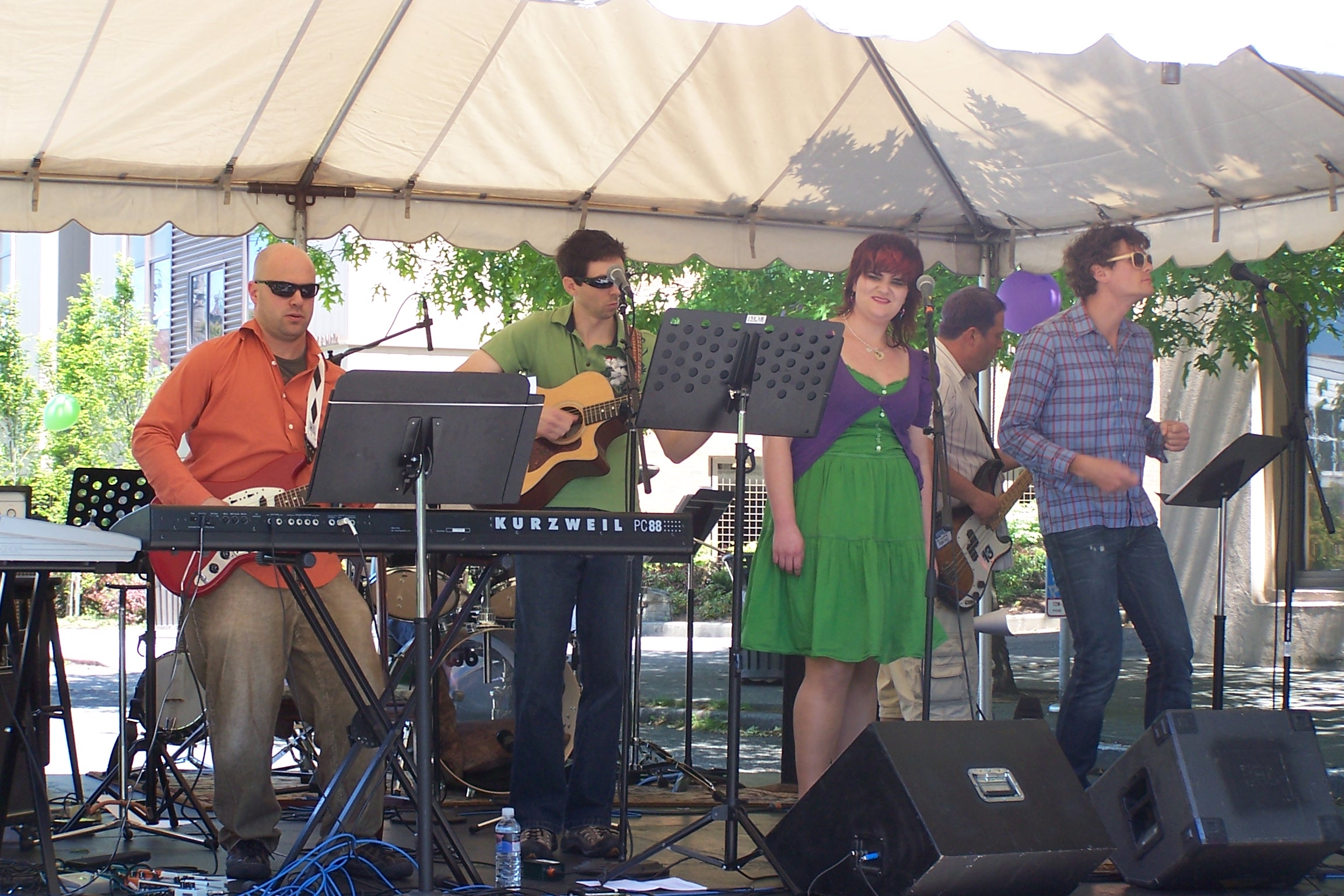
The worship band worked up a command performance of their favorite covers of the last year for our block party.

The worship band worked up a command performance of their favorite covers of the last year for our block party.

[1] Robert E. Webber, Ancient-Future Time: Forming Spirituality through the Christian Year (Grand Rapids: Baker Books, 2004), 161-162.

[2] Roberto Goizueta, Caminemos con Jesus: Toward a Hispanic/ Latino Theology of Accompaniment (Maryknoll, N.Y.: Orbis Books, 1995), p. 94. Qtd. In William A. Dyrness, Poetic Theology: God and the Poetics of Everyday Life (Grand Rapids: William B. Eerdmans Publishing Co., 2011), 55.

A Fasting Florilegium

“Consumerism, instead of satisfying needs, constantly creates new ones, often generating excessive activism. Everything seems necessary and urgent and one risks not even finding the time to be alone with oneself for a while. St Augustine’s warning is more timely than ever. “Enter again into yourself.” Yes, we must enter again into ourselves if we want to find ourselves. Not only our spiritual life is at stake but indeed our personal, family and social equilibrium itself. One of the meanings of penitential fasting is to help us recover an interior life. The effort of moderation in food also extends to other things that are not necessary, and this is a great help to the spiritual life. Moderation, recollection and prayer go hand in hand.” – Pope John Paul II http://www.ewtn.com/library/PAPALDOC/JP960310.HTM

 “…go back through history and inquire into the ancient origins of fasting. It is not a recent invention; it is an heirloom handed down by our fathers. Everything distinguished by antiquity is venerable. Have respect for the antiquity of fasting. It is as old as humanity itself; it was prescribed in Paradise…. Fasting gives birth to prophets and strengthens the powerful; fasting makes lawgivers wise. Fasting is a good safeguard for the soul, a steadfast companion for the body, a weapon for the valiant, and a gymnasium for athletes.” – Basil “Homily on Fasting” http://www.hsir.org/pdfs/2009/03/04/20090304aStBasilOnFasting%20Folder/20090304aStBasilOnFasting.pdf

“Fasting is a person’s whole-body, natural response to life’s sacred moments… not an instrument designed to get desired results. The focus in the Christian tradition is not ‘if you fast you will get,’ but ‘when this happens, God’s people fast.” – Scot McKnight, Fasting p. ix, xvii

“Each time we feel hunger or resist the temptation to eat and drink we are reminded of why we are not eating or drinking, namely because we want to become people whose entire heart, mind, soul, and strength are devoted to loving God. We can also give our surplus to others who are in need and learn to use the things of this world properly. Should we be attracted to fasting for less worthwhile reasons, such as losing weight for cosmetic reasons, these very thoughts help us recognize the mixed nature of our motives.” – Diogenes Allen, Spiritual Theology p. 83

“We must be careful not to make a formal fasting, or one that in truth “satisfies” us because it makes us feel as though we have all in order. Fasting makes sense if it really affects our security, and also if a benefit to others comes from it, if it helps us to grow in the spirit of the Good Samaritan, who bends down to his brother in need and takes care of him. Fasting involves choosing a sober life, which does not waste, which does not “discard”. Fasting helps us to train the heart to essentiality and sharing. It is a sign of awareness and responsibility in the face of injustices, abuses, especially towards the poor and the little ones, and is a sign of our trust in God and His providence.” – Pope Francis http://en.radiovaticana.va/storico/2014/03/05/pope_francis_celebrates_ash_wednesday_mass/en1-778966

“It is not the uncleanness of meat that I fear, but the uncleanness of an incontinent appetite. I know that permission was granted Noah to eat every kind of flesh that was good for food; that Elijah was fed with flesh; that John, blessed with a wonderful abstinence, was not polluted by the living creatures (that is, the locusts) on which he fed. But I also know that Esau was deceived by his hungering after lentils and that David blamed himself for desiring water, and that our King was tempted not by flesh but by bread. And, thus, the people in the wilderness truly deserved their reproof, not because they desired meat, but because in their desire for food they murmured against the Lord. Set down, then, in the midst of these temptations, I strive daily against my appetite for food and drink. For it is not the kind of appetite I am able to deal with by cutting it off once for all, and thereafter not touching it, as I was able to do with fornication. The bridle of the throat, therefore, must be held in the mean between slackness and tightness.” Augustine, Confessions, XXXI

“…fasting represents an important ascetical practice, a spiritual arm to do battle against every possible disordered attachment to ourselves. Freely chosen detachment from the pleasure of food and other material goods helps the disciple of Christ to control the appetites of nature, weakened by original sin, whose negative effects impact the entire human person. Quite opportunely, an ancient hymn of the Lenten liturgy exhorts: ‘Utamur ergo parcius, / verbis cibis et potibus, / somno, iocis et arctius / perstemus in custodia – Let us use sparingly words, food and drink, sleep and amusements. May we be more alert in the custody of our senses.’” – Pope Benedict XVI http://w2.vatican.va/content/benedict-xvi/en/messages/lent/documents/hf_ben-xvi_mes_20081211_lent-2009.html

“Fasting loves not many words, deems wealth superfluous, scorns pride, commends humility, helps man to perceive what is frail and paltry.” – Augustine, Sermon LXXII

This last quote is not like the others, but I’m fascinated by the physical correlation to our spiritual practices. How does letting go of what is superfluous renew our grasp on what is essential? Fasting actually prompts our bodies to seek energy from other sources than bread alone, trains them to seek the good and release the bad, and triggers healing processes on a cellular level. “Free radicals can be generated by poorly functioning mitochondria (the powerhouses of the cell). The switch between eating normally and fasting causes cells to temporarily experience lower-than-usual levels of glucose (blood sugar), and they are forced to begin using other sources of less readily available energy, like fatty acids. This can cause the cells to turn on survival processes to remove the unhealthy mitochondria and replace them with healthy ones over time, thus reducing the production of free radicals in the long-term.” – Douglas Bennion, Martin Wegman, and Michael Guo  http://theconversation.com/feast-then-famine-how-fasting-might-make-our-cells-more-resilient-to-stress-38808

Advent Week 2: Waiting for Peace

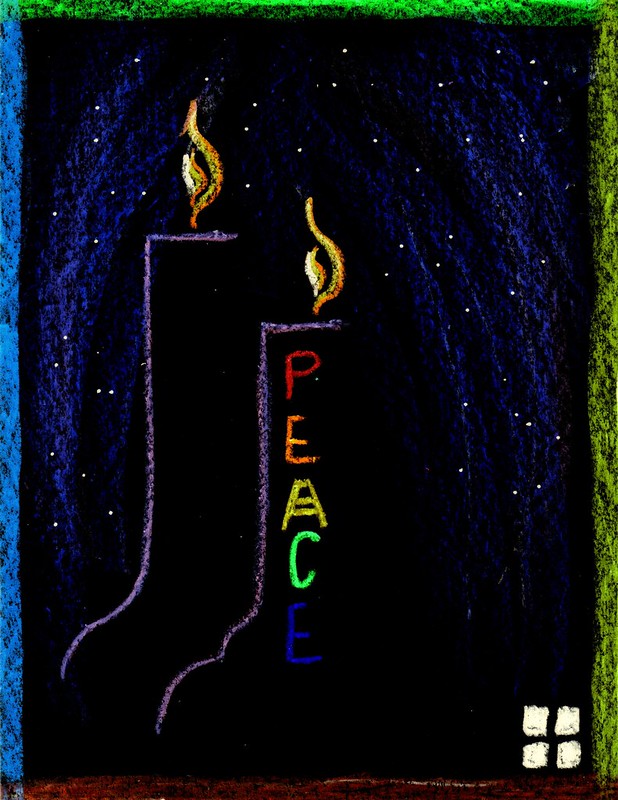
ADVT02 “Peace” by Stushie

Another tough week. A week of violence and revelations of violence and of just how deep the violence of the so-called good people of the world runs.

Thankfully the same scripture that instructs us to seek and receive peace, which seems so far removed from our world right now, also discourages us from faking it, from pretending the wounds aren’t so bad and spouting nonsense about peace when there is no peace. We of all people should trust neither in political promises of security nor in our innate collective goodness to one another to eventually win out. The kind of peace we can drum up ourselves doesn’t require waiting.  It tends toward immediate gratification (taking whatever pacifies our desires)  or mollification (caving in to other’s illegitimate demands) or diversion – gorging our senses to overwhelm our sensitivity to one another’s needs, eating to the point where we can no longer imagine starvation, turning up our own personal soundtracks so we don’t hear the suffering of others, looking at anything as long as it is away.

The sense of shalom peace that courses throughout the words of Genesis and Jeremiah and Jesus entails relational wholeness. None of us can achieve that kind of peace alone. It has nothing to do with getting away from it all and everything to do with assuming rightful places within a righted all. It is a peace we receive from drawing near to a God who would suffer the violence of birth and death to be with us. It is a peace we seek for our cities and neighbors as we strive to do right by one another.

from “Here on Earth”

The old man living
In his rented room
Grows lonely as the night comes on
Especially in winter

And the boy shooting drugs
On the tenement roof
Is lonely whether or not
He has companions

Lovers lie sleeping
Side by side
A wilderness between them

And their unborn infant
Is already alone
So soon to be discarded
Even as he begins
Unfolding in the womb
Of his lonely mother

Because the scatterer
Has overtaken us
Betraying promises
Estranging lovers

Tearing us inwardly
And tearing us apart
One from another

And this is why
Those of us who are sated
Find it so easy to ignore
Those of us who are starving

And why we have been known
To torture one another
Why there are times
When we are far more cruel
Than the animals.

Nevertheless
Taken all together
Or taken one by one
We are the holiest
Of all earth’s creatures

For he who kindled
The fire of the sun
He who draws out the tender leaves
From the dark twigs of winter

He who has whittled
A cabin for the snail
Has also carved our names
In the palm of his hand

And he became a child
The better to be near us
Born in the wintertime
Born on a journey….

– by Anne Porter, from Living Things: Collected Poems (New Hampshire: Steerforth Press, 2006), p. 124.

Advent Week 1: Waiting with Hope

advent week 1 (2)

It’s been a bad week to be told to wait.

An especially frustrating – even demeaning – time to be told to wait for justice, for the world to be set right, that things will get better, things which are not entirely in our hands to fix, things that can only truly change through some odd and mystical combination of patience and systemic upheaval, accountability and radical forgiveness, quiet and cataclysm.

Waiting with hope is the antithesis of an escapism. Waiting with hope does not mean blithely ignoring or submitting to the status quo, but walking humbly enough to find oneself in the company of those most deeply threatened by it, who have no choice but to wait, because their lives depend on others acting justly. That’s deeply unsettling when you think about it: living at one another’s mercy. We all do it, but it’s a gamble with blatantly rigged odds. Sadly we don’t extend kindness or even the benefit of the doubt with anything resembling equality and no one is under any illusion that we can rectify that overnight. And so we wait, but in the hope that justice will be established, that power will protect the powerless, that the starving will have their fill of good things. We wait with those who wait. “You’re tired. But everyone’s tired./ But no one is tired enough.” So…

Wait

Wait, for now.
Distrust everything if you have to.
But trust the hours. Haven’t they
carried you everywhere, up to now?
Personal events will become interesting again.
Hair will become interesting.
Pain will become interesting.
Buds that open out of season will become interesting.
Second-hand gloves will become lovely again;
their memories are what give them
the need for other hands. And the desolation
of lovers is the same: that enormous emptiness
carved out of such tiny beings as we are
asks to be filled; the need
for the new love is faithfulness to the old.

Wait.
Don’t go too early.
You’re tired. But everyone’s tired.
But no one is tired enough.
Only wait a little and listen:
music of hair,
music of pain,
music of looms weaving all our loves again.
Be there to hear it, it will be the only time,
most of all to hear
the flute of your whole existence,
rehearsed by the sorrows, play itself into total exhaustion.

 – Galway Kinnell

from Selected Poems. © Houghton Mifflin, 1983

A DIY Prayerbook for All Saints’ Day

binding2Even if your little patch of Christendom veers away from praying to the saints, we can all admit we could stand to pray more like them.

One year we set up a 24/7 prayer room to that end. People signed up to pray in one hour increments. One of the stations featured a fan file of these half-page size “prayers of the saints” (printed in more varied and attractive fonts and formats than my lil’ ol’ blog can muster), a few simple drawing and binding materials (card stock, binder rings, cord or ribbon, and a hole punch) and this invitation:

Read through the prayer cards in the file.

Do any give words to what is in your heart?

Are there any you would like to pray regularly and make your own?

Collect those that speak to you or speak for you

and bind them into a personal prayer book to take with you.

Make it as simple or elaborate as you like.

Use ribbon, glue or binder rings; illuminate it with your own illustrations.

There are blank cards for writing your own prayers.binding1

Prayer cards:

May the Light of Lights come

To my dark heart from Thy place;

May the Spirit’s wisdom come

To my heart’s tablet from my Saviour.


Be the peace of the Spirit mine this night,

Be the peace of the Son mine this night,

Be the peace of the Father mine this night,

The peace of all peace be mine this night,

Each morning and evening of my life.

– Celtic Traditional[1]


O Lord, I have heard of your renown,

and I stand in awe, O Lord,

of your work.

In our own time revive it;

in our own time make it known;

in wrath may you remember mercy.

  • Habakkuk 3:2


As the rain hides the stars,

as the autumn mist hides the hills,

as the clouds veil the blue of the sky,

so the dark happenings of my lot hide the shining of thy face from me.

Yet, if I may hold thy hand in the darkness,

it is enough, since I know, that though I may stumble in my going,

Thou dost not fall.

     – Scottish Gaelic Traditional[2]


Father, I abandon myself into your hands; do with me what you will. Whatever you may do, I thank you: I am ready for all, I accept all. Let only your will be done in me, and in all Your creatures – I wish no more than this, O Lord.

Into your hands I commend my soul; I offer it to you with all the love of my heart, for I love you Lord, and so need to give myself, to surrender myself into your hands, without reserve, and with boundless confidence,

For you are my Father.

– Charles de Foucauld[3]

Come Lord Jesus,

take away scandals from Your kingdom which is my soul,

and reign there.

You alone have the right.

For greediness comes to claim a throne within me;

haughtiness and self-assertion would rule over me;

pride would be my king;

luxury says, “I will reign”;

ambition, detraction, envy and anger struggle within me for the mastery.

I resist as far as I am able;

I struggle according as help is given me.

I call on my Lord Jesus.

For his sake I defend myself,

since I acknowledge myself as wholly his possession.

He is my God,

Him I proclaim my Lord.

I have no other king than my Lord, Jesus Christ.

Come, then, O Lord, and disperse these enemies by your power,

and you shall reign in me, for you are my King and my God.

– St. Bernard of Clairvaux[4]


Almighty God, have mercy on (Name)and on their faults and mine together.

Vouchsafe to amend and redress and make us saved souls in heaven together.

Where we may ever live and love together with you and your blessed saints.

By such easy, tender, merciful means as your own infinite wisdom can best devise;

and on all that bear me evil will and would do me harm.

– St. Thomas More[5]


O my God, with all my heart I am sorry for having sinned against You,

not because I fear the punishment my sins deserve,

but because You are so good

and because I owe to You everything good that I have ever had.

    – St. Julie Billart[6]


O tender Father, you gave me more, much more than I ever thought to ask for.

I realize that our human desires can never really match what you long to give us.

Thanks and again thanks, O Father, for having granted my petitions,

and that which I never realized I needed or petitioned.

– St. Catherine of Siena[7]


O Lord my God, Teach my heart this day where and how to see you, Where and how to find you. You have made me and remade me, And you have bestowed on me All the good things I possess, And still I do not know you. I have not yet done that For which I was made. Teach me to seek you, For I cannot seek you Unless you teach me, Or find you Unless you show yourself to me. Let me seek you in my desire, Let me desire you in my seeking. Let me find you by loving you, Let me love you when I find you.

– St. Anselm[8]

Lord Jesus, bind us to you and to our neighbor with love.

May our hearts not be turned away from you.

May our souls not be deceived nor our talents or minds enticed by allurements of error,

so that we may never distance ourselves from your love.

Thus may we love our neighbor as ourselves with strength, wisdom and gentleness.

With your help, you who are blessed throughout all ages.

      – St. Anthony of Padua

[9]

      Hearken to the cry of my heart

        You know, O Lord, what I ask of you

          My heart has so often told you.
          O desire of my soul, grant me the favor I implore;
              – St. John Eudes

[10]

Disturb us, Lord, when

We are too well pleased with ourselves,

When our dreams have come true

Because we have dreamed too little,

When we arrived safely

Because we sailed too close to the shore.


Disturb us, Lord, when

With the abundance of things we possess

We have lost our thirst

For the waters of life;

Having fallen in love with life,

We have ceased to dream of eternity

And in our efforts to build a new earth,

We have allowed our vision

Of the new Heaven to dim.


Disturb us, Lord, to dare more boldly,

To venture on wider seas

Where storms will show your mastery;

Where losing sight of land,

We shall find the stars.


We ask You to push back

The horizons of our hopes;

And to push into the future

In strength, courage, hope, and love.

— Sir Francis Drake[11]


O my God, speak, your servant is listening and is ready to obey you in all things.

      – St. Angela Merici of Brescia

[12]

    Alas, dear Christ, the Dragon is here again.
    Alas, he is here: terror has seized me, and fear.
    Alas that I ate of the fruit of the tree of knowledge.
    Alas that his envy led me to envy too.
    I did not become like God; I was cast out of Paradise.
    Temper, sword, awhile, the heat of your flames
    and let me go again about the garden,
    entering with Christ, a thief from another tree.

    –

      St. Gregory Nazianzus

[13]

Now all glory to God, who is able to keep you from falling away and will bring you with great joy into his glorious presence without a single fault. All glory to him who alone is God, our Savior through Jesus Christ our Lord. All glory, majesty, power, and authority are his before all time, and in the present, and beyond all time! Amen.

– St. Jude [14]

Check out the sites and books cited below for additional prayers.


[1] Collected by Alexander Carmichael. Qtd. in Shirley Toulson, The Celtic Year: A Celebration of Celtic Christian Saints, Sites and Festivals (Rockport, Mass.: Element Books, 1996), 41.

[2] World Prayers, “As the Rain Hides the Star,” http://www.worldprayers.org/archive/prayers/celebrations/as_the_rain_hides_the_star.html  (accessed June 17, 2011).

[3] qtd. in Woodeene Koenig-Bricker, Prayers of the Saints:An Inspired Collection of Holy Wisdom (San Francisco: HarperSanFrancisco, 1996), 47-48.

[4] qtd. in Woodeene Koenig-Bricker, Prayers of the Saints:An Inspired Collection of Holy Wisdom (San Francisco: HarperSanFrancisco, 1996), 103-104.

[5] qtd. in Woodeene Koenig-Bricker, Prayers of the Saints:An Inspired Collection of Holy Wisdom (San Francisco: HarperSanFrancisco, 1996), 94-95.

[6] qtd. in Woodeene Koenig-Bricker, Prayers of the Saints:An Inspired Collection of Holy Wisdom (San Francisco: HarperSanFrancisco, 1996), 61.

[7] qtd. in Woodeene Koenig-Bricker, Prayers of the Saints:An Inspired Collection of Holy Wisdom (San Francisco: HarperSanFrancisco, 1996), 42.

[8] http://www.beliefnet.com/Faiths/Prayer/2009/07/Prayers-of-the-Saints.aspx?p=4 Accessed 10/06/14.

[9] qtd. in Woodeene Koenig-Bricker, Prayers of the Saints:An Inspired Collection of Holy Wisdom (San Francisco: HarperSanFrancisco, 1996), 29.

[10] qtd. in Woodeene Koenig-Bricker, Prayers of the Saints:An Inspired Collection of Holy Wisdom (San Francisco: HarperSanFrancisco, 1996), 101.

[11] http://www.worldprayers.org/archive/prayers/invocations/disturb_us_lord_when_we.html (accessed 10/06/14).

[12] qtd. in Woodeene Koenig-Bricker, Prayers of the Saints:An Inspired Collection of Holy Wisdom (San Francisco: HarperSanFrancisco, 1996), 59.

[13] qtd. in Woodeene Koenig-Bricker, Prayers of the Saints:An Inspired Collection of Holy Wisdom (San Francisco: HarperSanFrancisco, 1996), 75.

[14] Jude 1:24-25 New Living Translation

Last Words | Reformed Worship

Last Words | Reformed Worship.

A Good Friday service comprised of seven movements, each of which focuses on one of Jesus’ seven last words and consists of a gospel reading, a meditation, and a congregational response. It combines elements traditional to the Stations of the Cross, Tre Ore, and Tenebrae services, a few dramatic devices of the Passion Play, suggestions for art and music, and some of my own writing.

Consider the Groundhog

“Presentation in the Temple” by Fra Angelico. Come to think of it, in these portrayals with the swaddling clothes and halo, Jesus does look like a candle. Do you think he ever sees his own shadow?


By some strange coincidence, February 2nd is both the rather goofy custom of Groundhog’s Day and the rather more solemn feast of Candlemas, a holiday celebrating the Presentation of Jesus at the Temple, his Meeting with Simeon and Anna, and the Purification of Mary. Random, right? Not at all. The two are intimately connected. (The Super Bowl, however, is a moveable feast and so, no matter what anybody tells you today, not particularly related to this episode in the story of divine revelation.)
Christians have been observing the interconnected events commemorated by Candlemas since the 4th or 5th century. Mary took Jesus with her to the temple to be dedicated as the firstborn and for her own rite of purification 40 days after he was born according to Jewish law. According to the New Testament Simeon recognized that the child would be a light to the Gentiles, hence the candle motif and the Eastern church’s name for the day: Hypapante, or “Meeting.”

As Candlemas falls close to the midpoint of winter, it accrued additional cultural significance in many countries. It marked the really, truly bitter end of the Christmas season, when all the decorations must come down and people mentally moved on to wondering when they could safely plant some more food already. Around this time the wild beasts, dormant during the brunt of the season, would tentatively emerge to gauge if the worst of the weather had passed or if a longer winter’s nap might be in order. In the UK, folks expected to see anything from wolves to snakes to bears, but badgers were somehow singled out as nature’s forecasters in this regard – I’m guessing because they made for less dangerous viewing. Badgers apparently being in shorter supply in Germany and the New World, the Pennsylvania Dutch made do with a woodchuck or groundhog.

So Punxsutawney Phil is essentially the Easter Bunny of Candlemas.

Incidentally, if you’re one of the 3 in 7 Americans who can never remember if seeing his shadow means six more weeks of winter if it’s the other way around perhaps it’s the French influence. They have contradictory traditional sayings which predict that a sunny Candlemas, or Chandeleur, portends the final hour and/or the first of forty more days of winter. What the French can agree on, however, is that crepes must be eaten today or dire consequences will ensue.

Making crepes the chocolate bunnies of Candlemas.

Different traditions focus on different aspects of the day, so if you’d like to get observant, you can start almost anywhere:
• Light candles and have crepes for dinner. (The French wheat industry thanks you!)
• Host a Wives’ Feast. (This and “Women’s Christmas” on Epiphany are opportunities for people of a certain gender who may find themselves standing in the kitchen for most of the holidays to sit down and talk about something other than oven temperatures and dietary restrictions.)
• I realize no one’s ever thought of this before, but how about a pancake breakfast at church?
• Have child dedications during service and/or a special blessing or time of prayer for the newborns and new parents in the congregation.
• Pass out candles during the benediction to symbolize carrying the light of the world out with us as we go. Invite people to carry and light them in a dark place or as a symbol of their holding a dark place up in prayer. Or set up candles around the room labeled with various “areas of life” (health, finances, relationships, work, etc.) and offer a “Meeting” time at the end of the service. Invite people to light their candle in some area of life in which they want to see Jesus and send people out with them lit. (According to tradition, anyone who makes it home with the candle still lit won’t die that year: BONUS!)

Celebrating Epiphany: CMB

Here in France we’ve already celebrated, doling out some little Christmas presents that arrived late, and letting the youngest sit under the table to call out who got the next piece of the King Cake.
galette des rois
Surprisingly, she chose herself last and the fève turned out to be a ceramic wolf with a surfboard. I used the powers bestowed on me by the silver paper crown I won finding it to pack the girls off to bed as soon as possible after all that, as it was also their first day of school here. Eight straight hours of French were taking their toll and they have to get up and do it again tomorrow.
So you’ll have to go on without us this year, but those folks who have a few more hours left in the day (or who relish the thought of some holy tagging under cover of darkness) should check out this lovely tradition and the modern German take on it as chronicled by the equally lovely Susan Forshey at the Contemplative Cottage. http://contemplativecottage.com/2014/01/05/chalking-the-door-20cmb14/