
This gallery contains 14 photos.
DIY Stations of the Cross this Lent with images from the public domain Continue reading

This gallery contains 14 photos.
DIY Stations of the Cross this Lent with images from the public domain Continue reading
It happened today on my start screen calendar. I watched it flip from Good Friday directly to Easter (tomorrow), with nary a Holy Saturday in between. One of the earliest Christian heresies was that Jesus didn’t really die. There were variations on the theme — he merely swooned, or he was never so human or incarnate or mortal as to be able to manage it.
To be fair, it really is hard to reconcile the fully God and fully human thing with being fully dead and then fully capable of doing something about it. Go ahead and try for a minute; I’ll wait.
There has been much written on the scandal of the cross, but to a large degree, that’s just human nature and divine nature played out to their fullest. Of course if God shows up to restore justice we’re going to crucify him. And of course God will let us.
What’s truly shocking is the day after that, and the day after that. Death and resurrection are the true scandals. That we could stop the pulse of the one who set the planets in motion. That God would come back to us afterward, promising life abundant.
The church calendar doesn’t skip from Good Friday to Easter. It makes space for a great silence, a deep reckoning and wrestling with the consequences of what we have done. The people in Jesus’s life have followed him, loved him, betrayed him, mocked him, and killed him. And today they mourn him.
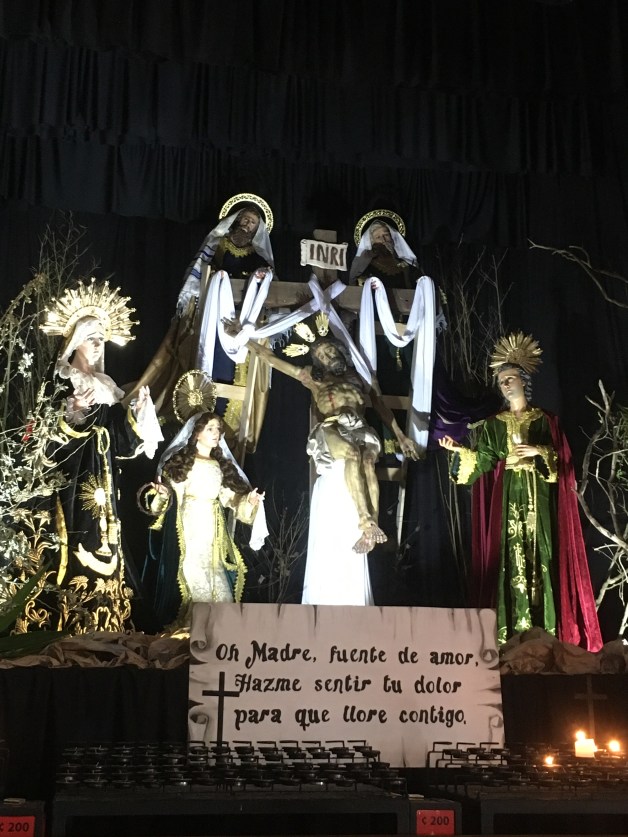
“Oh Mother, fountain of love, cause me to feel your pain, so that I may cry with you.” photo by Jenn Cavanaugh
This Lent, we have walked together alone through unrelenting cycles of grief and confusion. Today we have been given a day to name and mourn our losses, to feel and so clarify our feelings. Sometimes we only recognize what we truly love for what it truly is when it has been taken away from us.
Your absence has gone through meLike thread through a needle.Everything I do is stitched with its color.— “Separation” by W. S. Merwin
This is a season of apocalypse, not in that the world is ending, but in that one superficial layer of it has been pulled back to reveal another layer of depth. What have you seen that you can’t unsee? Make a note of it, because there will be a temptation to snap out of this weirdness and revert to a version of “reality” that merely glossed over what is real.
We are living in a time in which the old has passed away and new has not yet come. For today, let’s just sit here a spell and reckon with it. We might feel like we’re stuck in Stephen King’s novel The Stand (for which he is, apparently sorry), but it’s a line and image from his Pet Sematary that should stick with us now: “Sometimes, dead is better.” We didn’t go through all of this for that kind of twisted at-all-costs reanimation, did we?
This is the time to sift between the habits we miss because they brought consolation to the world and those that simply made us comfortably numb to it.
It’s okay to grieve the loss of normalcy, to admit that it hurts to give up the things that make us happy. I, for one, should be traveling next week, not making sack lunches for homeless teens with nowhere to be during the day.
Or should I?
This is not the fast we would have chosen, but if we can see it through in the spirit of the fast God chooses, then we and the world will ultimately be better for it.
Yesterday we buried our dead. Today we mourn. Tomorrow we will have the holy task of ushering back to life what is worthy of our love and devotion and co-creating the world anew.
A prayer from the cross – by Leonard Cohen
If it be your will
That I speak no more
And my voice be still
As it was before
I will speak no more
I shall abide until
I am spoken for
If it be your will
If it be your will
That a voice be true
From this broken hill
I will sing to you
From this broken hill
All your praises they shall ring
If it be your will
To let me sing
From this broken hill
All your praises they shall ring
If it be your will
To let me sing
If it be your will
If there is a choice
Let the rivers fill
Let the hills rejoice
Let your mercy spill
On all these burning hearts in hell
If it be your will
To make us well
And draw us near
And bind us tight
All your children here
In their rags of light
In our rags of light
All dressed to kill
And end this night
If it be your will
If it be your will
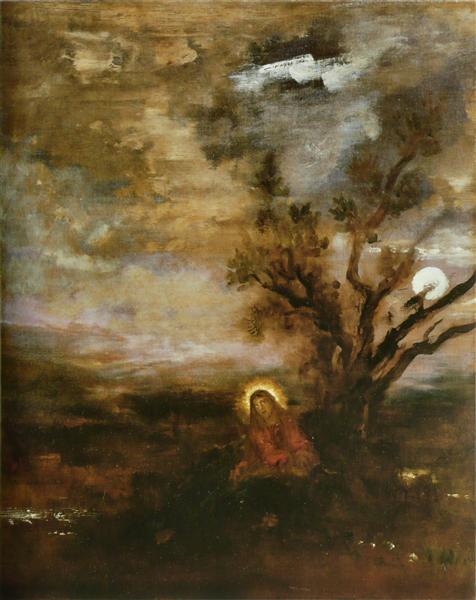
Le Christ au jardin des Oliviers — Gustave Moreau
We know he was a man because, once doomed,
he begged for reprieve. See him
grieving on his rock under olive trees,
his companions asleep
on the hard ground around him
wrapped in old hides.
Not one stayed awake as he’d asked.
That went through him like a sword.
He wished with all his being to stay
but gave up
bargaining at the sky. He knew
it was all mercy anyhow,
unearned as breath. The Father couldn’t intervene,
though that gaze was never
not rapt, a mantle around him. This
was our doing, our death.
The dark prince had poured the vial of poison
into the betrayer’s ear,
and it was done. Around the oasis where Jesus wept,
the cracked earth radiated out for miles.
In the green center, Jesus prayed for the pardon
of Judas, who was approaching
with soldiers, glancing up – as Christ was – into
the punctured sky till his neck bones
ached. Here is his tear-riven face come
to press a kiss on his brother.
The American Church in Paris just posted a short film for Maundy Thursday. The voiced-over reflections by youth and young adults from the congregation capture the spirit of the times, both now and then: a gathering of disciples processing the events of the last few weeks, discussing how the world has changed and what the future may hold, trying to find meaning and make sense of it all without the benefit of hindsight; denial and admission of fear; incredulity in the face of death.
“Very truly, I tell you, one of you will betray me.” – Jesus (John 13:21)
“Well, did you trust your noble dreams and gentle expectations to the mercy of the night? The night will always win.”
Worse yet, Jesus, did you trust your noble dreams and gentle expectations to the mercy of your followers? Well, then you will always be betrayed. Even if we regret it in the morning. Even if we miss “your stupid face” and “bad advice” when we’ve done everything in our power to flee your presence.
The disciples each had to ask if he would be the one to betray you, Jesus, because they all knew deep down that they were capable of it. More than that, they had absorbed years of your teaching and knew their incapability of living up to it. Judas just knew it better than any of them. Recognized the foolishness of filling all these earthen vessels and tried to shift the onus back on you and your divinity to usher in the kingdom of God. He wasn’t wrong in thinking us unequal to the task.
Even in our attempts to be faithful, we try “to clothe your bones” with poor production values, to make you real to the world around us with unconvincing words that turn people off and trite music that falls flat.
“I throw this to the wind, but what if” Judas “was right” in a way — to just get it over with, and quickly? It was an honest betrayal of sorts, that literally gutted him, compared to Peter swearing up and down that he would never betray Jesus. We can only swear such a thing by the moon — “th’inconstant moon” that changes form and position constantly like our variable love (Romeo and Juliet, II:2).
Jesus knew this would happen all along, and yet he chose to trust, he chooses to entrust us with his message to the world, to include us in his intimate circle, to call us friends. Part of striving to live worthy of such a calling includes facing the inevitability of failing to do so. Jesus entrusting human beings with following the will of God means that yes, the night will always win. But the darkness will not have the last word. The day of the Lord is now, and coming. Jesus’s faithfulness in following the will of God means that the night will never triumph.
Two parables of the fig tree. Two ways of trying too hard only to have nothing real to show for it. On which side do you err? Pouring so much of your energy into the leafy appearance of productivity with nothing left to share? Or running in so many directions that you rob yourself of the joy of seeing something through to fruition? The fig tree speaks to our tendency to prioritize looking like we have it all together over doing what we were made to do and the futility of trying to have and do it all.
12 The next day as they were leaving Bethany, Jesus was hungry. 13 Seeing in the distance a fig tree in leaf, he went to find out if it had any fruit. When he reached it, he found nothing but leaves, because it was not the season for figs. 14 Then he said to the tree, “May no one ever eat fruit from you again.” And his disciples heard him say it.
15 On reaching Jerusalem, Jesus entered the temple courts and began driving out those who were buying and selling there. He overturned the tables of the money changers and the benches of those selling doves, 16 and would not allow anyone to carry merchandise through the temple courts. 17 And as he taught them, he said, “Is it not written: ‘My house will be called a house of prayer for all nations’? But you have made it ‘a den of robbers.’”
18 The chief priests and the teachers of the law heard this and began looking for a way to kill him, for they feared him, because the whole crowd was amazed at his teaching.
19 When evening came, Jesus and his disciples went out of the city.
20 In the morning, as they went along, they saw the fig tree withered from the roots. 21 Peter remembered and said to Jesus, “Rabbi, look! The fig tree you cursed has withered!” – Mark 11:12-21

Today’s lectionary text from Isaiah 42 describes the Lord’s chosen servant and the gentle and faithful justice he will mete. In verse 7, God charges him:
You will give sight to the blind,
bring prisoners out of prisons,
and bring those who live in darkness
out of dungeons. (God’s Word Translation)
Jesus preached his first sermon on the first bit of Isaiah 61, and made it clear that he was that selfsame chosen servant. This is Jesus’s “life verse:”
The Spirit of the Lord God is upon Me,
Because the Lord has anointed Me
To preach good tidings to the poor;
He has sent Me to heal the brokenhearted,
To proclaim liberty to the captives,
And the opening of the prison to those who are bound;
To proclaim the acceptable year of the Lord (Isaiah 61:1-2a, NKJV)
In exegeting another text referring to this “acceptable time” of salvation, Paul makes it clear that we are also called to be the Lord’s servants, and NOW is the acceptable time (2 Corinthians 6:1-2). God’s favor is ongoing and we are to preach this same good news. And you know what?
There’s never been a better time to set some captives free.
I realize this feels like wading into the political, but the gospel does that sometimes. Sorry. I’m just a messenger.
Honestly, though, I think we might have more common ground here than we’re told we do. We all have to reconcile in our theologies the Biblical images of radical forgiveness and “eye for an eye” consequences. We might lean ideologically toward one end or the other of that spectrum, but we can generally agree that that is the spectrum. Punishments should fit the crime. We can support a correctional system, but not institutionalized cruelty. We seek peace and justice, not perpetuating cycles of violence and vengeance.
Any one of us could think of any number of crimes that could land a person in prison, but that don’t warrant the kind of Russian roulette to which mass confinement in a time of Covid-19 has now sentenced them.
Likewise, any one of us could think of detained populations that don’t deserve to be in heightened danger. Not all of them get as much air time as nursing home residents and cruise ship passengers, but they’re often in even tighter quarters, and in less control of crucial practices of basic hygeine. Political prisoners. Asylum-seekers. Hurting people caught in possession of drugs. Folks guilty of, or simply accused of, misdemeanors. Psychiatric patients committed “for their own safety” and youth remanded to juvenile detention “for their own good.” People in jail as part of “due process,” not as the result of it.
Let’s advocate for them. Demand their release. Sponsor them. Post bail for them. Write a letter on behalf of political prisoners. Request house arrest rather than solitary confinement for an inmate with a medical condition. At least make sure they have soap. Pray for them:
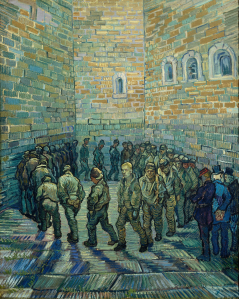
“Prisoners Exercising” by Vincent van Gogh
I call for you cultivation of strength in the dark.
Dark gardening
in the vertigo cold.
in the hot paralysis.
Under the wolves and coyotes of particular silences.
Where it is dry.
Where it is dry.
I call for you
cultivation of victory Over
long blows that you want to give and blows you are going to get.
Over
what wants to crumble you down, to sicken
you. I call for you
cultivation of strength to heal and enhance
in the non-cheering dark,
in the many many mornings-after;
in the chalk and choke.
— “To Prisoners” by Gwendolyn Brooks
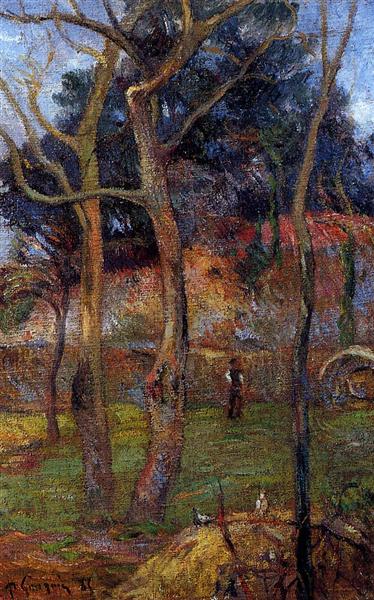
Bare Trees by Paul Gauguin
Hymn
I know if I find you I will have to leave the earth
and go on out
over the sea marshes and the brant in bays
and over the hills of tall hickory
and over the crater lakes and canyons
and on up through the spheres of diminishing air
past the blackset noctilucent clouds
where one wants to stop and look
way past all the light diffusions and bombardments
up farther than the loss of sight
into the unseasonal undifferentiated empty stark
And I know if I find you I will have to stay with the earth
inspecting with thin tools and ground eyes
trusting the microvilli sporangia and simplest
coelenterates
and praying for a nerve cell
with all the soul of my chemical reactions
and going right on down where the eye sees only traces
You are everywhere partial and entire
You are on the inside of everything and on the outside
I walk down the path down the hill where the sweetgum
has begun to ooze spring sap at the cut
and I see how the bark cracks and winds like no other bark
chasmal to my ant-soul running up and down
and if I find you I must go out deep into your
far resolutions
and if I find you I must stay here with the separate leaves
— A. R. Ammons
Jesus is quickening the pace toward Jerusalem and the cross. What must you do to keep up?
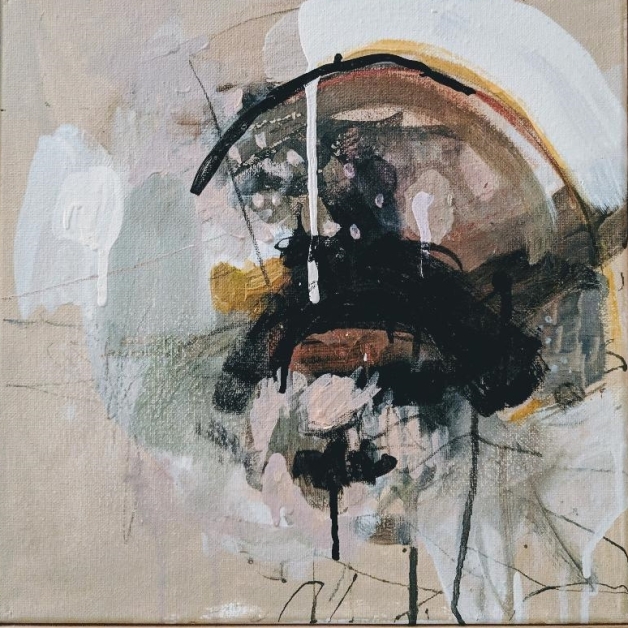
Abstract #2 by Trisha Gilmore
I said to my soul, be still, and let the dark come upon you
Which shall be the darkness of God. As, in a theatre,
The lights are extinguished, for the scene to be changed
With a hollow rumble of wings, with a movement of darkness on darkness,
And we know that the hills and the trees, the distant panorama
And the bold imposing facade are all being rolled away–
Or as, when an underground train, in the tube, stops too long between stations
And the conversation rises and slowly fades into silence
And you see behind every face the mental emptiness deepen
Leaving only the growing terror of nothing to think about;
Or when, under ether, the mind is conscious but conscious of nothing–
I said to my soul, be still, and wait without hope
For hope would be hope for the wrong thing; wait without love,
For love would be love of the wrong thing; there is yet faith
But the faith and the love and the hope are all in the waiting.
Wait without thought, for you are not ready for thought:
So the darkness shall be the light, and the stillness the dancing.
– from Four Quartets by T. S. Eliot
 Homespun