Advent Again – day 5

Choose the better part…

(c) The Fleming Collection; Supplied by The Public Catalogue Foundation

“Glasgow Tenement” by David Ross Warrilow

“Listen. Put on morning.” by W. S. Graham

Listen. Put on morning.
Waken into falling light.
A man’s imagining
Suddenly may inherit
The handclapping centuries
Of his one minute on earth.
And hear the virgin juries
Talk with his own breath
To the corner boys of his street.
And hear the Black Maria
Searching the town at night.
And hear the playropes caa
The sister Mary in.
And hear Willie and Davie
Among bracken of Narnain
Sing in a mist heavy
With myrtle and listeners.
And hear the higher town
Weep a petition of fears
At the poorhouse close upon
The public heartbeat.
And hear the children tig
And run with my own feet
Into the netting drag
Of a suiciding principle.
Listen. Put on lightbreak.
Waken into miracle.
The audience lies awake
Under the tenements
Under the sugar docks
Under the printed moments.
The centuries turn their locks
And open under the hill
Their inherited books and doors
All gathered to distil
Like happy berry pickers
One voice to talk to us.
Yes listen. It carries away
The second and the years
Till the heart’s in a jacket of snow
And the head’s in a helmet white
And the song sleeps to be wakened
By the morning ear bright.
Listen. Put on morning.
Waken into falling light.

Advent Again – Day 3

What are you waiting for?

from “I Am Waiting” by Lawrence Ferlinghetti

I am waiting for the Great Divide to be crossed

and I am anxiously waiting

for the secret of eternal life to be discovered

by an obscure general practitioner

and I am waiting

for the storms of life

to be over

and I am waiting

to set sail for happiness

and I am waiting

for a reconstructed Mayflower

to reach America

with its picture story and tv rights

sold in advance to the natives

and I am waiting

for the lost music to sound again

in the Lost Continent

in a new rebirth of wonder


I am waiting for the day

that maketh all things clear

and I am awaiting retribution

for what America did

to Tom Sawyer

and I am waiting

for Alice in Wonderland

to retransmit to me

her total dream of innocence

and I am waiting

for Childe Roland to come

to the final darkest tower

and I am waiting

for Aphrodite

to grow live arms

at a final disarmament conference

in a new rebirth of wonder


I am waiting

to get some intimations

of immortality

by recollecting my early childhood

and I am waiting

for the green mornings to come again

youth’s dumb green fields come back again

and I am waiting

for some strains of unpremeditated art

to shake my typewriter

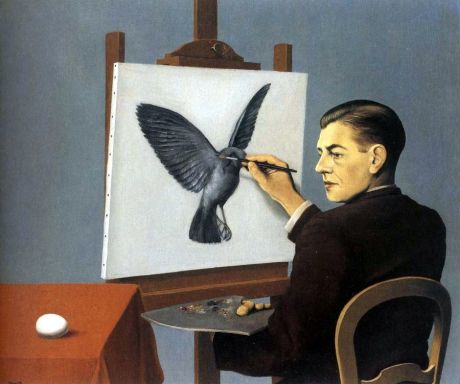
magritte-la-clairvoyance

“La Clairvoyance” by René Magritte


and I am waiting to write

the great indelible poem

and I am waiting

for the last long careless rapture

and I am perpetually waiting

for the fleeing lovers on the Grecian Urn

to catch each other up at last

and embrace

and I am awaiting

perpetually and forever

a renaissance of wonder

Advent Again – Day 2

“When did we see you…?”

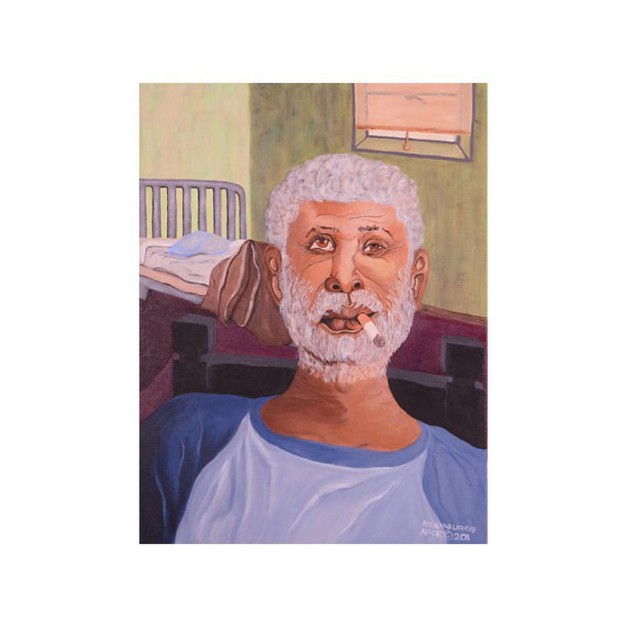
lafayeoldbrokeandalone

Old, Broke and Alone” by Adrienne La Faye


A long time ago, I took a walk down a street in Harlem in New York City. I came upon a man who asked me for a dollar. He had asked a few other people before me, but they only passed him by without glancing his way. I stopped and handed the man some money. As I began to turn away, he reached out and shook my hand. He looked me in the eyes and said, “I will bless you.” Now, I’m not saying that was God Himself. But how do we know that it wasn’t someone working for him, walking around in disguise, just to see what we would do?

MUHAMMAD ALI, The Soul of a Butterfly

Advent Again – Day 1

“Making Peace” by Denise Levertov


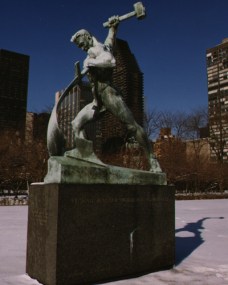
swords-to-ploughshares-evgeniy

“Let Us Beat Swords into Plowshares” by Evgeniy Vuchetich, in reference to today’s lectionary reading: Isaiah 2:1-5


A voice from the dark called out,

‘The poets must give us

imagination of peace, to oust the intense, familiar

imagination of disaster. Peace, not only

the absence of war.’

      But peace, like a poem,

is not there ahead of itself,

can’t be imagined before it is made,

can’t be known except

in the words of its making,

grammar of justice,

syntax of mutual aid.

   A feeling towards it,

dimly sensing a rhythm, is all we have

until we begin to utter its metaphors,

learning them as we speak.

  A line of peace might appear

if we restructured the sentence our lives are making,

revoked its reaffirmation of profit and power,

questioned our needs, allowed

long pauses . . .

  A cadence of peace might balance its weight

on that different fulcrum; peace, a presence,

an energy field more intense than war,

might pulse then,

stanza by stanza into the world,

each act of living

one of its words, each word

a vibration of light—facets

of the forming crystal.

The Visions, Vibrations, and Tremors of Mary

For Advent, an ekphrastic poem of Mary’s secret thoughts on the annunciation – by Jenn Cavanaugh.

Source: The Visions, Vibrations, and Tremors of Mary

Advent Week 2: Waiting for Peace

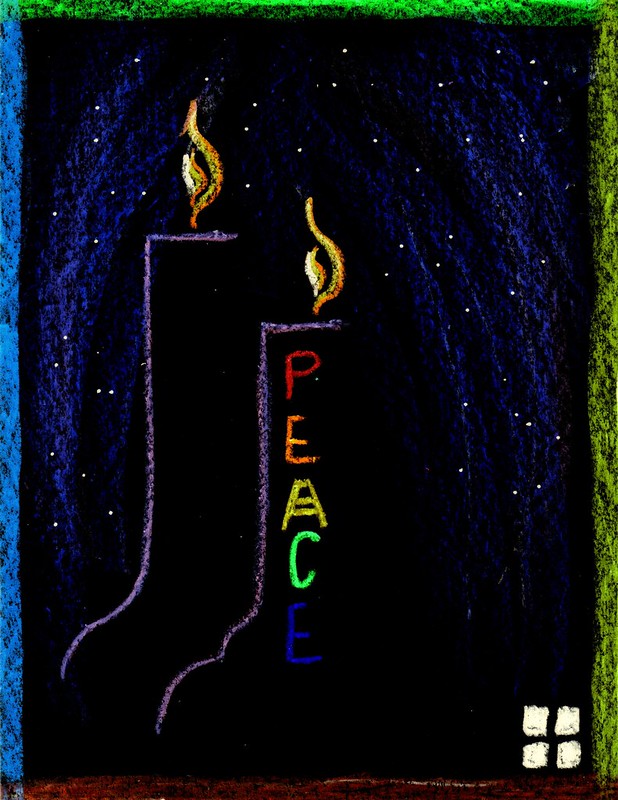
ADVT02 “Peace” by Stushie

Another tough week. A week of violence and revelations of violence and of just how deep the violence of the so-called good people of the world runs.

Thankfully the same scripture that instructs us to seek and receive peace, which seems so far removed from our world right now, also discourages us from faking it, from pretending the wounds aren’t so bad and spouting nonsense about peace when there is no peace. We of all people should trust neither in political promises of security nor in our innate collective goodness to one another to eventually win out. The kind of peace we can drum up ourselves doesn’t require waiting.  It tends toward immediate gratification (taking whatever pacifies our desires)  or mollification (caving in to other’s illegitimate demands) or diversion – gorging our senses to overwhelm our sensitivity to one another’s needs, eating to the point where we can no longer imagine starvation, turning up our own personal soundtracks so we don’t hear the suffering of others, looking at anything as long as it is away.

The sense of shalom peace that courses throughout the words of Genesis and Jeremiah and Jesus entails relational wholeness. None of us can achieve that kind of peace alone. It has nothing to do with getting away from it all and everything to do with assuming rightful places within a righted all. It is a peace we receive from drawing near to a God who would suffer the violence of birth and death to be with us. It is a peace we seek for our cities and neighbors as we strive to do right by one another.

from “Here on Earth”

The old man living
In his rented room
Grows lonely as the night comes on
Especially in winter

And the boy shooting drugs
On the tenement roof
Is lonely whether or not
He has companions

Lovers lie sleeping
Side by side
A wilderness between them

And their unborn infant
Is already alone
So soon to be discarded
Even as he begins
Unfolding in the womb
Of his lonely mother

Because the scatterer
Has overtaken us
Betraying promises
Estranging lovers

Tearing us inwardly
And tearing us apart
One from another

And this is why
Those of us who are sated
Find it so easy to ignore
Those of us who are starving

And why we have been known
To torture one another
Why there are times
When we are far more cruel
Than the animals.

Nevertheless
Taken all together
Or taken one by one
We are the holiest
Of all earth’s creatures

For he who kindled
The fire of the sun
He who draws out the tender leaves
From the dark twigs of winter

He who has whittled
A cabin for the snail
Has also carved our names
In the palm of his hand

And he became a child
The better to be near us
Born in the wintertime
Born on a journey….

– by Anne Porter, from Living Things: Collected Poems (New Hampshire: Steerforth Press, 2006), p. 124.

Advent Week 1: Waiting with Hope

advent week 1 (2)

It’s been a bad week to be told to wait.

An especially frustrating – even demeaning – time to be told to wait for justice, for the world to be set right, that things will get better, things which are not entirely in our hands to fix, things that can only truly change through some odd and mystical combination of patience and systemic upheaval, accountability and radical forgiveness, quiet and cataclysm.

Waiting with hope is the antithesis of an escapism. Waiting with hope does not mean blithely ignoring or submitting to the status quo, but walking humbly enough to find oneself in the company of those most deeply threatened by it, who have no choice but to wait, because their lives depend on others acting justly. That’s deeply unsettling when you think about it: living at one another’s mercy. We all do it, but it’s a gamble with blatantly rigged odds. Sadly we don’t extend kindness or even the benefit of the doubt with anything resembling equality and no one is under any illusion that we can rectify that overnight. And so we wait, but in the hope that justice will be established, that power will protect the powerless, that the starving will have their fill of good things. We wait with those who wait. “You’re tired. But everyone’s tired./ But no one is tired enough.” So…

Wait

Wait, for now.
Distrust everything if you have to.
But trust the hours. Haven’t they
carried you everywhere, up to now?
Personal events will become interesting again.
Hair will become interesting.
Pain will become interesting.
Buds that open out of season will become interesting.
Second-hand gloves will become lovely again;
their memories are what give them
the need for other hands. And the desolation
of lovers is the same: that enormous emptiness
carved out of such tiny beings as we are
asks to be filled; the need
for the new love is faithfulness to the old.

Wait.
Don’t go too early.
You’re tired. But everyone’s tired.
But no one is tired enough.
Only wait a little and listen:
music of hair,
music of pain,
music of looms weaving all our loves again.
Be there to hear it, it will be the only time,
most of all to hear
the flute of your whole existence,
rehearsed by the sorrows, play itself into total exhaustion.

 – Galway Kinnell

from Selected Poems. © Houghton Mifflin, 1983

Holy Days are Here Again: Christmas Edition

 “In recent years the church itself has become the target of a good deal of criticism and, for many, has simply been dismissed as a meaningful player in contemporary culture. And yet, all the while, as we have seen, there is an increasingly urgent desire for images that capture something of the depth and beauty of life, for practices that can structure one’s life and spark affection. Religion has always been the custodian of such symbols, and they were the center of the church’s life from the beginning. Yet the sad fact is that few people turn to the church for such symbols today.”[1]

Dietrich Bonhoeffer famously claimed that “the church is only the church when it exists for others.”[2] That means the things we do in and as a church are deeply motivated by the people outside of the church. This kind of talk sometimes devolves into a sense that we should warp all the things we do in support of our own spiritual walks and lives to accommodate a random, idealized person who is not yet interesting in living a Christian life. That’s the sort of thing that ends in worship services where we don’t talk about Jesus for fear of alienating someone not in the room. That is not what it means to be the church for others.

In order to be the church for others we must first be the Church. There must be something going on in our midst for the seeker to find. It is both considerate and constructive to consider often what others interested but uninitiated in our language and practices would take away from observing them. Do they extend the welcome of Christ? The Church talking about how best to minister to people where they’re at is one of the most Christ-like things we could be doing. The conversation about whether we do certain things or talk amongst ourselves in certain ways because they’re “churchy” or because they’re significant to us and to living out our faith should be ongoing. The best way to be sensitive to people who have not completely bought into our community’s vision of God, however, is not to make it blander and presumably more palatable, but rather to offer sacrificial hospitality, complete translucence, and the richest of fare to the best of our abilities.[3] People don’t go on spiritual quests looking for superficiality, but depth. It’s worth discussing what might make people think to include our church on their quest and what offputtingly shallow practices, attitudes, and lingo they might encounter here if they do.
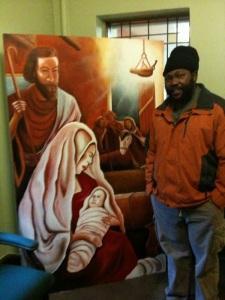
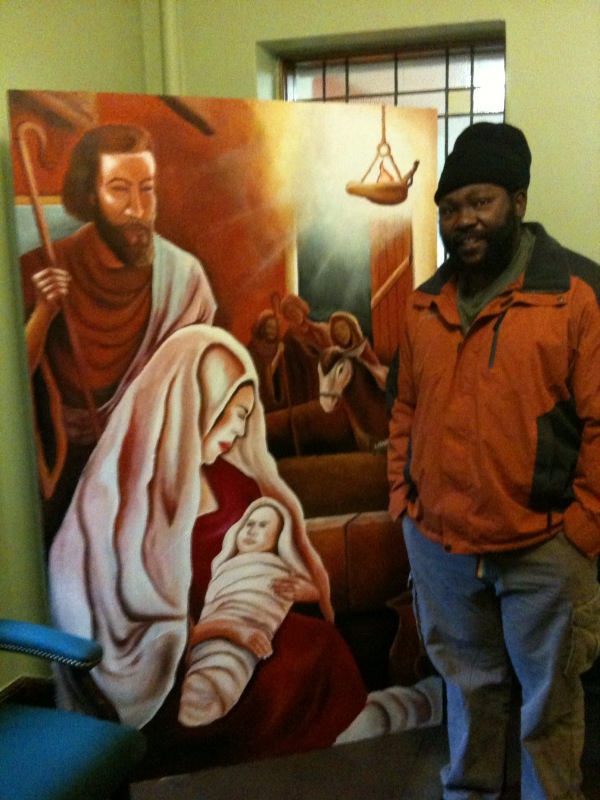
Bigga Gonzalez with the mural he painted during worship for Advent 2010. Each week the sermon and music focused on a different character in the Christmas story and so did the painting. Photograph by Jenn Cavanaugh.

Bigga Gonzalez with the mural he painted during worship for Advent 2010. Each week the sermon and music focused on a different character in the Christmas story and so did the painting. Photograph by Jenn Cavanaugh.

We often talk like we expect people to just wander in off the street in search of a place to encounter God. Remarkably, that does happen almost every time we open our doors, but it’s more of a symptom of desperate spiritual starvation than an indicator that they’re ready to throw in their lot with us on this journey. Consider the kind of confidence and trust we’re asking of people: to lose themselves in the worship of God in the company of strangers. Perhaps some word-of-mouth or outward sign will mark it as a place that is safe and trustworthy enough to enter, but increasingly the church building itself is not a sufficient sign of such. It may be that the sights, sounds and actions of our worship, ministry and community, visible from street level, audible through the open doors and perceptible in our neighbors’ daily lives could serve as such signs. Even then – even if people wander in for the music or the art or the safety itself – there’s no guarantee you have drawn them into worship. On the other hand, the symbolic act of walking into a church may be for them a greater step toward acknowledging God as God than most of your regular attenders take on an average Sunday.

Holy days are prime opportunities to be church for the world. It seems that people who do not normally attend church feel freer to come by. They are also the best times to revisit, and occasionally reinvent, our most significant traditions. It honors and blesses visitors and regulars alike to take breaks from our regular programming to dive deep into the festivals of the Christian year. What if Christmas in the church were as cozy and low-key as the secular versions most of us remember fondly as the best Christmas ever, the one that restored our souls and fostered our sense of family?

Homemade Christmas

The holidays wreak havoc on schedules. The churchy modus operandi entails planning extra, elaborate, once-a-year activities and services with only a skeleton crew to run them. Under these conditions, most proposed new traditions happen exactly once. Here’s an idea for a new tradition that may be more significant for the community, but probably less work for any one person than anything else you’ve done for Christmases past.

Sometime before Thanksgiving recruit nine volunteers who know they will be in town for Christmas Eve. Try to include a good cross-section of the church: young and old, male and female, starving artists and software engineers, different ethnicities. Assign them each a passage of scripture for a traditional lessons and carols service . Let them each plan a “lesson and carol” movement with a talk or a reading or an interpreted work of art and a song or activity for the congregation to respond with. Make sure you have at least one musician at their disposal for the singing. They each need to have their plans in writing a week prior to Christmas Eve so you can be sure not everyone is planning to sing Away in a Manger. Nine people who may not normally have much of a voice in church will have just blessed your congregation and twice-a-year visitors and made them feel like family.
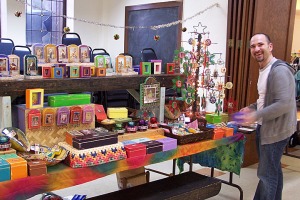
To file in the "not less work, but great fun" category: the Christmas Arts & Crafts Bazaar. In recent years we've taken a break from making it so sales focused and simply spent the day making art together.

To file in the “not less work, but great fun” category: the Christmas Arts & Crafts Bazaar. In recent years we’ve taken a break from making it so sales focused and simply spent the day making art together.


[1] William A. Dyrness, Poetic Theology: God and the Poetics of Everyday Life (Grand Rapids: William B. Eerdmans Publishing Co., 2011), 220.

[2] Dietrich Bonhoeffer, Letters and Papers from Prison, 1997, 1953:282 [Ethics]

[3] One of the most powerful forms of translucence is acknowledging the limit of our powers and abilities. Instead of presenting our efforts as the end-all-be-all, what if we offered them as offerings and articulated whenever asked our experience that there is more and greater than we can do or say? This allows us to work toward God’s will being done without limiting God in others’ minds.
Sacred Space on a Budget: Advent

At our small, city church, our idea-to-budget ratio runs extremely high. I have long applied this quote to my own life, but it has also become a prevailing theme and philosophy in our arts and worship planning:

“Economy is the art of making the most of life.

The love of economy is the root of all virtue.”

– George Bernard Shaw

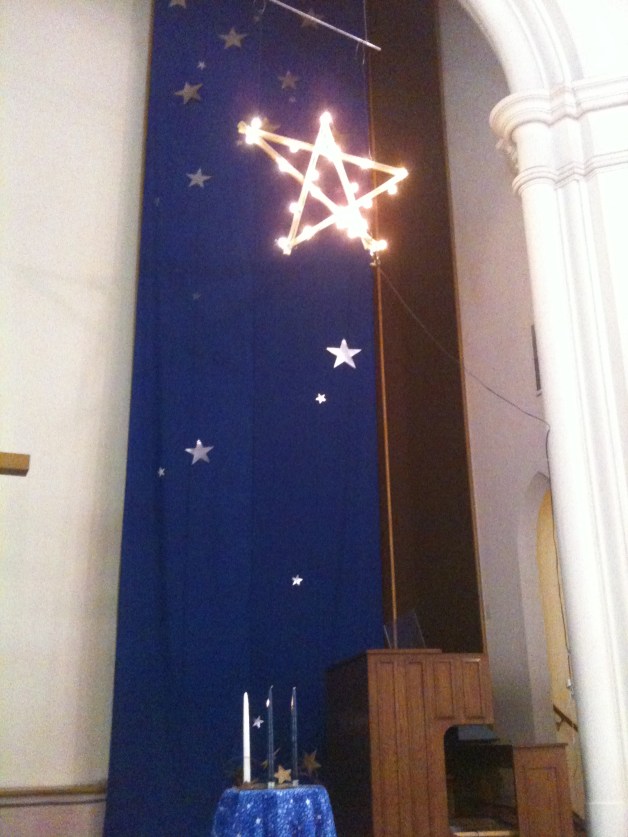
As much of a fan as I am of putting your money where your values are, I have also seen how making much of little stimulates creativity. Limits are good for art, and improvising with found materials has become part of our aesthetic and ethos. We’ve ingrained this practice to such a degree we didn’t manage to spend the relatively roomy budget we allowed ourselves for dolling up the sanctuary this season. The more dramatic bits were practically free, made from paper, foil, scrap wood, and an upcycled string of bulbs.

Star by Trish, Fabric Hanging by Deb & Cristie

Star by Trish, Fabric Hanging by Deb & Cristie

The Advent “wreath” is a 6′ length of wire with rusted tin stars coiled around a basic candleholder.

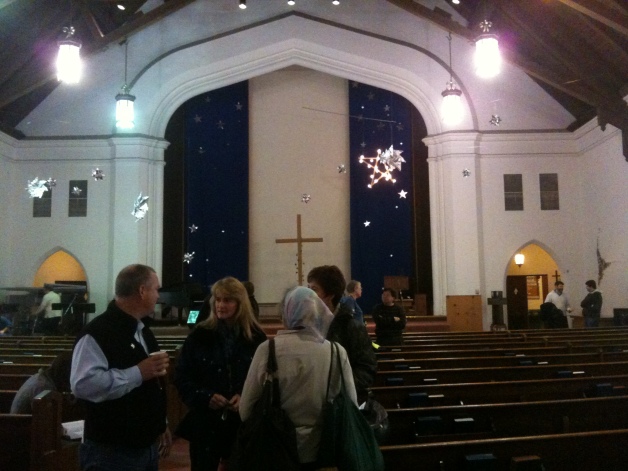
We strung a big X of fishing line across the sanctuary above the pews and hung silver origami stars of various styles at varying lengths. The silver caught the light and the layout created the illusion of depth, distance, and filling space on multiple planes with only 13 stars and 2 lines.

I really must take some pictures with an actual camera again someday, but you get the idea.

I really must take some pictures with an actual camera again someday, but you get the idea.

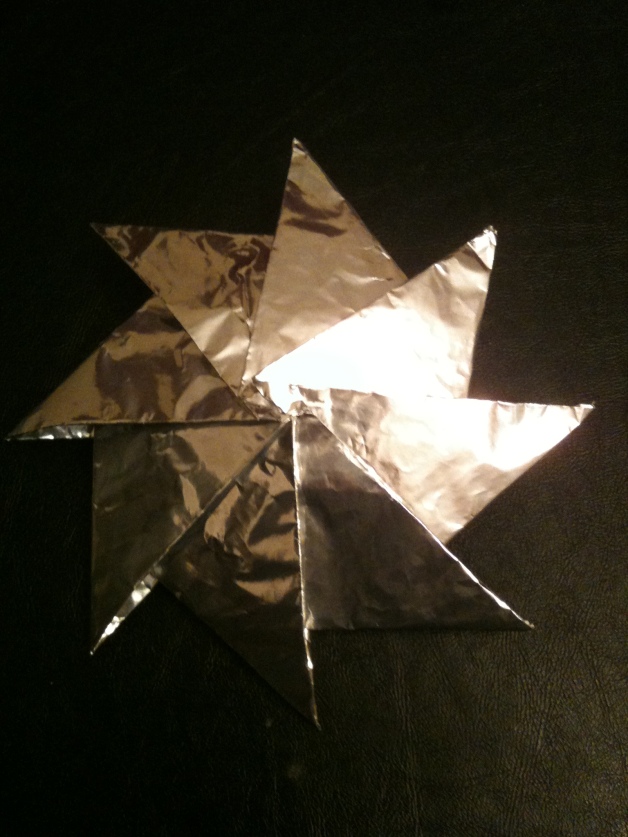
We’re planning to save these for another year and add a similar number of stars on two lines run straight across to achieve more of a knock-out effect. Here are the stars up close along with links to the online tutorials I followed to make them.

The septima stars were quite simple to fold. The component pieces could be easily mass-produced by a chatty group with idle hands, and the pattern is forgiving enough you can use slightly imperfect aluminum foil squares.

septima star

The kusudama pieces are a little more complicated, and I did cheat and use one piece of tape at each join so they could survive the handling necessary to hang them. Better suited for origami paper and crafty types willing to pay more attention to detail. If you do too many yourself, be prepared to dream about crane folds.

kusudama Click here for more beautiful patterns. Most are more involved, and many are more flower-like than star-like. Hmm… Easter, anyone?

Advent Reflection – Day 23

The Savior must have been
A docile Gentleman—
To come so far so cold a Day
For little Fellowmen—

The Road to Bethlehem
Since He and I were Boys
Was leveled, but for that ‘twould be
A rugged Billion Miles—

– Emily Dickinson

Eight elegant lines of Theological Anthropology and Christology dancing on the tongue and lingering in the mouth. Christ is at once one of us, subject to the rigors of travel and the nip in the air; yet very God, leveling the impossible expanse between us by walking it in humble and generous condescension.