Advent Reflection – Day 22

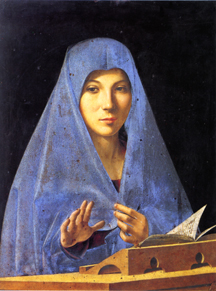
1_Virgin_Annunciate2
from “The Virgin Annunciate by Antonello da Messina”


Again.     Closer.


This time only one hand startles,
Losing her place in the book of hours.
The other goes on worrying the light
Habit of modesty worn to protect the angels.


Will it be the image bound to emerge from this blur of words
Shuddering through her? A full moon of the language of rising up
And coming down, building up and tearing down, swelling until
Everything she sees echoes with its own formation and demise….


– Jenn Cavanaugh

Advent Reflection – Day 20

I fully intended to provide some commentary on this amazing excerpt from Karl Barth’s commentary on Luke 1:5-23, but he says it all and brings together the seemingly disparate themes I’ve been dwelling on this season: the sacred and the secular, our disconnection and longings for more, and our role as heralds and followers. All I could do was hang on and try to redact it faithfully (emphases mine).

“Above all it saddens us that we are so cut off from each other, that there are always such different worlds – you in your house and me in my house, you with your thoughts and me with mine. This is simply not the way life is meant to be, this separate life we all lead. But with one single change we could have infinitely more joy and good fortune and righteousness among us, if we could open our hearts and talk with each other.

And then we experience the fact that we are mute. Yes, we certainly talk with each other, we find words all right, but never the right words; never the words that would really do justice to what actually moves us, what actually lives in us; never the words that would really lead us out of our loneliness into community. Our talk is always such an imperfect, wooden, dead talk. Fire will not break out in it, but can only smolder in our words….

Zechariah was mute because he did not believe the angel. We all are just like Zechariah in the sanctuary. Every one of us has a hidden side of our being that is, as it were, in touch with God. We are secretly in a close connection with the eternal truth and love, even if we ourselves are not aware of it…. Yes, this inward word of God, which God speaks to us by means of his angels, contains precisely that which so moves and unsettles us. It is this word that so delights and grieves us, and which we would so gladly tell one another.

Without this word we would not suffer so deeply from the need that presses in upon us, and from the injustice that we must stand by and watch. We would not be able to resist so powerfully and become so indignant against the lies and violence that we see dominating life apart from this word. We would not have the urge to exercise love and to become loving if it were not for the fact that within us is God’s voice, placed into our heart. In this way God spoke to Zechariah of something quite grand – a coming great decision and turning of all things, of the approaching better age at hand, of the Savior meant to become a helper for the people, and of his herald, whose father he himself would become….

Believing is not something as special and difficult or even unnatural as we often suppose. Believing means that what we listen to, we listen to as God’s speech. What moves us is not just our own concern, but precisely God’s concern….

We must once and for all give up trying to be self-made individuals. Let us cease preaching by ourselves, being right by ourselves, doing good by ourselves, being sensible by ourselves, improving the world by ourselves. God wants to do everything, certainly through us and with us and never without us; but our participation in what he does must naturally originate and grow out of his power, not ours. O, how we could then speak with one another. For whatever does not grow out of God produces smoke, not fire….

So now here we stand, simultaneously deaf and mute like Zechariah…. In spite of his unbelief, he was still a herald of Advent, one who waited for God…. When everything came to pass which he could not believe and could not express, then he was suddenly able to believe and speak. For God does not stand still when we come to a standstill, but precedes us with his deeds and only waits so that we can follow. And so we will accept – even with all that we cannot say, and with all that we have not yet heard – that we are also heralds of Advent. We will finally believe, and then we will also hear.”

–          Karl Barth, “Lukas 1:5-23,” from Predigten 1917 , translated by Robert J. Sherman in Watch for the Light: Readings for Advent and Christmas (Farmington, Penn.: The Plough Publishing House), 133-140.
 

Advent Reflection – Day 19

Advent by Rae Armantrout

In front of the craft shop,

a small nativity,

mother, baby, sheep

made of white

and blue balloons.

skygodgirl


               *

Sky

           god

                      girl.


Pick out the one

that doesn’t belong.

             * 

Some thing


close to nothing

                               flat

from which,


fatherless,

everything has come.

Advent Reflection – Day 15

More on the light that shines in the darkness….

How the Light Comes: A Blessing for Christmas Day

AndTheDarknessDidNotOvercomeItJanLRichardson

“And the Darkness Did Not Overcome It” by Jan L. Richardson

I cannot tell you how the light comes.

What I know is that it is more ancient than imagining.

That it travels across an astounding expanse to reach us.

That it loves searching out what is hidden what is lost what is forgotten or in peril or in pain.

That it has a fondness for the body for finding its way toward flesh for tracing the edges of form for shining forth through the eye, the hand, the heart.

I cannot tell you how the light comes, but that it does. That it will. That it works its way into the deepest dark that enfolds you, though it may seem long ages in coming or arrive in a shape you did not foresee.

And so may we this day turn ourselves toward it. May we lift our faces to let it find us. May we bend our bodies to follow the arc it makes. May we open and open more and open still

to the blessed light that comes.

Art & Reflection by Jan L. Richardson. Go here http://adventdoor.com/category/poetry/page/2/ to see more of her amazing Advent images and reflections or here http://janrichardsonimages.com/details.php?gid=60&pid=345 to purchase a digital download or art print

Advent Reflection – Day 13

How to be a Poet, Advent Version

I figured if I rambled through enough of my favorite Advent-related writings a theme or two for the season would emerge. I’m still circling around the articulation of it, but the first theme relates to the implicit question of how to handle our holy days and seasons in our day and age.

In Day 10’s post Andrew Greeley writes that “we who are followers of Jesus do not run from the secular; rather we try to transform it. It is our mission to make holy the secular aspects of Christmas just as the early Christians baptized the Christmas tree.” The English language harbors many words that have acquired self-contradictory meanings. We can count the word “holiday” in their number. Taking a holiday implies checking out, vacation, a break from the reality of the everyday. Greeley encourages Christians instead to make our holidays, by steadily embracing certain qualities and, I would add, fostering a certain quality of attention to the time and times. Which brings us to another ambiguous word that has been much on my mind: “secular.” The word originally referred to something “of a generation or time” – timely rather than timeless.  The Church began using it to distinguish between worldly and heavenly matters, “secular” denoting that which is passing away. From there it has come to signify that which is not religious or spiritual. In common usage it sometimes functions as the opposite of sacred, which it is not. It refers to the religiously neutral aspects of a particular time and place, which may or may not be sacred. Most of our daily activities would be considered secular – work, conversation, meals, recreation – yet we can easily recognize the spiritual significance and sacred potential of each of them. Seasons like Advent and Lent invite us to do so. Greeley reminds us to make holy our work, our conversations, and meals and recreational activities. Wendell Berry says “There no unsacred places.” During Advent we remember that God has come to us in time, at just the right time, and we redeem our time waiting for Him to come again. We are waiting for the eternal to enter the secular. Here’s the context of that line from Berry:

How to be a Poet

(to remind myself)

i

Make a place to sit down.
Sit down. Be quiet.
You must depend upon
affection, reading, knowledge,
skill—more of each
than you have—inspiration,
work, growing older, patience,
for patience joins time
to eternity. Any readers
who like your work,
doubt their judgment.

ii

Breathe with unconditional breath
the unconditioned air.
Shun electric wire.
Communicate slowly. Live
a three-dimensioned life;
stay away from screens.
Stay away from anything
that obscures the place it is in.
There are no unsacred places;
there are only sacred places
and desecrated places.

iii

Accept what comes from silence.
Make the best you can of it.
Of the little words that come
out of the silence, like prayers
prayed back to the one who prays,
make a poem that does not disturb
the silence from which it came.

– Wendell Berry

We observe Advent the way poets observe: through the radical simplicity of sitting down, being quiet, and learning to speak of silence with disturbing it. We bend our resources and histories toward playing our own particular parts in a larger intention and story. Rather than loudly denouncing the world for stealing our holiday we observe it and make it holy and offer it again. We watch and work for the sacred to animate our secular lives and celebrations. As the hopes and fears of our times and desecrated places rise to the surface so easily this time of year, we acknowledge them as our own and expect Jesus.

Advent Reflection – Day 11

from “Room for Christ”

“It is no use saying that we are born two thousand years too late to give room to Christ. Nor will those who live at the end of the world have been born too late. Christ is always with us, always asking for room in our hearts.

But not it is with the voice of our contemporaries that he speaks, with the eyes of store clerks, factory workers, and children that he gazes; with the hands of office workers, slum dwellers, and suburban housewives that he gives. It is with the feet of soldiers and tramps that he walks, and with the heart of anyone in need that he longs for shelter. And giving shelter or food to anyone who asks for it, or needs it, is giving it to Christ….

[There was a] custom that existed among the first generations of Christians, when faith was a bright fire that warmed more than those who kept it burning. In every house then, a room was kept ready for any stranger who might ask for shelter; it was even called ‘the stranger’s room’; and this was not because… the man or woman to whom they gave shelter reminded them of Christ, but because – plain and simple and stupendous fact – he was Christ.

It would be foolish to pretend that it is always easy to remember this. If everyone were holy and handsome, with alter Christus shining in neon lighting from them, it would be easy to see Christ in everyone. If Mary had appeared in Bethlehem clothed, as St. John says, with the sun, a crown of twelve stars on her head, and the moon under her feet, then people would have fought to make room for her. But that was not God’s way for her, nor is it Christ’s way for himself, now when he is disguised under every type of humanity that treads the earth.”

– Dorothy Day

Advent Reflection – Day 9

The Gift


One day the gift arrives – outside your door,

Left on a windowsill, inside the mailbox,

Or in the hallway, far too large to lift.


Your postman shrugs his shoulders, the police

Consult a statute, and the cat miaows.

No name, no signature, and no address,


Only, “To you, my dearest one, my all…”

One day it fits snugly in your pocket,

Then fills the backyard like afternoon in Spring.


Monday morning, and it’s there at work –

Already ahead of you, or left behind

Amongst the papers, files and photographs;


And were there lipstick smudges down the side

Or have they just appeared? What a headache!

And worse, people have begun to talk:


“You lucky thing!” they say, or roll their eyes.

Nights find you combing the directory

(A glass of straw-colored wine upon the desk.)


Still hoping to chance on a forgotten name.

Yet mornings see you happier than before –

After all, the gift has set you up for life.


Impossible to tell, now, what was given

And what was not: slivers of rain on the window,

Those gold-tooled Oeuvres of Diderot on the shelf,


The strawberry dreaming in a champagne flute –

Were they part of the gift or something else?

Or is the gift still coming, on its way?


          Kevin Hart

strawberry champagne

Advent Reflection – Day 8

“Waiting is active. Most of us think of waiting as something very passive, a hopeless state determined by events totally out of our hands. The bus is late. You cannot do anything about it, so you have to sit there and just wait. It is not difficult to understand the irritation people feel when somebody says, ‘Just wait.’ But there is none of this passivity in scripture. Those who are waiting are waiting very actively. They know that what they are waiting for is growing from the ground on which they are standing. That’s the secret. The secret of waiting is the faith that the seed has been planted, that something has begun. Active waiting means to be present fully to the moment, in the conviction that something is happening where you are and that you want to be present to it. A waiting person is someone who is present to the moment, who believes that this moment is THE moment. A waiting person is a patient person. The word ‘patience’ means the willingness to stay where we are and live the situation out to the fullest in the belief that something hidden there will manifest itself to us. Impatient people are always expecting the real thing to happen somewhere else and therefore want to go elsewhere. The moment is empty. But patient people dare to stay where they are. Patient living means to live actively in the present and wait there.”

    – Henri Nouwen

“The Aged Simeon” by James Tissot


Advent Reflection – Day 6

Christmas Green

Just now the earth recalls His stunning visitation.  Now
the earth and scattered habitants attend to what is possible: that He
of a morning entered this, our meagered circumstance, and so
relit the fuse igniting life in them, igniting life in all the dim
surround.  And look, the earth adopts a kindly affect.  Look,
we almost see our long estrangement from it overcome.
The air is scented with the prayer of pines, the earth is softened
for our brief embrace, the fuse continues bearing to all elements
a curative despite the grave, and here within our winter this,
the rising pulse, bears still the promise of our quickening.

– Scott Cairns in Compass of Affection: Poems New and Selected

This photograph was taken by Jim Peaco of the National Park Service 10 years after the 1988 Yellowstone fires  Lodgepole pine forests reestablish themselves amongst standing dead trees.

Advent Reflection – Day 5

A little change of tempo for today’s reflection….

Dave Brubeck died yesterday, old and full of years. Today would have been his 92nd birthday. He was a jazz great who knew his classical stuff and a consummate performer to the end. He never planned to be a musician. He went to school to study veterinary science until the head of the program convinced him to transfer to the conservatory, even though he didn’t read music. He was ordered to form his first band while serving under Patton in WWII. Coming home from the war he decided “something should be done musically to strengthen man’s knowledge of God.” He joined the Catholic Church after a full orchestration of the Lord’s Prayer setting he was working came to him in a dream. Brubeck brought all the joy and freedom of his jazz stylings and innovative time signatures to bear in his sacred works. His wife handled the texts. Together they wrote one of my favorite Christmas songs. It’s much more a Christmas Day celebration than an Advent reminder to wait, but musically and lyrically it wells with the hope we’re invited to live into and celebrate this week.

The music in the video is actually two pieces from Brubeck’s La Fiesta de la Posada – the finale, called “La Piñata,” followed by “God’s Love Made Visible.” Some of the lyrics by Iola Brubeck:

God’s love made visible!  Incomprehensible! He is invincible!
His Love shall reign!
From love so bountiful, blessings uncountable make death surmountable!
His Love shall reign!