Easter Card

easter-chimes-awaken-nature-1896.jpg!Large Alphonse Mucha

“Easter Chimes Awaken Nature” by Alphonse Mucha

Seraphim sing in no time zone. Cherubim see

as clearly on as back, invest acacia wood with arkhood

in their certainty; their winged ornamentation

gilds the tabernacle shade. Comprehending the

compacted plan centered in every seed, the grown

plant is no more real to them, and no surprise.

Dampened by neither doubt nor supposition,

the archangel sees with eyes sharper than ours.

For him, reality’s seemingly random choice is all clear

Cause and Effect: each star of snow tells of intelligence;

each cell carries its own code; at a glance each angel

knows from whence the crests of all the wrinkles on

the sea rebound. He has eternity to tell it all,

and to rejoice.

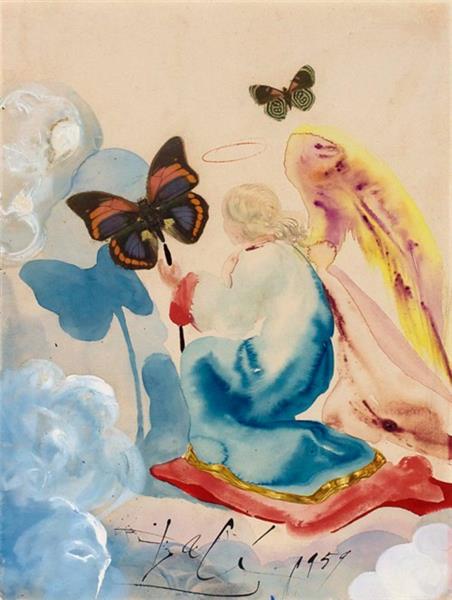
easter-angel-1959.jpg!Large salvador dali

“Easter Angel” by Salvador Dali

But here and now in Judea, what is

this scandal of particularity? This conjunction of straw

and splendor? Of deity and agony? The echo of

sharp laughter from a crowd, as hammered nails pierce flesh,

pierces the Bright Ones with perplexity. They see

the Maker’s hands helpless against Made Wood.

The bond is sealed with God’s blood, the body buried.

In this is Love’s substance become darkness

to their light. The Third Day sweetens the mystery.

Astonished heralds now of Resurrection,

they have eternity to solve it, and to praise.


 — from “Angel Vision” by Luci Shaw

Did you know that Hallmark commissioned Salvador Dali to make a series of greeting cards? I believe this must have been one of the few images saccharin enough for such a use, and yet…. Trusting the artist enough to look deeper I see that butterfly crucified and the angel meditating on the grueling and transformative power of the cross, on death and resurrection and God and humanity revealed in one body.

Happy Easter! Christ is risen!

Lenten Calendar: Holy Saturday

It happened today on my start screen calendar. I watched it flip from Good Friday directly to Easter (tomorrow), with nary a Holy Saturday in between. One of the earliest Christian heresies was that Jesus didn’t really die. There were variations on the theme — he merely swooned, or he was never so human or incarnate or mortal as to be able to manage it.

To be fair, it really is hard to reconcile the fully God and fully human thing with being fully dead and then fully capable of doing something about it. Go ahead and try for a minute; I’ll wait.

There has been much written on the scandal of the cross, but to a large degree, that’s just human nature and divine nature played out to their fullest. Of course if God shows up to restore justice we’re going to crucify him. And of course God will let us.

What’s truly shocking is the day after that, and the day after that. Death and resurrection are the true scandals. That we could stop the pulse of the one who set the planets in motion. That God would come back to us afterward, promising life abundant.

The church calendar doesn’t skip from Good Friday to Easter. It makes space for a great silence, a deep reckoning and wrestling with the consequences of what we have done. The people in Jesus’s life have followed him, loved him, betrayed him, mocked him, and killed him. And today they mourn him.

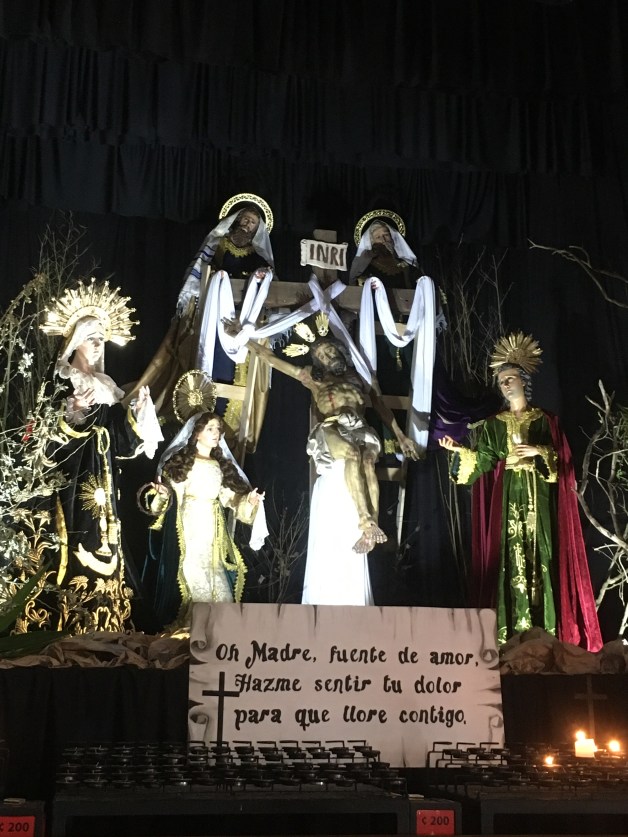
20200310_194606953_iOS

“Oh Mother, fountain of love, cause me to feel your pain, so that I may cry with you.”                                                                                                           photo by Jenn Cavanaugh

This Lent, we have walked together alone through unrelenting cycles of grief and confusion. Today we have been given a day to name and mourn our losses, to feel and so clarify our feelings. Sometimes we only recognize what we truly love for what it truly is when it has been taken away from us.

Your absence has gone through me
Like thread through a needle.
Everything I do is stitched with its color.
— “Separation” by W. S. Merwin

This is a season of apocalypse, not in that the world is ending, but in that one superficial layer of it has been pulled back to reveal another layer of depth. What have you seen that you can’t unsee? Make a note of it, because there will be a temptation to snap out of this weirdness and revert to a version of “reality” that merely glossed over what is real.

We are living in a time in which the old has passed away and new has not yet come. For today, let’s just sit here a spell and reckon with it. We might feel like we’re stuck in Stephen King’s novel The Stand (for which he is, apparently sorry), but it’s a line and image from his Pet Sematary that should stick with us now: “Sometimes, dead is better.” We didn’t go through all of this for that kind of twisted at-all-costs reanimation, did we?

This is the time to sift between the habits we miss because they brought consolation to the world and those that simply made us comfortably numb to it.

It’s okay to grieve the loss of normalcy, to admit that it hurts to give up the things that make us happy. I, for one, should be traveling next week, not making sack lunches for homeless teens with nowhere to be during the day.

Or should I?

This is not the fast we would have chosen, but if we can see it through in the spirit of the fast God chooses, then we and the world will ultimately be better for it.

Yesterday we buried our dead. Today we mourn. Tomorrow we will have the holy task of ushering back to life what is worthy of our love and devotion and co-creating the world anew.

Lenten Calendar: Godly Sorrow

I am earworm-prone at the best of times. Musically, tunes often get stuck for no rhyme or reason and threaten to drive me out of my own mind. Lyrically, however, the lines I latch onto tend to be significant indicators of my mental state. Of course, in the worst of times, the mind races, and all these phrases become less helpful as they overlap at higher and higher rpms. I have to unspool and untangle them to make sense of them and self-diagnose.

Today’s first earworm is actually the title of a Harvard Business Review article: That Discomfort You’re Feeling is Grief. I absolutely recommend you read it right now, if you need to hear that it’s okay to be a “swirling, curling storm” (ay, there’s the lyric) of all the feels and how to weather that storm. This one has the prosaic advantage of directness and requires little to no unpacking. But it’s proving deadly accurate. Just about every conflicted emotion and thought of the day held up against that statement confirms it. That Discomfort You’re Feeling is Grief. Why, yes, yes it is, now that you mention it. That seems premature, but [several beats here while I actually read the article instead of just having the portentous, disembodied headline echoing in my head] yes.

Most of us have lost something of value at this point, and it only compounds our anxiety that there is no consensus about how much more we stand to lose or for how long. Not only is the ground is shifting beneath us, but the fissures and faults in the lay of the land are also being laid bare.

With my brain currently functioning as sort of sloppy concordance on the themes, it’s struck me recently how Scripture distinguishes between different forms of grief, sorrow, and distress; there are times they are appropriate and times they are inappropriate; ways they can harm us and ways they can be redemptive. “In fact, to be distressed in a godly way causes people to change the way they think and act and leads them to be saved. No one can regret that. But the distress that the world causes brings only death” (2 Corinthians 7:10, God’s Word Translation).

Repentance, in today’s world, is for suckers. It involves self-incrimination in a culture that constantly reminds of our rights to remain silent, plead the fifth, and shift the blame. Feeling guilty without admitting guilt and anxiety without corrective action are forms of worldly sorrow. Admitting guilt is what allows us to stop wallowing in it. Responding properly to the conviction that we’ve done wrong is an opportunity to find redemption in the consequences. In her chapter on Lent in The Circle of Seasons: Meeting God in the Church Year, Kimberlee Conway Ireton writes

“There is nothing self-flagellating about repentance. In fact, true repentance is just the opposite: it frees us…. Like fasting, repentance creates space in our lives; it allows us to hear the voice of God speaking to our hearts. Through repentance we become reacquainted with our truest selves, the selves God created in his own image” (p. 78).

Or, as the old-school version of 2 Corinthians 7:10 on repeat in my head goes, “godly sorrow produces repentance leading to salvation” (NKJV). I love the bounds that makes in so few words, from distress to rescue.

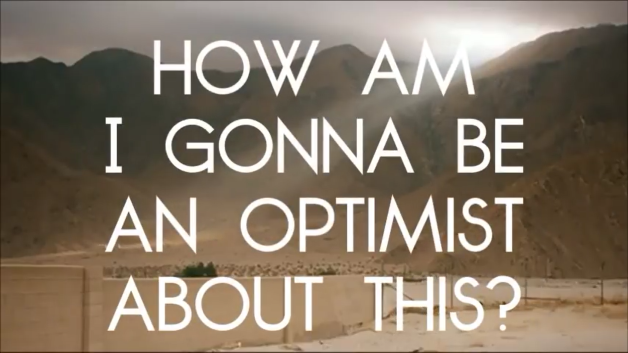
Which brings me to my final earworm, courtesy of Bastille’s “Pompeii.”

2020-03-24 (2)

Where on earth did that question come from? I mean, the obvious answer is that I’m not. I don’t get to be optimistic before anyone, much less myself, has any idea of what we’re dealing with here. I’m in the held breath calm before a storm of utterly uncertain size, and grinning about how it’s all going to be okay when they’re using exhibition centers as field hospitals and ice rinks as morgues in Madrid would be downright creepy.

And yet, in the midst of coming to terms with my small personal losses, empathizing with friends with larger concerns, and mourning with those dealing with ultimate concerns, the hope- and future-oriented pinwheels of my racing mind are spinning as well.

That discomfort we’re feeling is grief, but in response to it, the Harvard Business Review is urging us to “stock up on compassion.” And a lot of people are doing so, eagerly.

There’s something encouraging in the collective grief of facing how precariously most of us really live. God can make use of that kind of sorrow. That kind of conviction can lead to the kind of repentance that makes real change possible.

“See what this godly sorrow has produced in you: what earnestness, what eagerness to clear yourselves, what indignation, what alarm, what longing, what concern, what readiness to see justice done.” 2 Corinthians 7:11a (NIV) 

We are, beyond a doubt, alarmed, but it’s making us listen again. We’re hearing more good faith explorations of ethical questions, bordering at times on my vague memories of civil discourse. We’re collectively confronting the quandary of whom to save in the trolley dilemma, and questioning a system that seems most concerned with saving the trolley. It’s appalling to witness, but some scales fall away from our eyes when our elected officials propose literal human sacrifice on the altar of capitalism to appease the gods of the market.

None of this is cause for optimism, per se. “To be an optimist about this” has nothing do with expressing blind faith in human capabilities or pretending a deadly virus is a godsend. It doesn’t mean disregarding disheartening realities; it means letting our godly sorrow change the way we think and act in the face of them. It means devoting ourselves less to clawing our way back to a broken status quo and more to cultivating an earnest readiness, longing, and concern to see justice established where it was not before.

Lenten Calendar: An Irish Blessing

clover taped to a wall

Photo by Anna Shvets on Pexels.com

That you might be brave in times of trial,
when others lay crosses upon your shoulders.
When mountains must be climbed and chasms are to be crossed;
when hope scarce can shine through.
That every gift God gave you might grow along with you
and let you give the gift of joy to all who care for you.
That you may always have a friend who is worth that name.
whom you can trust, and who helps you in times of sadness.
who will defy the storms of daily life at your side.

– Irish blessing, author unknown; trans. Charles Mitchell

Lenten Calendar: Prayer for Direction

Sit with your uncertainties for a bit. Name them. Acknowledge them. Accept that most of them will still be with you tomorrow and that, in most cases, feeling certain or uncertain about a thing will not significantly affect what tomorrow actually has in store. Pick one concern that could benefit from attention and attend to it: research, seek advice, talk it through with a friend, journal your thoughts, listen, pray…

moon over half dome ansel adams

“Moon over Half Dome” – Ansel Adams

Lent: X

O, teach me to untangle hope
from hope that’s false,
and lead me farther down the winding path
and whatever else

you think I need, because the angle
of the woven slope
of love and grief is steep. Unless the bind
is by design.

— Maurice Manning


Lenten Calendar: Forsaken

Every hour of every day there are crucifixions,

Justice Scales by Emory Douglas

Justice Scales by Emory Douglas

the Christ on trial in someone, somewhere,
judged in fear, condemned in ignorance,
mocked and beaten, imprisoned, killed,
while we watch at the foot of the cross
or from three cock crows away, and ask,
‘God, God, why have you forsaken them?’

The world is full of Good Fridays and Golgothas.
In the small arena of our lives,
there appears to be the same defeat of goodness
and it’s difficult to wear a bright smile
when the heart hangs heavy in a darkness
full of thorns and nails and swords.
Unable to see beyond dyings, we cry,
‘God, God, why have you forsaken us?’

from ‘Easterings’ by Joy Cowley


Justice requires attention and presence. Injustice demands we look or walk away. We sense this when we witness it — if God were only here, we think, this would never happen. Pray for somewhere that seems God-forsaken. Keep your eyes open for ways to shine God’s light in and on dark places.

Lenten Calendar: Be Food

The Way In

Sometimes the way to milk
     and honey is through the body.

the-spoonful-of-milk-1912.jpg!Large Marc Chagall

The Spoonful of Milk – Marc Chagall


Sometimes the way in is a song.
But there are three ways in
     the world: dangerous, wounding,
and beauty.
To enter stone, be water.
To rise through hard earth, be plant
desiring sunlight, believing in water.
To enter fire, be dry.
To enter life, be food.

— Linda Hogan

Lenten Calendar: Wounds

“If someone asks, ‘What are these wounds on your body?’ they will answer, ‘The wounds I was given at the house of my friends.’” – Zechariah 13:6

I knew a woman with a wound that had never healed. She came from Kosovo. Ten years before I met her she’d had a procedure to drain a lung her tuberculosis was filling up fast, and the gaping hole it left in her side never closed up. She was perfectly capable of everyday activities, but it affected her whole life. She was beautiful and intelligent, with a mix of stoicism and cheerfulness prized in her culture, but she never married. All her friends and siblings did, including a brother who had suffered a head injury as a child that left him wall-eyed and slow. He had a dozen healthy children and a grandchild on the way. She had a wound that told the story of her life.

Even those of us with wounds that have healed know that every scar has a story. They are mementos of reckless childhoods, of moments in which we forgot our own strength or limitations, of burst appendices, of giving birth. They are physical records of our lives that we carry around on our bodies.

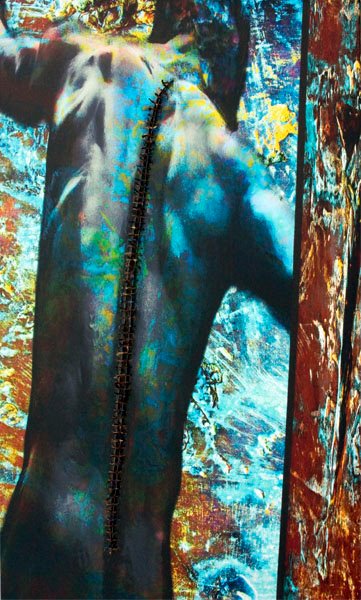
Seattle artist Paul Tonnes has a major abdominal scar from a surgery he was too young to remember to correct a condition he was too young to recall having, and yet his body reminds him. The printed canvases in his series Wounds have all been slashed and stitched together in such a way that the violence done is still visible, even palpable, but the damage is being held together in hopes of healing. The Wounds do not depict the violence – no indication is given of the source of these wounds – as much as the healing process. The palette of the pieces is bold, mottled, and reminiscent of bruising. The stitching is roughly done with twine, utilitarian knots and autopsy needles, some of which still dangle from the canvas as if to acknowledge the work left to be done; others remain worked into the canvas itself as if they are an integral part of the work.

wounds tonnes

art by Paul Tonnes

Some of the wounds seem old or even postmortem. Did the youthful immortal, sculpted of marble and sporting a Y-incision, suffer from internal injuries? Was cracking his perfect chest the only way to see them? Were they visible even then? One woman’s wounds seem to serve as points of connection to the world around her, as much as sources of pain. Her wounds seem smaller than the others, more like stings. Other wounds are still open and raw, but no blood and guts pour out of them. The openness is a void, a space for healing. Or maybe those are the cracks that Leonard Cohen recognized were present in everything because “that’s how the light gets in.”

Not all the wounds are on the figure’s person. Some are environmental, but the tension of them is felt in the musculature of the Davidic torso and the amorphous body reminiscent of Michelangelo’s Four Prisoners; the poorly sewn gash in the canvas suggests the damaged surroundings in which he’s struggling for the freedom to be fully formed. An Atlas-like figure bends under a burden with a tightly stitched seam. As the artist noted, if the stone had not been repaired, our beleaguered titan would have had half as much to carry, but someone somehow took the trouble to make the burden itself whole. Who does that?

The physicality of these ruptured canvases reminds me of the physicality of Lent. Lent is a time many of us seek to identify and break the physical habits that inhibit our spiritual lives or establish new habits that reconcile our physical and spiritual lives. Sometimes we subject ourselves to things at Lent because we want to get our heads around the harrowing reality of our sins and of Christ’s sacrificial journey to Jerusalem to put them to death in his own body. We suffer graphic and gut-wrenching depictions of the Passion and exactly what happens when a nail is driven through a human hand. We imagine ourselves suffocating. We are people with a violent and physical story. These canvases bring me back to the healing beauty of the cross and the wounds of Christ that are our wounds. Some of these wounds are fresh and raw. Some are emotional scars with stories that have shaped our stories and where we see ourselves in the story of salvation.

Tonnes offers powerful images to sit with during Lent as we consider the violence done to and around us, as we confess and repent of the violence we’ve done, as we present our wounded bodies and souls to the One who offers healing, and as we cultivate the disciplines that will help us continue to do so all year long. Any one of them could be read as a Christ figure. Any one of them could be any one of us.

Paul Tonnes is a Seattle artist working in the mixed media realms of digital manipulation, print, and encaustic. His series “Wounds” consisting of cut and stitched canvases explores the human body’s potential for healing. You can see more of his profound work at paultonnes.com


No Fear of the World: The Sequel

Click here if you missed part 1

Any theology of culture will intertwine with an interpreter’s rational, theological, and ideological characterization of the present condition of humanity. If culture is a uniquely human creation, its status relies on our status. Does the image of God within us validate our good creations? Does our fallen state taint our works indelibly? Does our redemption transfer to the work of our hands and minds? Most theologies of culture cite the incarnation as a model. If Christ took on flesh and lived among us, we cannot follow God in the abstract or love our neighbor in only an otherworldly sense. In fact, the Trinity as a whole, not just the second person, exemplifies God’s commitment to humanity. God created, entered, and remains at large in this world and has commissioned and empowered the Church to walk to the ends of it to communicate that good news. Turning our back on the world is not an option for Christ’s body.

This is not to say that Christians should not be discerning consumers. Discernment is a constant process that constitutes a major portion of the Christian’s job description. This discernment process, however, occurs within the Christian community, not by forcing our vision on those outside of it. Ralph C. Wood advises we become “self-critical citizens of the world as well as self-critical confessors of the Faith.”[1] We learn to critique our cultures because, like it or not, they define a significant portion of our selves. If Christ did not come to condemn the world, why would he send us poor souls to do so? Or, as Paul once put it to the Corinthians, “What business is it of mine to judge those outside the church? Are you not to judge those inside?”[2] American Christians need to stop trying to enforce “Christian values”[3] outside of the body of Christ. If we concerned ourselves as much with keeping the Church and our own self-righteous selves on the straight and narrow as we currently do with perfect strangers who happen to act or sing for a living, we might wake up one morning to find we have a credible witness in the world.

When we come to terms with and gratitude for the fact that God has set us in our extended human families for our own good and for theirs, we begin to create within our cultures in order to bless them, rather than to curse. We stop trying to protect our own religious sensibilities and God himself by creating a safe cultural ghetto for ourselves. We can describe all our work in the world the way Tim Foreman of Switchfoot describes his band’s music: “Christian by faith, not by genre.”[4]

The apostle Paul validated what he found valid in the Athenian worldview, but sought to enlarge and inform it.  He served the Corinthians by becoming like them to win them over, for the sake of the gospel.[5]  The Church has traditionally patronized and sponsored the artistic tendencies of high culture.  Christians approve what is excellent, see nature (including human nature, in the form of the conscience) as a source of general revelation, and accept that what is true, beautiful, and good in human life represents God’s pervasive, common grace within all creation.  We can comfortably affirm ennobling tales of self-sacrifice, and the sentimental images, captured in oils, of devoted parents or a glowing sunset as echoes of God’s presence in our everyday lives. But what about Skins, Grand Theft Auto, and Here Comes Honey Boo Boo?  What of the superficial and frivolous, the gaudy and offensive? Should we consume such things? Contribute to their creation?

Not all the ideals of our culture will reflect our ideals, but our convictions of how things should be should not blind us to how things are. We must become conscious of the forces at work and play in our popular cultures that shape us or attempt to shape us. Being aware of the rules and ethos of Survivor, for example, allows us to recognize and resist social currents that might otherwise carry us along to unthinking engagement in behavior antithetical to the gospel.  While the language of voting people off the island, dismissing the weakest link, and pursuing entirely wrongheaded notions of winning becomes ingrained and normalized in our collective psyche, those in discerning Christian communities remind each other that the people of God are called to live into a different reality. What if Christians created everyday culture that reflected that reality? How can we do that if we’re not familiar with our culture as it actually exists? What if we occasionally took our kids to an “inappropriate” but important movie and talked to them about it instead of forbidding them to go? What if we listened to their music with them instead of insisting they turn it down or investing our energies in keeping them culturally ignorant? Once a week ask them to play you something and help you hear or see why it is significant to them.[6]

We all have different tastes. I’m not suggesting we feign a fondness for Glee where none exists, but do I become a better witness among my neighbors and co-workers by flaunting my complete ignorance of a show that informs and influences their lives?  Dick Staub counsels us to be “serious about faith, savvy about faith and culture, and skilled in relating the two…. Culturally savvy Christians follow the path of neither the cultural glutton nor the cultural anorexic. Instead, they are marked by their discretion and thoughtful discernment.”[7] Discernment is a form of wisdom Christ offers his Church through the Spirit to enable us to walk well in a world full of falling hazards and diversions. It is a gift and a tool that we become more adept at using as we practice it. Much of parenting consists of equipping our children to make good decisions then allowing them the freedom and responsibility to do so. God parents us in much the same way. We need to develop lifestyles of prayerfully listening to the Spirit to rightly and readily discern how to relate to particular aspects of our cultures, but God’s word equips us with some basic principles. Staub summarizes the relevant guidelines in Paul’s letters to the Romans and the Corinthians: all things are lawful, but not all are beneficial. We are not to be controlled by cultural goods or to use them to occasion another’s fall, but rather to do everything we do to the glory of God.[8] We are to remain in conversation with people who do not believe as we do. “Be wise in the way you act toward outsiders; make the most of every opportunity. Let your conversation be always full of grace, seasoned with salt, so that you may know how to answer everyone.”[9] Which response best stimulates that kind of conversation: “I don’t watch that show/ play that game/ listen to that music because I heard it was evil” or “I watched/ played/ listened to that a couple times, but I was so turned off by the glorified violence/ portrayal of women as objects/ the racist-sounding lyrics I just stopped. You obviously follow it more closely than I do, though. What about it appeals to you? What am I missing?”

Sometimes our neighbors and co-workers diversions will be just that: diversions – opportunities to check out from real life. Let’s not read too much into those or pretend we don’t have our own indefensible diversions. People who consistently try to convert others to a favorite movie or band or sport, however, have probably found something that moves them and relates to their desire for more out of life. In Your Neighbor’s Hymnal, Jeff Keuss talks about pop music as one of the many cultural forms in which we may find spiritual solace or expression; chances are our neighbors already have.

“True, there is pop music fandom that draws people into the trivial and mundane just as there are some Christian worship services that celebrate consumer culture more than critique it or provide an alternative. But the drive to find something larger than ourselves and make it public is a starting point – even a shallow faith is better than no faith at all. And in this we are to celebrate rather than too quickly denounce the fanboy faith that permeates the culture around us. Our neighbor’s hymnal is filled with pop songs that are sowing the seeds of faith and pushing for a form of life that is larger than the mundane and points to a transcendence worth paying attention to.”[10]

If we dismiss out of hand the cultural texts and goods that God may use to open our neighbor’s heart to something beyond this world, we squelch the prospect of discovering an addition to our playlist that works similarly on us; worse, we hazard quenching the Spirit, who – as the old song goes – moves in mysterious ways.

[1] Wood, Contending for the Faith: The Church’s Engagement with Culture (Waco, Tex.: Baylor University Press, 2003), 102.

[2] 1 Corinthians 5:12.

[3] Whatever those are; the fact that Christians can’t agree on them doesn’t bode well for their universal legislation anyway.

[4] qtd. in Andrew Beaujon, Bodypiercing Saved My Life: Inside the Phenomenon of Christian Rock (Cambridge, Mass.: Da Capo), 42.

[5] 1 Corinthians 9:9-13

[6] This will be a test, by the way. If they put themselves out to articulate something that matters to them and you only find fault with it, don’t expect them to play along next week. Even if a song or video turns you off completely, listen to your child’s heart and how media speaks to it and affirm that heart. Also, don’t expect their articulation to be particularly articulate or convincing at first. By having these conversations you may be giving them their first lessons in putting their spiritual lives into words; they’re not learning this in school. Listen for opportunities to augment their vocabulary for discussing soul issues without putting words in their mouths.

[7] Staub, The Culturally Savvy Christian: A Manifesto for Deepening Faith and Enriching Popular Culture in an Age of Christianity-Lite (San Francisco: Jossey-Bass, 2007), 1, 151.

[8] ibid. 152-153.

[9] Colossians 4:5-6, TNIV.

[10] Jeffrey F. Keuss, Your Neighbor’s Hymnal: What Popular Music Teaches Us about Faith, Hope, and Love (Eugene, Ore.: Cascade Books, 2011), 22.