Lenten Calendar: Hiding

Today’s lectionary psalm is Psalm 32 – a maskil, or contemplative psalm imparting wisdom. It deals in visceral images of the pain and futility of trying to hide our dark secrets from God.

When I kept silent,
    my bones wasted away
    through my groaning all day long.
For day and night
    your hand was heavy on me;
my strength was sapped
    as in the heat of summer.

This oppressive feeling of guilt and shame lifts completely after coming clean with God, but then this psalm we’re supposed to think about and learn from does a funny thing. Just after busting the myth that we can hide from God, it refers to God as a hiding place. Obviously not from God, but from those who would punish us for giving up our pretense and deceit. God’s presence is the safest place to be our whole selves.

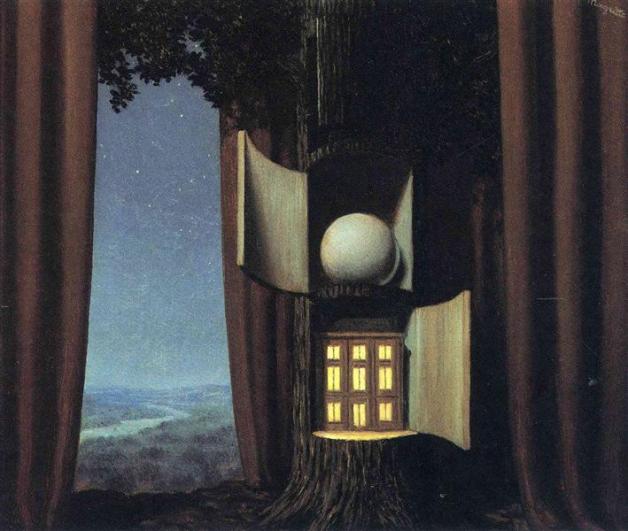
La Voix du sang Magritte

La Voix du sang by René Magritte

The lyrics to Our Lady Peace’s “Hiding Place” echo those of the psalm…

Have you seen what I saw
The sky came down from afar?

Have you been there before
That place where hearts’re reborn?

I’m looking for a place to go
I’m waiting on another
Hiding place for hearts

Have you dreamed of a world
Where armor sheaths your bones?

Have you ransomed your soul
To pay for all that you’ve got wrong?

Never give up

… and the video evokes the feelings of danger and safety.


Lenten Calendar: Meek

Consider the mushroom, it neither boasts nor vaunts itself above its fellows, and yet it grows in every environment. It knows the power of numbers working humbly and steadily in concert. Individually, they are fragile; together, they are inexorable.

shallow focus photography of mushrooms

Photo by Chris Gonzalez on Pexels.com

Mushrooms

Overnight, very
Whitely, discreetly,
Very quietly

Our toes, our noses
Take hold on the loam,
Acquire the air.

Nobody sees us,
Stops us, betrays us;
The small grains make room.

Soft fists insist on
Heaving the needles,
The leafy bedding,

Even the paving.
Our hammers, our rams,
Earless and eyeless,

Perfectly voiceless,
Widen the crannies,
Shoulder through holes. We

Diet on water,
On crumbs of shadow,
Bland-mannered, asking

Little or nothing.
So many of us!
So many of us!

We are shelves, we are
Tables, we are meek,
We are edible,

Nudgers and shovers
In spite of ourselves.
Our kind multiplies:

We shall by morning
Inherit the earth.
Our foot’s in the door.

— Sylvia Plath


Lenten Calendar: Change

Most of us — if we’re honest — will admit that we resist change, even if we like the idea of it. We may delight in newness, have a penchant for novelty, welcome distraction, or coolly ride out circumstances, but that doesn’t mean we want anything to shift within ourselves on a profound level.

Lent is an apt season for reflecting on the things in our lives that want to move, that cannot or should not remain the same. A gift that needs to grow, priorities desperate to realign, bits of our psyche we’ve worried so much that they’re raw or calloused and need to be left alone to heal.

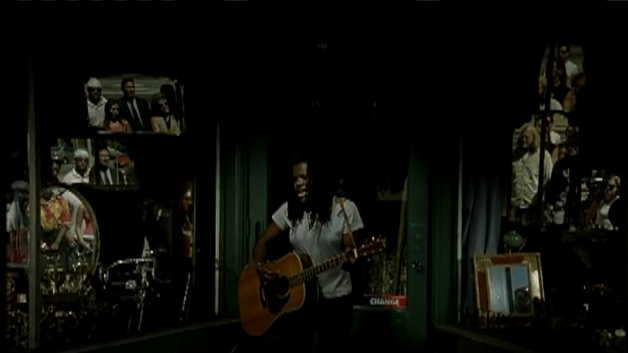
Tracy Chapman’s song “Change” asks all the right questions — questions we can only safely ask ourselves in the presence of a God of love.

2020-02-29 (2)

“If everything you think you know
Makes your life unbearable
Would you change?”

“If not for the good why risk falling?”

“If you’d broken every rule and vow
And hard times come to bring you down
Would you change?”

“Are you so upright you can’t be bent
If it comes to blows?”

“If you knew that you would find a truth
That brings a pain that can’t be soothed
Would you change?”

Lenten Calendar: Wounds

“If someone asks, ‘What are these wounds on your body?’ they will answer, ‘The wounds I was given at the house of my friends.’” – Zechariah 13:6

I knew a woman with a wound that had never healed. She came from Kosovo. Ten years before I met her she’d had a procedure to drain a lung her tuberculosis was filling up fast, and the gaping hole it left in her side never closed up. She was perfectly capable of everyday activities, but it affected her whole life. She was beautiful and intelligent, with a mix of stoicism and cheerfulness prized in her culture, but she never married. All her friends and siblings did, including a brother who had suffered a head injury as a child that left him wall-eyed and slow. He had a dozen healthy children and a grandchild on the way. She had a wound that told the story of her life.

Even those of us with wounds that have healed know that every scar has a story. They are mementos of reckless childhoods, of moments in which we forgot our own strength or limitations, of burst appendices, of giving birth. They are physical records of our lives that we carry around on our bodies.

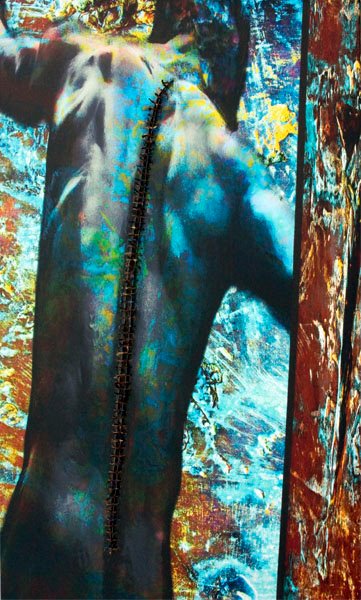
Seattle artist Paul Tonnes has a major abdominal scar from a surgery he was too young to remember to correct a condition he was too young to recall having, and yet his body reminds him. The printed canvases in his series Wounds have all been slashed and stitched together in such a way that the violence done is still visible, even palpable, but the damage is being held together in hopes of healing. The Wounds do not depict the violence – no indication is given of the source of these wounds – as much as the healing process. The palette of the pieces is bold, mottled, and reminiscent of bruising. The stitching is roughly done with twine, utilitarian knots and autopsy needles, some of which still dangle from the canvas as if to acknowledge the work left to be done; others remain worked into the canvas itself as if they are an integral part of the work.

wounds tonnes

art by Paul Tonnes

Some of the wounds seem old or even postmortem. Did the youthful immortal, sculpted of marble and sporting a Y-incision, suffer from internal injuries? Was cracking his perfect chest the only way to see them? Were they visible even then? One woman’s wounds seem to serve as points of connection to the world around her, as much as sources of pain. Her wounds seem smaller than the others, more like stings. Other wounds are still open and raw, but no blood and guts pour out of them. The openness is a void, a space for healing. Or maybe those are the cracks that Leonard Cohen recognized were present in everything because “that’s how the light gets in.”

Not all the wounds are on the figure’s person. Some are environmental, but the tension of them is felt in the musculature of the Davidic torso and the amorphous body reminiscent of Michelangelo’s Four Prisoners; the poorly sewn gash in the canvas suggests the damaged surroundings in which he’s struggling for the freedom to be fully formed. An Atlas-like figure bends under a burden with a tightly stitched seam. As the artist noted, if the stone had not been repaired, our beleaguered titan would have had half as much to carry, but someone somehow took the trouble to make the burden itself whole. Who does that?

The physicality of these ruptured canvases reminds me of the physicality of Lent. Lent is a time many of us seek to identify and break the physical habits that inhibit our spiritual lives or establish new habits that reconcile our physical and spiritual lives. Sometimes we subject ourselves to things at Lent because we want to get our heads around the harrowing reality of our sins and of Christ’s sacrificial journey to Jerusalem to put them to death in his own body. We suffer graphic and gut-wrenching depictions of the Passion and exactly what happens when a nail is driven through a human hand. We imagine ourselves suffocating. We are people with a violent and physical story. These canvases bring me back to the healing beauty of the cross and the wounds of Christ that are our wounds. Some of these wounds are fresh and raw. Some are emotional scars with stories that have shaped our stories and where we see ourselves in the story of salvation.

Tonnes offers powerful images to sit with during Lent as we consider the violence done to and around us, as we confess and repent of the violence we’ve done, as we present our wounded bodies and souls to the One who offers healing, and as we cultivate the disciplines that will help us continue to do so all year long. Any one of them could be read as a Christ figure. Any one of them could be any one of us.

Paul Tonnes is a Seattle artist working in the mixed media realms of digital manipulation, print, and encaustic. His series “Wounds” consisting of cut and stitched canvases explores the human body’s potential for healing. You can see more of his profound work at paultonnes.com


Lenten Calendar: Ash Wednesday

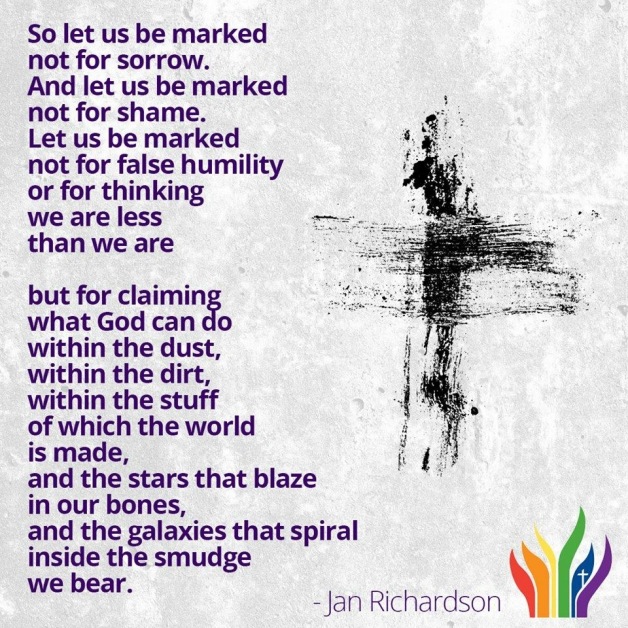
jan richardson ash wednesday

The imposition of ashes. Most of us don’t relish any kind of imposition, so what brings us out on a school night to rub dirt on each other’s foreheads? What kind of season kicks off with people lining up to be reminded of their own mortality? A rather grim one, you’d expect. But Lent turns morbidity on its head and makes it an invitation into life. Lent begins where we end, but ends with the death of death.

Ash Wednesday is an in your face, on your face, square between the eyes reminder that we’re all going to die, so let’s stop wasting life being anything less than God made us to be. Also, we’re dust, so let’s not feel any pressure to be anything more than God us to be, either. Accepting that our days are numbered teaches us to number our days and so gain a heart of wisdom. Life is precious in its finitude and we live it better when we are mindful of what we are spending it on.

Many of our modern fasts take into account that time is a limited resource. What practice would you like to build into or moderate or remove from your life to make the most of your time?


Lenten Calendar: Another Season, Another Fast

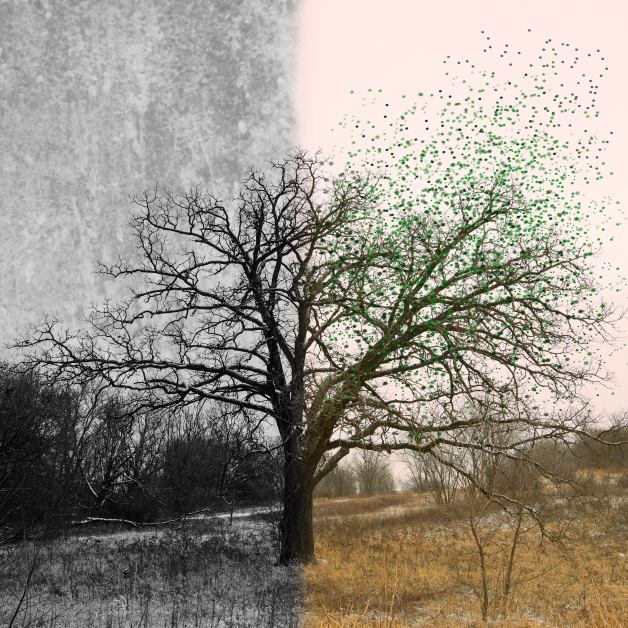
Julie Elfers Winter to Spring

art by Julie Elfers

I’ve blogged a few of years of Advent reflections, but Lent calls for a different kind of pace and energy that I’m just now trying to summon and articulate for the first time.

Both Advent and Lent are fasts, designated times of preparation that allow us to better celebrate the feasts of Christmas and Easter. Both seasons are quiet, but Advent mirrors the deepening stillness of winter’s approach, where Lent channels the subterranean stirrings of early spring.

Advent is lament, crying out in our need and powerlessness as the darkness deepens around us. Lent is repentance, throwing off every self-imposed impediment so we can walk in freedom and power in the light, The discipline of Advent is to cultivate hope in spite of the darkness around us. The discipline of Lent is to spite the darkness within and share the hope that is also within us.

During Advent we meditate on the wonder of God coming to be human as we are: small and vulnerable. During Lent we follow Jesus in his earthly ministry, striving to become human as he is: whole and restoring others to wholeness.

In Advent we fall to our knees in anticipation of a blessing and receive the gift of a savior. In Lent we rise to our feet to be a blessing and learn to give sacrificially in the model of the Savior.

Advent is dwelling on the promise of Isaiah 9:6; it’s a call to wait on the Lord. Lent is embracing the exhortation of Isaiah 58:6; it’s a call to action.

Each of the 40 days of Lent I will try to post a little something to get us moving. A song, a poem, an article, a study, a wandering exploration, a quote…. We’ll see. I have no overarching plan beyond the grand tradition of the disciples – just praying to be able to keep up as Jesus quickens his pace toward Jerusalem.

Into the Labyrinth: The Road to Emmaus

Traditionally, the labyrinth is an uncluttered opportunity for centering prayer. It usually consists of a single path that leads into the center and back out. There are twists and turns, switchbacks, and apparent setbacks that actually take you further along the path to your goal, but feel like moving in the wrong direction. Unlike in a maze – the labyrinth’s choose-your-own-adventure cousin – if you simply walk the path in front of you, you will get where you’re going. Labyrinths are often found outdoors or in relatively bare chapels with an altar and candles that welcome people to come and unburden themselves of whatever they’re carrying, yoke themselves to Christ, and practice walking in the spirit. It is a lovely form of sacred space: simple yet suggestive. The idea presented below is not intended as an improvement over a traditional labyrinth. We borrowed the labyrinth motif because it brought to life the sense of realization while in movement, the walking epiphanies of the story of the disciples meeting Jesus on the road to Emmaus. As such, it would be appropriate to set up during Epiphany or during Lent – when we wander the desert not to lose ourselves, but to find our center – as well as when we did it: during the season of Easter, before Ascension, when this story originally took place.
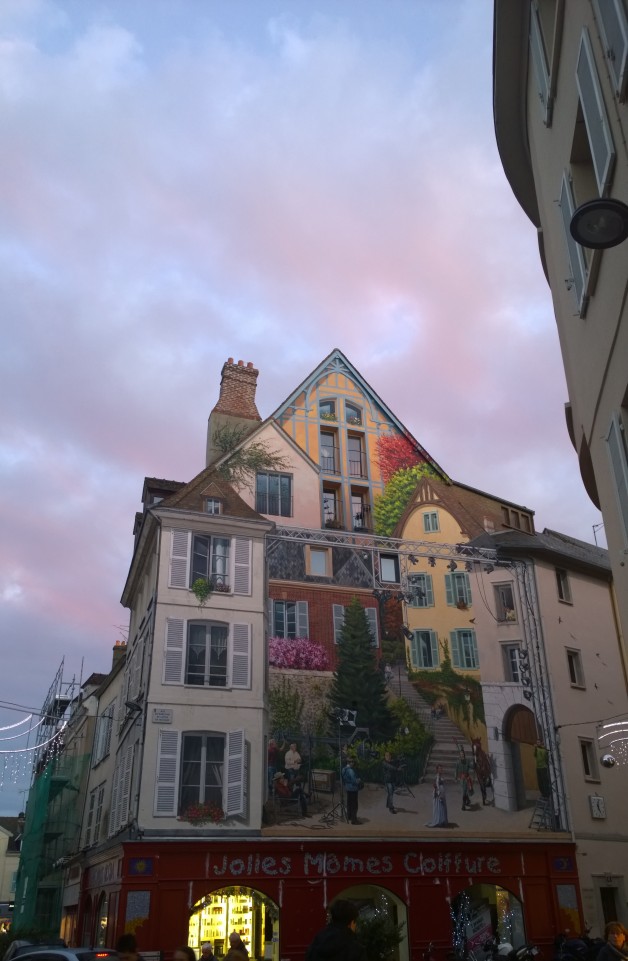
WP_20141208_17_01_36_Pro__highres (2)

A labyrinth of the everyday – trompe l’oeil outside Chartres Cathedral

Road to Emmaus Labyrinth

Luke 24:13-35

Our[1] labyrinth consisted of a huge drop cloth on the floor marked in a variation on a classic labyrinth pattern.[2] With staggered starts, the labyrinth could accommodate four or five people at a time. We set up eight compact, numbered stations along the path – five going in, one at the center, and two going out.[3] Two readers (one reading the script, the other the scripture passages throughout) recorded an audio tour with music as follows. People were given headphones and a cheap, one-button mp3 player and invited to pause and play and go at their own pace. In this script the numbers correspond to the track number.

  1. “Welcome”

Welcome to the Emmaus Road Labyrinth. Here we enter the story of two disciples meeting the resurrected Jesus as they walked along the road to a town called Emmaus. In a sense, we’ll be walking along with them as we progress into and back out from the heart of the labyrinth. A labyrinth is not a maze. A maze is a puzzle to be solved. A labyrinth is a path to be followed. Walking a labyrinth is a completely different exercise than running a maze. Here there is no fear of being lost. The labyrinth externally enacts the internal experience of centering. Spiritually, it represents space set apart, or sacred space, in which we are drawn into the center, to the recognition of the presence of God, then return to the world blessed and changed by the experience, and better equipped to be an agent of blessing and change.


Each station in the labyrinth has one track on this audio guide. Go at your own pace. This is a time to walk in the Spirit, swap stories with Jesus and listen for the voice of God in your life. If the words or music become a distraction, feel free to pause, skip ahead or ignore the recording entirely. Enter the labyrinth and continue walking until you reach station one.


  1. “Station One (going in): They were kept from recognizing him” Luke 24:13-16

Jesus’ followers then and now have different perceptions of who he is and what he came to do. The disciples’ false perceptions of Jesus kept them from knowing and loving him for who he is. They thought he was a teacher, a revolutionary, a ruler; they thought he was dead.

It is difficult to recognize the presence of God when God doesn’t act according to our assumptions. St. John of the Cross called this the dark night of the soul. He saw it as a time in which, despite all appearances and perceptions, even though it feels like stumbling around in the dark, the soul grows in faith and intimacy with Christ Himself, rather than with illusions of Him.


Open the flaps to see images of the Jesus we think we know. Ask him to reveal himself so that we may love him as he truly is.[4]

Music: “The Dark Night of the Soul” by Loreena McKennitt


  1. “Station Two (going in): Downcast” Luke 24:17

The Seder is the traditional meal and central celebration of Passover. To read about the origins of Passover, please pause this recording and read Exodus 11 & 12 marked in the bibles here. The entire extended family is to come together. Throughout the meal, they retell the Exodus story in the first person as if they had been one of the slaves freed from Pharaoh’s bondage. The bitter herbs, horseradish here, are eaten to remind the participants of the bitterness of slavery.  Are you downcast? Where are you experiencing bitterness? Taste the herbs and let the words of Psalm 22 be your cry to heaven.


  1. “Station Three (going in): Storytelling, Part 1” Luke 24:18-24

The disciples on the road were consoling each other by telling stories and remembering Christ. On index cards, write about a time in your life when you met with God. Pin them to the storyboard. Read others’ stories and allow others to read your story.


  1. “Station Four (going in): Storytelling, Part 2” Luke 24:25-27

Now Jesus tells his story, explaining his work throughout the ages, establishing and re-establishing relationships with his people. Flip through a bible and take some time to hear God’s story of constant provision and love. The lectionary bookmarks and bibles are free for you to take with you.

Music: “Jesus’ Blood Never Failed Me Yet” by Jars of Clay (light) or Gavin Bryars (strong)


  1. “Station Five (going in): Welcoming the Stranger” Luke 24:28-29

The disciples welcomed Jesus though they did not yet recognize him. Who is the stranger walking along the road with you now? Have you ever encountered Christ in or through a stranger? Have you ever been that stranger? Consider these questions as you watch the video.[5] Pause this program and use the headphones attached to the monitor.


  1. “Station Six (center): Breaking Bread” Luke 24:30-31

Here in the center of the labyrinth, Jesus meets us and offers sustenance for the journey outward. Break bread with Christ. Join in this prayer from “Six Recognitions of the Lord” by Mary Oliver as you take and eat.


Oh, feed me this day, Holy Spirit, with

the fragrance of the fields and the

freshness of the oceans which you have

made, and help me to hear and to hold

in all dearness those exacting and wonderful

words of our Lord Christ Jesus, saying:

Follow me.


[minute pause]

When you are ready to begin your journey back out into the world, take a card and exit out the corner opposite from the one you entered. Practice walking prayerfully.


  1. “Station Seven (going out): Burning Hearts” Luke 24:32

What is Christ saying to you on the road? What does scripture say about Jesus? What does it say about you? Have you looked recently to see? Light a candle and pray for the scriptures to be opened to you, for the words to burn within your heart.

[pause]

What words from the scripture cards or from your bible reading do you want burned deeper into your heart? Write them onto a paper heart, tack it to a candle and take it with you. Light it at home, while it burns pray that the scriptures will be opened to you and your heart opened to them.

Music: “Listen” by Michelle Tumes


  1. “Station Eight (going out): Returning to Jerusalem” Luke 24:33-35

Where is your “Jerusalem?” Where will you now return and share what you have experienced? Who can you talk to about what you are learning about Jesus?

Christ is risen! Take a cross to give to a friend as a reminder of Christ the Lord, alive and walking with us.


[1] You know you have a successful collaboration going when no one can remember whose ideas were whose and they’ve become too interwoven to attribute them separately anyway. I got to write the script, but the experience as a whole was thought through and produced by everyone in our alt worship planning group: Cristie Kearny, Deb Hedeen, Judy Naegeli, Trisha Gilmore, Cathy Stevens, Heidi Estey, Kirk Heynen, James Kearny and Anika Smith.

[2] Ours happened to have one path leading in to the center and a different path leading back out, but generally I would recommend the Half-Chartres (basically the inside half of the design at Chartres Cathedral). You can find instructions for making a 12’ x 12’ version at “Karen’s Small Labyrinths” http://www.angelfire.com/my/zelime/labyrinthssmall.html#halfchartres. The size shown there would be sufficient for people to use one or two at a time with a single station in the middle, but wouldn’t accommodate what I’m describing here. Ours was about 4 times that size, maybe 25’ x 25’.

[3] The stations should be clearly numbered with the station number and the track number and labeled “going in” or “going out” so as not to confuse anyone. Remember they are all actually set up on and around a flat, open surface, so they will not be laid down linearly. If you use a single path labyrinth, people will be walking by stations 7 and 8 on the way in, but should only stop at them on the way out. We set up stations on small, low tables and music stands so they wouldn’t pose as obstacles by taking up too much space. Café tables would work nicely for the stations you can place around the outside of the circuit. Ideally, if someone’s standing at a station, another person should be able to pass them without stepping completely off the path.

[4] Our artists made this interactive piece. You can create your own by making a collage poster of images of Jesus or roles people think of Jesus playing: the miracle worker, the rustic shepherd, the white-suited televangelist, the revolutionary in a beret, the pacifist at a sit-in, etc. Then overlay the poster with another piece of poster board and cut flaps in it that open onto the various images.

[5] We commissioned a videographer and a high school student in our congregation to collaborate on a video of different kinds of people. You could make your own using stills of people in your church and neighborhood or footage from mission trips. Or you could download something along the lines of The Work of the People’s “Stranger” (http://www.theworkofthepeople.com/index.php?ct=store.details&pid=V00520) or LifesongMD’s “World Faces” (http://youtu.be/z6RLHKRs9D8).
Dead Can Dance: A Meditation and Playlist for Holy Saturday

The Dance of Death (1493) by Michael Wolgemut, from the Liber chronicarum by Hartmann Schedel

“[Jesus] was dead, to begin with. There was no doubt about that. The register of his burial was signed by the clergyman, the clerk, the undertaker, and the chief mourner…. [Jesus] was as dead as a door-nail…. There is no doubt that [Jesus] was dead. This must be distinctly understood, or nothing wonderful can come of the story I am going to relate.” adapted from Dickens’ _A Christmas Carol_

Christians are sorely tempted to gloss over or spiritualize the death of Christ. After all, how dead can we imagine the Source of all life? At what point do our imaginations fail to allow for his return to life? If we find Jesus’ resurrection easy to believe, might it be at the expense of our belief in Jesus’ death? Our scriptures and our creeds stress that Jesus did not just die, he was buried. He was counted and fully identified with the dead. He took kenosis, humanity, and mortality to their furthest limits and poured himself out even to death. Christ’s earliest followers wanted to impress upon all who would listen that he did not faint, lose consciousness, or swoon. He was not “mostly dead.” He was as dead as dead gets, deader than we’ll ever be, as ultimate in death as in life, not only the firstborn of all creation, but also the jigging and grinning leader and Lord of the danse macabre that ultimately unites us all regardless of who we were and what we believed. Wherever we go when we die, he went there, and conquered it in his own name. Harrowing of Hell - from a 15th century French Book of Hours at the Huntington Library

Death couldn’t hold him any more than heaven or earth could. Holy Saturday makes room in our theology for the death of God, and a God beyond Being, and all the contributions of William Blake and John of the Cross, Hegel and Nietchze, Caputo and Zizek. We are given a time to mourn him and celebrate his life, time for a proper wake, granted an interval to contemplate the horror of life without him, an opportunity to come together and make sense of and respond to what he was on about in life.

It’s a time to allow our perspectives to shift, like Robert DeLong sings about in “Global Concepts.”

After I die, I’ll re-awake,
redefine what was at stake
from the hindsight of a god.

Whether or not you believe Jesus completely grasped the entirety of who he was and what he came to do before he died, it’s quite obvious that his disciples did not. Only in losing him and in his return did they begin to understand the magnitude of what was at stake. Even those who believed he was the Messiah had a limited notion of what that meant before Christ’s death and resurrection. To John’s disciples who wondered if he was the One, he replied “that the blind see, the lame walk, the lepers are cleansed, the deaf hear, the dead are raised, the poor have the gospel preached to them” (Luke 7:22), and to the crowds he wondered aloud, if John’s preaching and my healing can’t do it, what’s it going to take to get you people mourning and dancing? What did you go out into the desert to see? A reed in the wind? A man in soft clothes? A prophet? What will you make of me coming to eat and drink with you?

Did I make money? Was I proud?
Did I play my songs too loud?
Did I leave my life to chance
or did I make you f***ing dance?

Holy Saturday redefines death, life, and power. The dance of the dead is not a sign of futility or defeat, but of completion, hope in more than this life, and victory.

Should I close my eyes and prophesize
Hoping maybe someday come?
Should I wet the ground with my own tears
Crying over what’s been done?

Should I lift the dirt and plant the seed
Even though I’ve never grown?
Should I wet the ground with the sweat from my brow
And believe in my good work?

Hey there, I’m flying up above
Looking down on the tired earth
I can see, I can see potential
Speaking through you, speaking to you
From all of heaven’s possibility

Power, hey, do know how it work?
Hey, do you know that the meek
They shall inherit the earth?
You should work, you should work
Yeah, for the self and the family

Should I hit the water or stay on dry land
Even though I’ve never swam?
Take machete, take them into the brush
Though at first there is no path

Taste the war paint on my tongue
As it’s dripping with my sweat
Place my gaze in the future’s path
Seeing things that ain’t come yet

Hope to watch the victory dance
After the day’s work is done
Hope to watch the victory dance
In the evening’s setting sun

Need more for your playlist? Try Elbow’s “The Night Will Always Win” (imagine Peter and Judas singing that for their various reasons), Dave Matthews’ “The Space Between” and The Waterboys’ “Song for the Life” along with, of course the Dead Can Dance’s eponymous album from way back when for atmosphere. Interestingly enough they put out an album called Anastasis (=resurrection) last year that I’ll be listening to tomorrow.

I’ll close with a poem that leads a great post on the subject of Holy Saturday by Christine Valters Paintner

Don’t surrender your loneliness so quickly.
Let it cut more deep.
Let it ferment and season you as few human
Or even divine ingredients can.
Something missing in my heart tonight
Has made my eyes so soft,
My voice so tender,
My need of God
Absolutely clear
.

~ Hafiz

First World Fasting

Or, Can I Keep My Fast with a Dilettante Grasshopper Martini?

I have been fasting on Wednesdays during Lent – my own mongrel, modified fast designed entirely to suit my own purposes. Admittedly, many of those purposes are spiritual, but it still feels more like self-care than self-denial. I just wasn’t feeling the denial this year. My flesh frankly hasn’t done much that would respond to punishment lately. I needed an especially affirming fast this year – to grow in gratitude for and proper relation to the good things in my life.

“Asceticism has a basic role in any spirituality, but ascetic practices, in my opinion, can be healthy or unhealthy. Suppose for example, I am considering fasting from food or from television. I use two criteria for deciding on the wholesomeness of my fast. First, does the discipline of saying no still affirm the goodness of creation? Is my motivation to gain more freedom for better service, to give up something good for something better? Second, am I expressing God’s love for me or seeking to achieve it? Is my human effort replacing the grace of God? Is this an effort made in order to earn the love of God? Or is this discipline a response to God’s forgiving grace in Christ? Does the practice lead to the freedom of the athlete who runs in the knowledge of God’s love or to the bondage of a desperate attempt to earn what cannot be earned?”

– Bradley P. Holt, Thirsty for God p. 55-56

As with many Protestant Christians of a certain age, my first forays into fasting were guided by Richard Foster’s A Celebration of Discipline which lauds fasting as, among other things, a tool of self-knowledge

“Fasting reveals the things that control us. We tend to cover up what is inside us with food and other good things, but in fasting these things surface…. At first we will rationalize that our anger, for example, is due to our hunger. We will then discover that we are angry not because of hunger, but because the spirit of anger is within us. We can rejoice in this knowledge because we know that healing is available through the power of Christ…. Fasting helps us keep our balance in life. How easily we begin to allow nonessentials to take precedence in our lives. How quickly we crave things we do not need until we are enslaved by them….”

This year I already felt keenly aware of the things controlling me. I was looking for a way to work my way free of them – not just for a season, but sustainably. My first fasts seem to have primed me toward greater gentleness with my self and others when I fast. I lower my expectations, or rather: I expect the weakness that is within all of us, and the temptation to lash out at it diminishes. Nowadays fasting seems to mellow me, so I’m experimenting with forms I can work reasonably into ordinary time. I’m a short-burst person seeking moderation and consistency – in my appetites and compulsions, in my attitudes and energy and focus. That artistic-Irish temperament serves my productivity, but not my long-haul relationships, of which I now have several and desire more. I’ve intentionally crafted this year’s fast to center on experiencing generosity, provision, and celebration rather than deprivation.

“When you fast, see the fasting of others. If you want God to know that you are hungry, know that another is hungry…. If you ask for yourself what you deny to others, your asking is a mockery…. Let us use fasting to make up for what we have lost by despising others. Let us offer our souls in sacrifice by means of fasting…. When you fast, if your mercy is thin your harvest will be thin; when you fast, what you pour out in mercy overflows into your barn. Therefore, do not lose by saving, but gather in by scattering. Give to the poor, and you give to yourself. You will not be allowed to keep what you have refused to give to others.”

– St. Peter Chrysologus, Sermon 43: PL 52, 320, 322

On this year’s fast I am hungry, but I’m not going hungry. I am not eating one day a week, but I’m not giving up protein or caffeine or vitamins or anything that leads to true debilitation or day-long headaches. It’s a series of small steps away from being an overfed, overstuffed, overinsulated Christian toward being a well-fed, nourished and grateful Christian, willing to give what I’ve been given and to feel the relatively small indignities and hurts of my first-world problems. If I can’t occasionally suffer through my own loneliness and stress without numbing the pain with an obscene number of mint fudge creme Oreos, what empathy can I offer another? Do I want to watch the news a la Marie Antoinette, thinking, “These people obviously need to eat more chocolate?” Or can I sympathize with others who are not making the best decisions because they are hungry or run down or off-balance as I myself get to be so, so easily?

It’s been a small, practical fast, and I’m learning small, practical lessons. My fast is not total enough to really be detoxifying, but it’s gotten me thinking about the connections between thinking and digesting, taking things in, and working things out, chewing and ruminating. I’m recognizing that I have resources and reserves that are meant to be called on, drawn on, and expended regularly. It is good to occasionally test their limits. It’s enough of a fast that I rely more on God, acknowledging what I’ve been given and practicing trust and patience where I lack. Fasting is a natural companion to other disciplines: fasting and silence, fasting and service, fasting and study. The fasts will take on distinct flavors, and they’re strangely filling. And even though I have been thinking of this as the year of the fast I have chosen, to the degree it has corresponded to the fast God has chosen, I have felt God’s promises of help and guidance made good….

“Is not this the kind of fasting I have chosen: to loose the chains of injustice and untie the cords of the yoke, to set the oppressed free and break every yoke? Is it not to share your food with the hungry and to provide the poor wanderer with shelter— when you see the naked, to clothe them, and not to turn away from your own flesh and blood? Then your light will break forth like the dawn, and your healing will quickly appear; then your righteousnesswill go before you, and the glory of the Lord will be your rear guard. Then you will call, and the Lord will answer; you will cry for help, and he will say: Here am I. If you do away with the yoke of oppression, with the pointing finger and malicious talk,10 and if you spend yourselves in behalf of the hungry  and satisfy the needs of the oppressed, then your light will rise in the darkness, and your night will become like the noonday. The Lord will guide you always; he will satisfy your needs in a sun-scorched land and will strengthen your frame. You will be like a well-watered garden, like a spring whose waters never fail. Your people will rebuild the ancient ruins and will raise up the age-old foundations; you will be called Repairer of Broken Walls, Restorer of Streets with Dwellings.

– Isaiah 58:6-12

Is there anything else to desire, really? It’s about finding satisfaction with what is truly satisfying, and not selling out my birthright or justice for my brothers and sisters by settling for a package of Oreos.

Pantoums

Despising the Pain: A Pantoum by Jenn Cavanaugh


I face death every day

For the joy that is set before me.

Dust returns. Death loses the fray –

The happy end begins the story.


For the joy that is set before me

I ride the eternal like a tide.

The happy end begins the story –

We’ll wear our spirits on the outside.


I ride the eternal like a tide,

Dizzied and spun, despising the pain.

We’ll wear our spirits on the outside

For the work that is not in vain.


Dizzied and spun, despising the pain,

Dust returns. Death loses the fray.

For the work that is not in vain

I face death every day.

Poor blog, doomed respository for my second-tier poems. I post this one as an example to accompany yesterday’s Writers Workshop post on the pantoum form, so you can see what you can get out of working in the form in short order. It’s only the third or fourth one I’ve ever written, and the results still feel blocky, compared to writing in unrhymed free verse. If you get something out of the theme or a phrase, I’m glad. Otherwise, this is what a writing exercise looks like!

So far, the best part of writing pantoums is that they practically write themselves – you put a couple of lines together, give them a flick, and you have a perpetual motion poetry machine. For me, they are line-generators. You put a line in, you get a line out, because the form is going to take you there. To write one that stands up as fine poetry, like the one I’ll leave you with here, I will probably have to give up the rhyme, as she did, make my lines more grammatically creative, and incorporate more narrative detail. A pantoum doesn’t have to tell a story, but the ones that appeal to me most suggest one. Do you have a favorite or one of your own to share?

Stillbirth by Laure-Anne Bosselaar


On a platform, I heard someone call out your name:

No, Laetitia, no.

It wasn’t my train—the doors were closing,

but I rushed in, searching for your face.


But no Laetitia. No.

No one in that car could have been you,

but I rushed in, searching for your face:

no longer an infant. A woman now, blond, thirty-two.


No one in that car could have been you.

Laetitia-Marie was the name I had chosen.

No longer an infant. A woman now, blond, thirty-two:

I sometimes go months without remembering you.


Laetitia-Marie was the name I had chosen:

I was told not to look. Not to get attached—

I sometimes go months without remembering you.

Some griefs bless us that way, not asking much space.


I was told not to look. Not to get attached.

It wasn’t my train—the doors were closing.

Some griefs bless us that way, not asking much space.

On a platform, I heard someone calling your name.