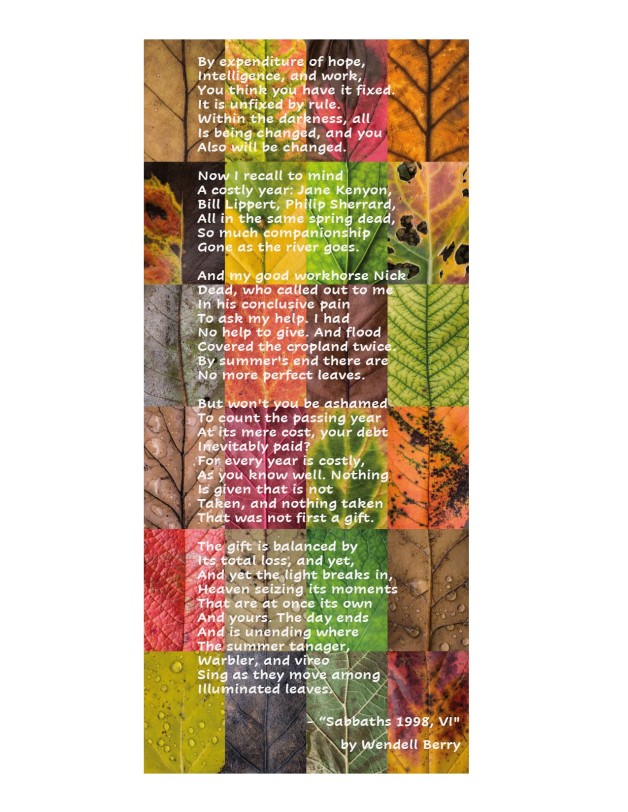
photos by Sepia, montage by Jenn Cavanaugh
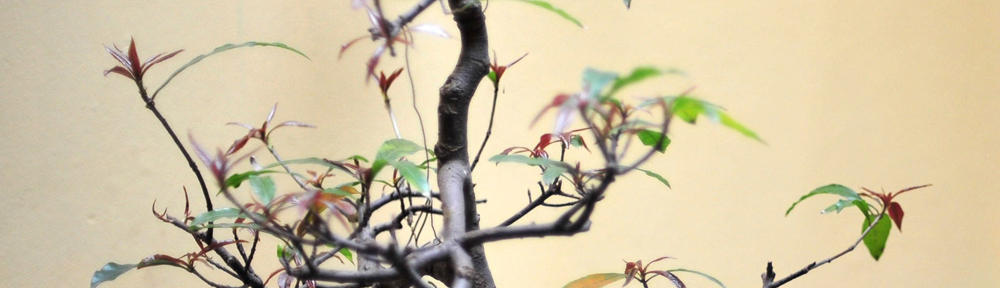
photos by Sepia, montage by Jenn Cavanaugh
My Cocoon tightens — Colors tease —
I’m feeling for the Air —
A dim capacity for Wings
Demeans the Dress I wear —
A power of Butterfly must be —
The Aptitude to fly
Meadows of Majesty implies
And easy Sweeps of Sky —
So I must baffle at the Hint
And cipher at the Sign
And make much blunder, if at last
I take the clue divine —
–Emily Dickinson
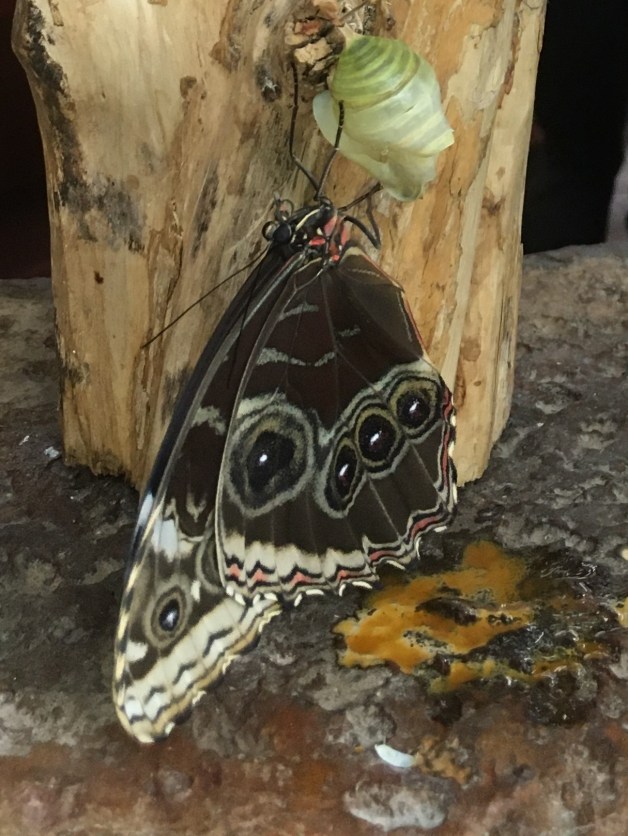
photo by Jenn Cavanaugh
We romanticize the caterpillar’s transformation, and it’s easy to do because it’s hidden. And because we relish the concept of shedding a homely, crawling, bristly self for a soaring and beautiful one, but no one wants to undergo what the caterpillar does. It’s a real death and resurrection. Essentially, it digests itself. Breaks down into goo and reforms on a cellular level before a sticky and difficult rebirth.
I’m sure I’ve learned this fact half a dozen different times, because my imagination regularly rejects it and returns to my childhood image of the insect contortionist twisting and bending, unfolding to reveal what it always was inside.
It turns out that there’s some truth to that image as well, in that there are structures within the caterpillar that it has always carried within itself that emerge intact to become the exterior qualities of the butterfly. It doesn’t break down completely, just the parts that were inherent to the larval stage break down and reform around the structures of the mature and fully realized version of itself, which entomologists call the imago. The structures are called imaginal discs. They carry a “pre-pattern” of the butterfly’s final incarnation. Entomologists, whom I’ve never properly credited as the poetic souls they obviously are, can chart a “fate map” for an imago by studying these discs.
I wonder, can we do the same for ourselves? I suspect that outside perspective helps here, but what parts of your self that have always been hidden inside you do you suspect are ready to emerge like wings? What divine clues have you been given to your ultimate design?
If transformation were really all about contortion and twisting into an unfamiliar shape, it seems like the caterpillar would seek out a wide, open space in which to do it. Instead, it creates a small, confined and private space in which to let the hard carapace that protected it dissolve, to let its wings and antennae move to the surface. In our Lenten confinement, so may it be.
This week’s lectionary readings play with the conceit of the rock that Moses struck to provide the newly liberated Israelites with fresh “living” water. “Strike the rock,” God says, “and water will come out of it, so that the people may drink.” Moses did so, in the sight of the elders of Israel. He called the place Massah and Meribah, because the Israelites quarreled and tested the LORD, saying, “Is the LORD among us or not?” (Exodus 17:6b-7)
“Is the LORD among us or not?” seems like a perfectly reasonable and non-rhetorical question. Some questions are mysteries to sit with and ponder, invitations to meditation, but this is the kind of question that demands an answer. It’s one that God answers when asked, even when the answer isn’t what the people expected. It’s one that Jesus answers even when he’s not asked. God wants us to know joy in “the rock of our salvation” (Psalm 95:1), and hope “because God’s love has been poured into our hearts” (Romans 5:5), and then to pass on this knowledge. Jesus tells the woman at the well that if she “knew the gift of God” she would have approached him asking for a drink, instead of the other way around (John 4:10). He tells her that this living water will become in those that drink it “a spring of water gushing up to eternal life” (John 4:14). Then he tells her everything she’s ever done and who he is, and she tells everyone else.
She and they and we become springs fed by the source: the rock that was struck.
In uncertain times, Gwendolyn Brooks names our desire to just be told what to do to so that everything will be okay. At first the answers given seem equally simplistic. Wear your boots [read: wash your hands!] and you won’t get sick! But then at some point — I’m not sure which point; I imagine it’s subjective by design — the simplistic answers seem to acquire a simple wisdom and move from the immediate to the important, from the actionable to the true and actual.
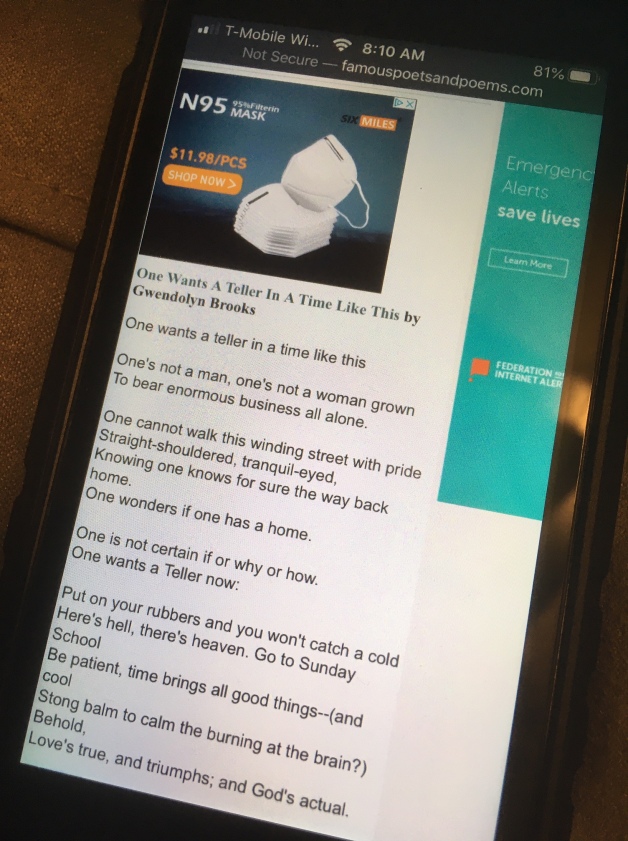
“One Wants a Teller in a Time Like This” by Gwendolyn Brooks – photo by Jenn Cavanaugh
[I couldn’t help but notice that not even the famous poets and poems are secure]
Sit with your uncertainties for a bit. Name them. Acknowledge them. Accept that most of them will still be with you tomorrow and that, in most cases, feeling certain or uncertain about a thing will not significantly affect what tomorrow actually has in store. Pick one concern that could benefit from attention and attend to it: research, seek advice, talk it through with a friend, journal your thoughts, listen, pray…
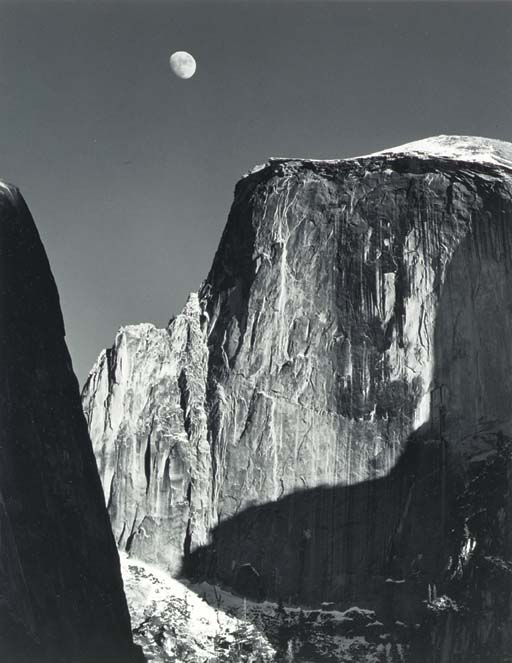
“Moon over Half Dome” – Ansel Adams
Lent: X
O, teach me to untangle hope
from hope that’s false,
and lead me farther down the winding path
and whatever elseyou think I need, because the angle
of the woven slope
of love and grief is steep. Unless the bind
is by design.— Maurice Manning
 Homespun