Advent Again – Day 3

What are you waiting for?

from “I Am Waiting” by Lawrence Ferlinghetti

I am waiting for the Great Divide to be crossed

and I am anxiously waiting

for the secret of eternal life to be discovered

by an obscure general practitioner

and I am waiting

for the storms of life

to be over

and I am waiting

to set sail for happiness

and I am waiting

for a reconstructed Mayflower

to reach America

with its picture story and tv rights

sold in advance to the natives

and I am waiting

for the lost music to sound again

in the Lost Continent

in a new rebirth of wonder


I am waiting for the day

that maketh all things clear

and I am awaiting retribution

for what America did

to Tom Sawyer

and I am waiting

for Alice in Wonderland

to retransmit to me

her total dream of innocence

and I am waiting

for Childe Roland to come

to the final darkest tower

and I am waiting

for Aphrodite

to grow live arms

at a final disarmament conference

in a new rebirth of wonder


I am waiting

to get some intimations

of immortality

by recollecting my early childhood

and I am waiting

for the green mornings to come again

youth’s dumb green fields come back again

and I am waiting

for some strains of unpremeditated art

to shake my typewriter
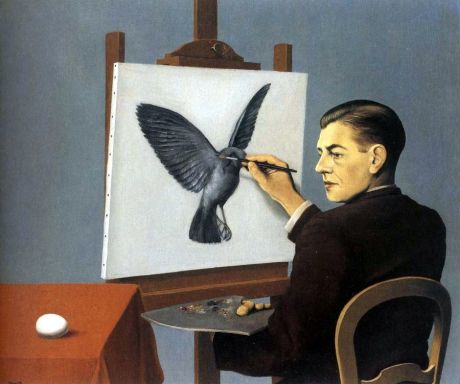
magritte-la-clairvoyance

“La Clairvoyance” by René Magritte


and I am waiting to write

the great indelible poem

and I am waiting

for the last long careless rapture

and I am perpetually waiting

for the fleeing lovers on the Grecian Urn

to catch each other up at last

and embrace

and I am awaiting

perpetually and forever

a renaissance of wonder

Pantoums

Despising the Pain: A Pantoum by Jenn Cavanaugh


I face death every day

For the joy that is set before me.

Dust returns. Death loses the fray –

The happy end begins the story.


For the joy that is set before me

I ride the eternal like a tide.

The happy end begins the story –

We’ll wear our spirits on the outside.


I ride the eternal like a tide,

Dizzied and spun, despising the pain.

We’ll wear our spirits on the outside

For the work that is not in vain.


Dizzied and spun, despising the pain,

Dust returns. Death loses the fray.

For the work that is not in vain

I face death every day.

Poor blog, doomed respository for my second-tier poems. I post this one as an example to accompany yesterday’s Writers Workshop post on the pantoum form, so you can see what you can get out of working in the form in short order. It’s only the third or fourth one I’ve ever written, and the results still feel blocky, compared to writing in unrhymed free verse. If you get something out of the theme or a phrase, I’m glad. Otherwise, this is what a writing exercise looks like!

So far, the best part of writing pantoums is that they practically write themselves – you put a couple of lines together, give them a flick, and you have a perpetual motion poetry machine. For me, they are line-generators. You put a line in, you get a line out, because the form is going to take you there. To write one that stands up as fine poetry, like the one I’ll leave you with here, I will probably have to give up the rhyme, as she did, make my lines more grammatically creative, and incorporate more narrative detail. A pantoum doesn’t have to tell a story, but the ones that appeal to me most suggest one. Do you have a favorite or one of your own to share?

Stillbirth by Laure-Anne Bosselaar


On a platform, I heard someone call out your name:

No, Laetitia, no.

It wasn’t my train—the doors were closing,

but I rushed in, searching for your face.


But no Laetitia. No.

No one in that car could have been you,

but I rushed in, searching for your face:

no longer an infant. A woman now, blond, thirty-two.


No one in that car could have been you.

Laetitia-Marie was the name I had chosen.

No longer an infant. A woman now, blond, thirty-two:

I sometimes go months without remembering you.


Laetitia-Marie was the name I had chosen:

I was told not to look. Not to get attached—

I sometimes go months without remembering you.

Some griefs bless us that way, not asking much space.


I was told not to look. Not to get attached.

It wasn’t my train—the doors were closing.

Some griefs bless us that way, not asking much space.

On a platform, I heard someone calling your name.

Writers Workshop: Haibun

Once or twice a year I’ll put together a guided writing workshop for our adult education time at church. I’ve found that introducing different forms and themes each week limbers us up to experiment with something new and gives us a nudge to get started rather than staring at blank sheets of paper. No one feels the need to write something expert in a form they’ve never encountered before or on a subject they just started thinking about five minutes ago. The writing is fresher, and people are consistently surprised by what they come up with. I think I have enough material to share at this point that I’ll make my intros to these forms and themes into their own “Writers Workshop” category.

The haibun form combines haiku and prose poetry. Originally it was a form of travelogue or journal writing. Writers pause in their poetic narrative or description of an event, person, place, or thing to compose a haiku that captures the emotions of their experience or encounter. The effect is that of a transfer of memory, whether real or imagined. The descriptive narrative evokes the senses with concise, poetic langauge, usually in the present tense, drawing the reader into a dreamy immediacy. The haiku functions to further the narrative or comment on it through summary or juxtaposition. Good haibun, like haiku, favors impressionism over abstraction. Don’t muse about how children grow up and leave us. Tell me about how your hand, now stuffed in a pocket, used to be both colder and warmer holding hers in this park. Then show me the indentation in the grass of the empty nest.

There are many examples to be found at Contemporary Haibun Online, and I’ll post one I wrote tomorrow.