The Bible and James Baldwin on Lament

James Baldwin was no stranger to feelings of alienation, disillusionment, betrayal, and fear for the fates of the marginalized. When we reckon with events that threaten our hope for the future and trust in one another, Baldwin and the Bible have words for us.

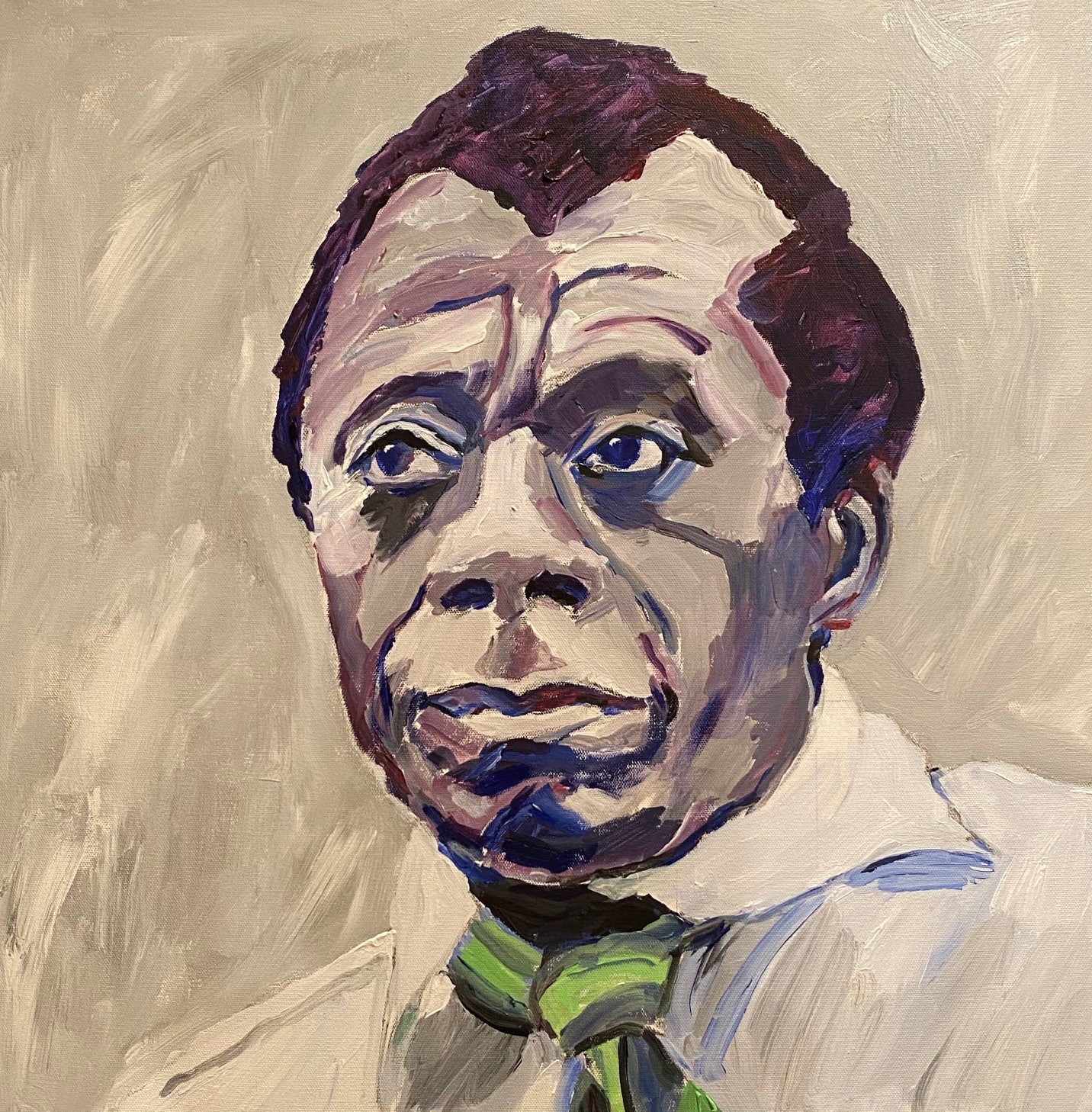
“James Baldwin” painting by Jeff Benesi

Sad Songs: Singing the Blues and Biblical Lament


Now, you women, hear the word of the LORD;
open your ears to the words of his mouth.
Teach your daughters how to wail;
teach one another a lament.
Death has climbed in through our windows
and has entered our fortresses;
it has removed the children from the streets
and the young men from the public squares.
– Jeremiah 9:20-21

“They gave our sorrow and our danger back to us, transformed, and they helped us to embrace and triumph over it. They gave us back our joy, and we could give it to our children. Out of the depths of the midnight hour, we could laugh.”
– James Baldwin: “Last of the Great Masters”

Where do we go when we’re discouraged? How do we go on when we are too world-weary to put one foot, one word, one thought in front of another? Baldwin likened himself to a blues singer, albeit one who didn’t know anything about music and couldn’t sing. This African-American musical tradition and the Old Testament Writings offer a soulful and honest way through our personal anguish to recognizing and reclaiming our collective humanity.

Write your own Psalm of Lament or Blues Song

It takes powerful language to articulate a powerful experience, to put words to what we feel might be too deep for words.

  • First, tell what happened. In one line. Strip away the context and consequences and even emotion (for now) and describe the worst moment of the whole experience in one telling detail. Pack the rest of the story into three more similar, one-phrase lines. (If you find they rhyme, you’re writing the blues, if not, we’ll just call it a lament.)
  • Take some time to pray. Identify the burning question kindled by this experience. Sometimes it’s simply “Why?” or “How could you?” but it might be something else. Ask the question, and listen for the answer. This doesn’t guarantee there will be one, but listen for it.
  • Now write more freely. What do you want to say now that is completely unacceptable to say? Write it down. Change up the way you describe your feelings. If you could concentrate this emotion on your tongue, what would it taste like? Don’t be afraid to use heightened or strong images. Some of the images in the Psalms are almost too strong to stomach, even theologically problematic (e.g. God bless anyone who bashes in the skulls of the children of the people who did this). Don’t worry about being correct or even fair to all parties. If God could watch this happen, God can handle what you have to say about how it makes you feel. Skip anything that softens it. No euphemisms or “maybes” or “I feel likes,” just what is. Pour it out there. How has the world changed since? End with one concrete example of something you do differently now.
  • Pause to reflect. What do you want or need in light of this? What do you want to be able to do again? Wait for a concrete image of what wholeness would look like now. Ask for it.
  • Describe in writing what it is you are waiting for.

This is the 2nd in a series of 8 devotions that was featured, in slightly altered form, on our bible app in March 2022 as ‘The Gospel according to James Baldwin*

Click here to read the first in the series

Lenten Calendar: Creation as Service

Not even five weeks ago, back when none of us thought we’d be giving up going to work or church or the gym for Lent, I was thinking about the fast described in Isaiah 58, and how this season was a call to action.

In the meantime, so many of our regular ways of serving have gone on hiatus. We’re cut off from the people we care for and our own daily needs are shifting, well, daily. Rather than developing deeper, sustainable rhythms of drawing out our souls on behalf of others, we’ve found ourselves in crisis mode.

How then, shall we serve? How do we redeem the time? How do we satisfy the afflicted souls and our own (Isaiah 58:10-11)?

Obviously, we need to be open to new and creative ways of doing so. As we seek entertainment and solace, we’re recognizing a collective need and appreciation for poetry and stories, art and music. So let’s recognize the creation thereof as a form of simultaneous service and soul-care.

For your sake poets sequester themselves,
gather images to churn the mind,
journey forth, ripening with metaphor,
and all their lives they are so alone…
And painters paint their pictures only
that the world, so transient as you made it,
can be given back to you,
to last forever.

All becomes eternal. See: In the Mona Lisa
some woman has long since ripened like wine,
and the enduring feminine is held there
through all the ages.

Those who create are like you.
They long for the eternal.
They say, Stone, be forever!
And that means: be yours.

Awakening desire, they make a place
where pain can enter;
that’s how growing happens.
They bring suffering along with their laughter,
and longings that had slept and now awaken
to weep in a stranger’s arms….

— Rainer Maria Rilke, trans. Anita Barrows and Joanna Macy

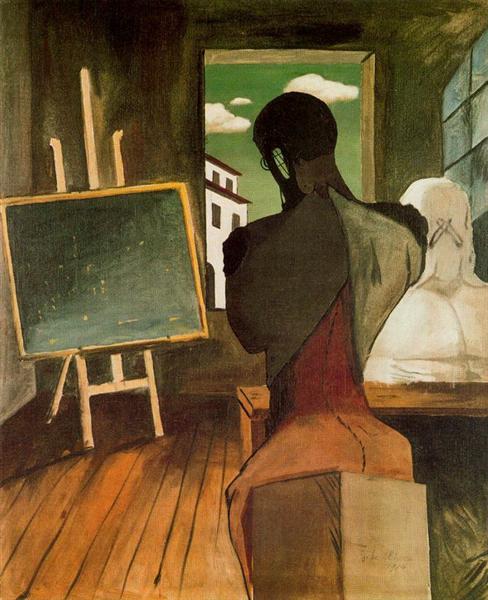
philosopher-and-poet.jpg!Large giorgio de chirico

Philosopher and Poet by Giorgio de Chirico

Personally, I find it more daunting than to motivating to hear how Shakespeare wrote King Lear while quarantined. It’s about as helpful as comparing your ministry to Jesus’ at age 33. For every one of us with extra time on our hands, there must be a dozen feeling more burdened and busy. My mental space for creative work has telescoped in on itself, rather than expanded. But. I do find that making creative time enhances my mental space — if I’m realistic about where I’m at and let myself be in it for the process more than the product. Don’t expect to produce your best work right now, but let yourself be play at being an artist. Set aside a time to sequester yourself like a poet instead of just staying home.

Make it a small regular gesture, or make it unsustainably all-consuming for a day, but find a way to assert your humanity in an environment that’s conditioning us to think of ourselves and others as medical statistics or economic units.

Sketch that view out your window and exchange it with a friend. Chronicle your thoughts in a lasting way, or in such a way that you can walk away from them for a while. Sing while cooking for one again or the twenty-first meal this week. Curate a playlist. Create something the best you can and then release it. Even if it’s only sufficient to charm or cheer yourself and your mother for a quarter of an hour or a dozen strangers for a minute or six of your most like-minded friends for five minutes, that’s half an hour of charm or cheer that would not have otherwise existed, and the making itself will help your cooped-up soul stretch.

Lenten Calendar: Telling

This week’s lectionary readings play with the conceit of the rock that Moses struck to provide the newly liberated Israelites with fresh “living” water. “Strike the rock,” God says, “and water will come out of it, so that the people may drink.” Moses did so, in the sight of the elders of Israel. He called the place Massah and Meribah, because the Israelites quarreled and tested the LORD, saying, “Is the LORD among us or not?” (Exodus 17:6b-7)

“Is the LORD among us or not?” seems like a perfectly reasonable and non-rhetorical question. Some questions are mysteries to sit with and ponder, invitations to meditation, but this is the kind of question that demands an answer. It’s one that God answers when asked, even when the answer isn’t what the people expected. It’s one that Jesus answers even when he’s not asked. God wants us to know joy in “the rock of our salvation” (Psalm 95:1), and hope “because God’s love has been poured into our hearts” (Romans 5:5), and then to pass on this knowledge. Jesus tells the woman at the well that if she “knew the gift of God” she would have approached him asking for a drink, instead of the other way around (John 4:10). He tells her that this living water will become in those that drink it “a spring of water gushing up to eternal life” (John 4:14). Then he tells her everything she’s ever done and who he is, and she tells everyone else.

She and they and we become springs fed by the source: the rock that was struck.

In uncertain times, Gwendolyn Brooks names our desire to just be told what to do to so that everything will be okay. At first the answers given seem equally simplistic. Wear your boots [read: wash your hands!] and you won’t get sick! But then at some point — I’m not sure which point; I imagine it’s subjective by design — the simplistic answers seem to acquire a simple wisdom and move from the immediate to the important, from the actionable to the true and actual.

brooks teller

“One Wants a Teller in a Time Like This” by Gwendolyn Brooks   –  photo by Jenn Cavanaugh

[I couldn’t help but notice that not even the famous poets and poems are secure]


Lenten Calendar: Unfinished

“So, you’re a background singer in your own life?

Why’re you in the background?

You gotta let the lies go

and let your hope grow.”

Kim B. Miller, “Lies”

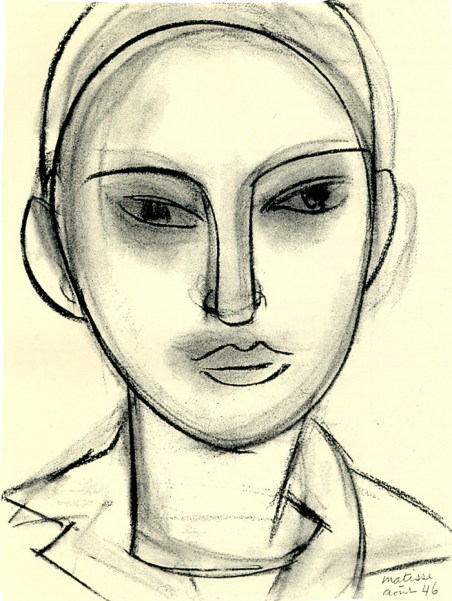
Face (Claude) Henri Matisse

Face (Claude) – Henri Matisse

I find a lot of hope in being unfinished — a work in progress. When things aren’t working out as planned, well, the story isn’t over yet. It helps me extend grace to others, but especially myself — there’s less pressure to be perfect or have it all figured out.

Sometimes I have to ask myself, though, why is that part of my life or myself so underdeveloped? Why is it just roughed in? A sketch I’m in no hurry to finish? What fears and lies are keeping me from committing the time and focus it would take to fill in the features? It’s safer to be all potential, even if that means squandering it, but God has hopes, dreams, plans, and work for our completed selves. What is one step toward that future self you’ve been avoiding for fear of mistakes? What if we accepted the possibility of imperfection along the way to being made perfect?

Lenten Calendar: Loss

Make no mistake: loss is not a gift. What was lost was a gift, sometimes one that wasn’t appreciated fully until it was lost, which only adds to the anguish.

Every loss is unique to the mourner, and yet the experience of loss is an inevitable part of life in this world.

Lent is a season to acknowledge it as real, to allow grief and regret to wrack us and ultimately, hopefully, to grow in appreciation for all we have been given, whether we still possess it or not. Loss leads easily to fear and defensiveness, but the recognition of the universality of loss can soften our hearts and make healers of the healed.

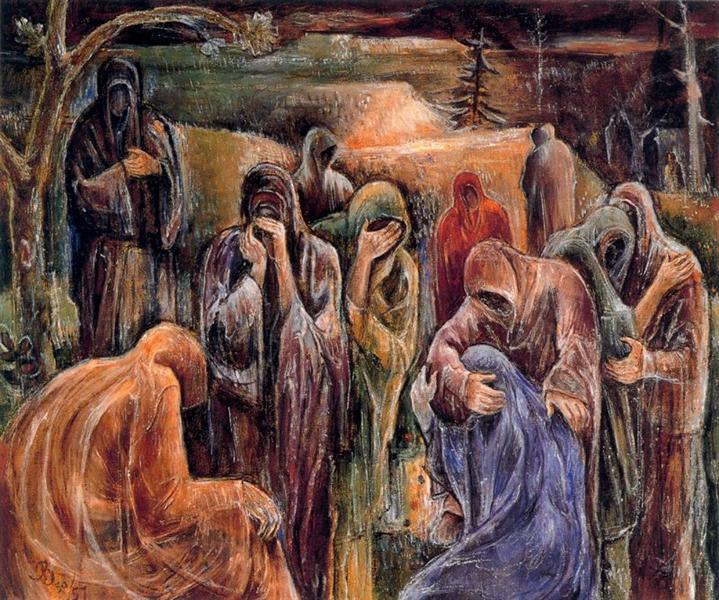
The Grieving Women Albert Bloch

Kindness

Before you know what kindness really is
you must lose things,
feel the future dissolve in a moment
like salt in a weakened broth.
What you held in your hand,
what you counted and carefully saved,
all this must go so you know
how desolate the landscape can be
between the regions of kindness.
How you ride and ride
thinking the bus will never stop,
the passengers eating maize and chicken
will stare out the window forever.

Before you learn the tender gravity of kindness
you must travel where the Indian in a white poncho
lies dead by the side of the road.
You must see how this could be you,
how he too was someone
who journeyed through the night with plans
and the simple breath that kept
him alive.

Before you know kindness as
the deepest thing inside,
you must know sorrow as
the other deepest thing.
You must wake up with sorrow.
You must speak to it till your voice
catches the thread of all sorrows
and you see the size of the cloth.
Then it is only kindness that
makes sense anymore,
only kindness that ties your shoes
and sends you out into the day
to gaze at bread,
only kindness that raises its head
from the crowd of the world to say
It is I you have been looking for,
and then goes with you
everywhere
like a shadow or a friend.

 — Naomi Shihab Nye

Lenten Calendar: Meek

Consider the mushroom, it neither boasts nor vaunts itself above its fellows, and yet it grows in every environment. It knows the power of numbers working humbly and steadily in concert. Individually, they are fragile; together, they are inexorable.

shallow focus photography of mushrooms

Photo by Chris Gonzalez on Pexels.com

Mushrooms

Overnight, very
Whitely, discreetly,
Very quietly

Our toes, our noses
Take hold on the loam,
Acquire the air.

Nobody sees us,
Stops us, betrays us;
The small grains make room.

Soft fists insist on
Heaving the needles,
The leafy bedding,

Even the paving.
Our hammers, our rams,
Earless and eyeless,

Perfectly voiceless,
Widen the crannies,
Shoulder through holes. We

Diet on water,
On crumbs of shadow,
Bland-mannered, asking

Little or nothing.
So many of us!
So many of us!

We are shelves, we are
Tables, we are meek,
We are edible,

Nudgers and shovers
In spite of ourselves.
Our kind multiplies:

We shall by morning
Inherit the earth.
Our foot’s in the door.

— Sylvia Plath


Into the Labyrinth: The Road to Emmaus

Traditionally, the labyrinth is an uncluttered opportunity for centering prayer. It usually consists of a single path that leads into the center and back out. There are twists and turns, switchbacks, and apparent setbacks that actually take you further along the path to your goal, but feel like moving in the wrong direction. Unlike in a maze – the labyrinth’s choose-your-own-adventure cousin – if you simply walk the path in front of you, you will get where you’re going. Labyrinths are often found outdoors or in relatively bare chapels with an altar and candles that welcome people to come and unburden themselves of whatever they’re carrying, yoke themselves to Christ, and practice walking in the spirit. It is a lovely form of sacred space: simple yet suggestive. The idea presented below is not intended as an improvement over a traditional labyrinth. We borrowed the labyrinth motif because it brought to life the sense of realization while in movement, the walking epiphanies of the story of the disciples meeting Jesus on the road to Emmaus. As such, it would be appropriate to set up during Epiphany or during Lent – when we wander the desert not to lose ourselves, but to find our center – as well as when we did it: during the season of Easter, before Ascension, when this story originally took place.
WP_20141208_17_01_36_Pro__highres (2)

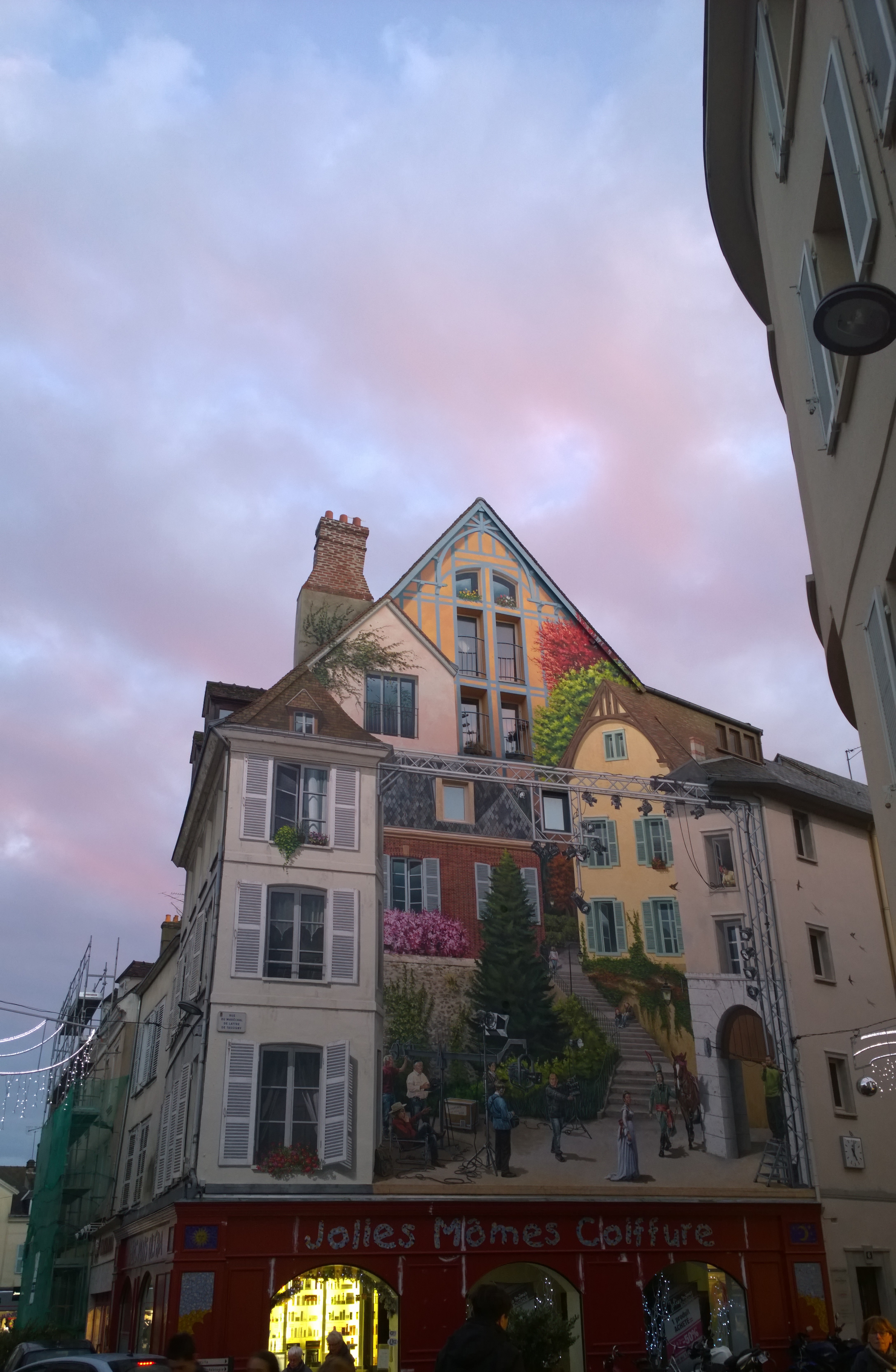
A labyrinth of the everyday – trompe l’oeil outside Chartres Cathedral

Road to Emmaus Labyrinth

Luke 24:13-35

Our[1] labyrinth consisted of a huge drop cloth on the floor marked in a variation on a classic labyrinth pattern.[2] With staggered starts, the labyrinth could accommodate four or five people at a time. We set up eight compact, numbered stations along the path – five going in, one at the center, and two going out.[3] Two readers (one reading the script, the other the scripture passages throughout) recorded an audio tour with music as follows. People were given headphones and a cheap, one-button mp3 player and invited to pause and play and go at their own pace. In this script the numbers correspond to the track number.

  1. “Welcome”

Welcome to the Emmaus Road Labyrinth. Here we enter the story of two disciples meeting the resurrected Jesus as they walked along the road to a town called Emmaus. In a sense, we’ll be walking along with them as we progress into and back out from the heart of the labyrinth. A labyrinth is not a maze. A maze is a puzzle to be solved. A labyrinth is a path to be followed. Walking a labyrinth is a completely different exercise than running a maze. Here there is no fear of being lost. The labyrinth externally enacts the internal experience of centering. Spiritually, it represents space set apart, or sacred space, in which we are drawn into the center, to the recognition of the presence of God, then return to the world blessed and changed by the experience, and better equipped to be an agent of blessing and change.


Each station in the labyrinth has one track on this audio guide. Go at your own pace. This is a time to walk in the Spirit, swap stories with Jesus and listen for the voice of God in your life. If the words or music become a distraction, feel free to pause, skip ahead or ignore the recording entirely. Enter the labyrinth and continue walking until you reach station one.


  1. “Station One (going in): They were kept from recognizing him” Luke 24:13-16

Jesus’ followers then and now have different perceptions of who he is and what he came to do. The disciples’ false perceptions of Jesus kept them from knowing and loving him for who he is. They thought he was a teacher, a revolutionary, a ruler; they thought he was dead.

It is difficult to recognize the presence of God when God doesn’t act according to our assumptions. St. John of the Cross called this the dark night of the soul. He saw it as a time in which, despite all appearances and perceptions, even though it feels like stumbling around in the dark, the soul grows in faith and intimacy with Christ Himself, rather than with illusions of Him.


Open the flaps to see images of the Jesus we think we know. Ask him to reveal himself so that we may love him as he truly is.[4]

Music: “The Dark Night of the Soul” by Loreena McKennitt


  1. “Station Two (going in): Downcast” Luke 24:17

The Seder is the traditional meal and central celebration of Passover. To read about the origins of Passover, please pause this recording and read Exodus 11 & 12 marked in the bibles here. The entire extended family is to come together. Throughout the meal, they retell the Exodus story in the first person as if they had been one of the slaves freed from Pharaoh’s bondage. The bitter herbs, horseradish here, are eaten to remind the participants of the bitterness of slavery.  Are you downcast? Where are you experiencing bitterness? Taste the herbs and let the words of Psalm 22 be your cry to heaven.


  1. “Station Three (going in): Storytelling, Part 1” Luke 24:18-24

The disciples on the road were consoling each other by telling stories and remembering Christ. On index cards, write about a time in your life when you met with God. Pin them to the storyboard. Read others’ stories and allow others to read your story.


  1. “Station Four (going in): Storytelling, Part 2” Luke 24:25-27

Now Jesus tells his story, explaining his work throughout the ages, establishing and re-establishing relationships with his people. Flip through a bible and take some time to hear God’s story of constant provision and love. The lectionary bookmarks and bibles are free for you to take with you.

Music: “Jesus’ Blood Never Failed Me Yet” by Jars of Clay (light) or Gavin Bryars (strong)


  1. “Station Five (going in): Welcoming the Stranger” Luke 24:28-29

The disciples welcomed Jesus though they did not yet recognize him. Who is the stranger walking along the road with you now? Have you ever encountered Christ in or through a stranger? Have you ever been that stranger? Consider these questions as you watch the video.[5] Pause this program and use the headphones attached to the monitor.


  1. “Station Six (center): Breaking Bread” Luke 24:30-31

Here in the center of the labyrinth, Jesus meets us and offers sustenance for the journey outward. Break bread with Christ. Join in this prayer from “Six Recognitions of the Lord” by Mary Oliver as you take and eat.


Oh, feed me this day, Holy Spirit, with

the fragrance of the fields and the

freshness of the oceans which you have

made, and help me to hear and to hold

in all dearness those exacting and wonderful

words of our Lord Christ Jesus, saying:

Follow me.


[minute pause]

When you are ready to begin your journey back out into the world, take a card and exit out the corner opposite from the one you entered. Practice walking prayerfully.


  1. “Station Seven (going out): Burning Hearts” Luke 24:32

What is Christ saying to you on the road? What does scripture say about Jesus? What does it say about you? Have you looked recently to see? Light a candle and pray for the scriptures to be opened to you, for the words to burn within your heart.

[pause]

What words from the scripture cards or from your bible reading do you want burned deeper into your heart? Write them onto a paper heart, tack it to a candle and take it with you. Light it at home, while it burns pray that the scriptures will be opened to you and your heart opened to them.

Music: “Listen” by Michelle Tumes


  1. “Station Eight (going out): Returning to Jerusalem” Luke 24:33-35

Where is your “Jerusalem?” Where will you now return and share what you have experienced? Who can you talk to about what you are learning about Jesus?

Christ is risen! Take a cross to give to a friend as a reminder of Christ the Lord, alive and walking with us.


[1] You know you have a successful collaboration going when no one can remember whose ideas were whose and they’ve become too interwoven to attribute them separately anyway. I got to write the script, but the experience as a whole was thought through and produced by everyone in our alt worship planning group: Cristie Kearny, Deb Hedeen, Judy Naegeli, Trisha Gilmore, Cathy Stevens, Heidi Estey, Kirk Heynen, James Kearny and Anika Smith.

[2] Ours happened to have one path leading in to the center and a different path leading back out, but generally I would recommend the Half-Chartres (basically the inside half of the design at Chartres Cathedral). You can find instructions for making a 12’ x 12’ version at “Karen’s Small Labyrinths” http://www.angelfire.com/my/zelime/labyrinthssmall.html#halfchartres. The size shown there would be sufficient for people to use one or two at a time with a single station in the middle, but wouldn’t accommodate what I’m describing here. Ours was about 4 times that size, maybe 25’ x 25’.

[3] The stations should be clearly numbered with the station number and the track number and labeled “going in” or “going out” so as not to confuse anyone. Remember they are all actually set up on and around a flat, open surface, so they will not be laid down linearly. If you use a single path labyrinth, people will be walking by stations 7 and 8 on the way in, but should only stop at them on the way out. We set up stations on small, low tables and music stands so they wouldn’t pose as obstacles by taking up too much space. Café tables would work nicely for the stations you can place around the outside of the circuit. Ideally, if someone’s standing at a station, another person should be able to pass them without stepping completely off the path.

[4] Our artists made this interactive piece. You can create your own by making a collage poster of images of Jesus or roles people think of Jesus playing: the miracle worker, the rustic shepherd, the white-suited televangelist, the revolutionary in a beret, the pacifist at a sit-in, etc. Then overlay the poster with another piece of poster board and cut flaps in it that open onto the various images.

[5] We commissioned a videographer and a high school student in our congregation to collaborate on a video of different kinds of people. You could make your own using stills of people in your church and neighborhood or footage from mission trips. Or you could download something along the lines of The Work of the People’s “Stranger” (http://www.theworkofthepeople.com/index.php?ct=store.details&pid=V00520) or LifesongMD’s “World Faces” (http://youtu.be/z6RLHKRs9D8).

Advent Again – day 22

“Do not be afraid to…”


“Hymn” by A.R. Ammons

I know if I find you I will have to leave the earth

and go on out

     over the sea marshes and the brant in bays

and over the hills of tall hickory

and over the crater lakes and canyons

and on up through the spheres of diminishing air

past the blackset noctilucent clouds

           where one wants to stop and look

way past all the light diffusions and bombardments

up farther than the loss of sight

    into the unseasonal undifferentiated empty stark


And I know if I find you I will have to stay with the earth

inspecting with thin tools and ground eyes

trusting the microvilli sporangia and simplest

     coelenterates

and praying for a nerve cell

with all the soul of my chemical reactions

and going right on down where the eye sees only traces


You are everywhere partial and entire

You are on the inside of everything and on the outside

forest-1890-cezanne

Forest (1890) by Paul Cezanne


I walk down the path down the hill where the sweetgum

has begun to ooze spring sap at the cut

and I see how the bark cracks and winds like no other bark

chasmal to my ant-soul running up and down

and if I find you I must go out deep into your

    far resolutions

and if I find you I must stay here with the separate leaves

Advent Again – day 20

Who am I.. that you have brought me thus far?

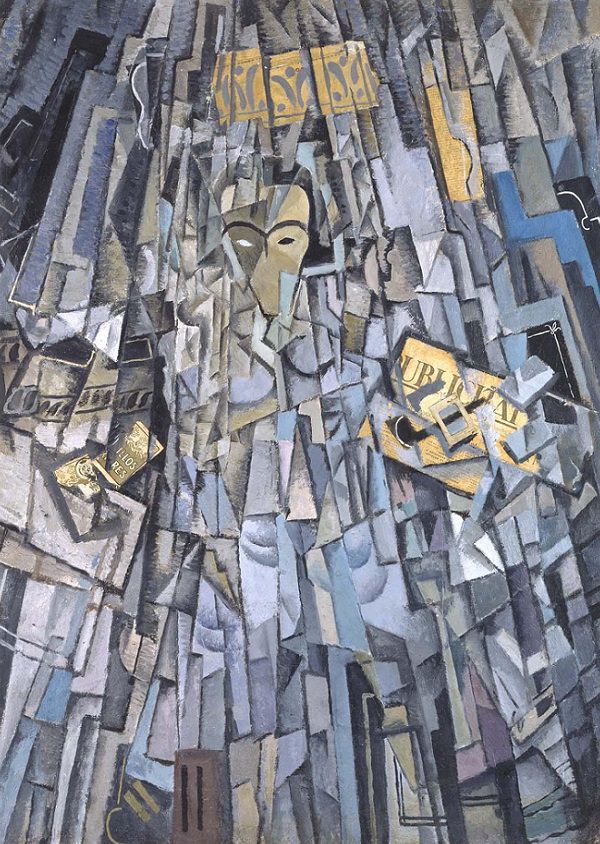
cubist-self-portrait-dali

Cubist Self-Portrait (1923) by Salvador Dali

from “Who Understands Me But Me?” by Jimmy Santiago Baca

I cannot fly or make something appear in my hand,
I cannot make the heavens open or the earth tremble,
I can live with myself, and I am amazed at myself, my love,
my beauty,
I am taken by my failures, astounded by my fears,
I am stubborn and childish,
in the midst of this wreckage of life they incurred,
I practice being myself,
and I have found parts of myself never dreamed of by me,
they were goaded out from under rocks in my heart
when the walls were built higher,
when the water was turned off and the windows painted black.
I followed these signs
like an old tracker and followed the tracks deep into myself,
followed the blood-spotted path,
deeper into dangerous regions, and found so many parts of myself,
who taught me water is not everything,
and gave me new eyes to see through walls,
and when they spoke, sunlight came out of their mouths,
and I was laughing at me with them,
we laughed like children and made pacts to always be loyal,
who understands me when I say this is beautiful?

Miss Vera Speaks


They ask how she grin through that face with that life.

I say I’s never shielded from nothing

‘Cept dying young.


People deep bruised by something

Talk like the world should end.

Won’t catch me dying every day like that.


‘Cause I seen them once

Just once – the cracks in the universe –

Thought I’d fall right through.


‘Stead I laughed – said some kind of God

Put up with a tattered-old place as here

Gotta have some grace for me.


– Jenn Cavanaugh

originally published in America, August 13, 2007

WP_20151111_001